
Elderly Emergency Plan: What to Include and How to Share It
How to make an emergency plan for an elderly parent in the UK: what to write down, who to name as backup, and how to keep the whole family working from it.
By The KinCarer team ·
An emergency plan for an elderly parent is a short, written set of arrangements that tells anyone stepping in what your parent needs, who to call and what happens next if the usual carer cannot be there. It also covers the wider problems: a fall, a power cut, a storm or having to leave the house in a hurry. You can build a good first version in an evening. The harder part is keeping it current and making sure everyone can find it.
If you are the person holding everything in your head, this is for you. Writing it down is not a sign that you expect the worst. It means the next person who has to step in will not be starting from nothing.
TL;DR
- An emergency plan sets out who covers care at short notice, what your parent needs day to day, and who to contact. Official UK guidance describes it as a personal plan for the person, their carers and emergency services.
- Start with an ordinary day: routines, medicines, mobility, communication, food and overnight care. A stand-in carer needs that picture most.
- Ask every named contact whether they agree to be on the plan, and name a backup for each key task.
- Plan separately for a medical emergency, a power or phone outage and an evacuation.
- Keep one up-to-date copy that relatives and paid carers can all see, and review it whenever medicines, health, equipment or care arrangements change.
Table of Contents
- What an emergency plan for an older person actually is
- Start with an ordinary day
- What to put in the plan
- Name backup carers and agree who does what
- Plan for the specific emergencies
- Helping without taking over
- Keep it alive: when to review
- Our perspective: one plan, one place
- Keep the plan where everyone can see it
- FAQ
- Sources
What an emergency plan for an older person actually is
A contingency or emergency plan is a written arrangement for short-notice cover when the usual carer cannot provide care. An NHS-linked carers guide explains that replacement support can come from relatives, friends, neighbours, local authority services, or a mix of these.
There are really two jobs in one document:
- Cover for the carer. If you are ill, stuck at work, abroad or in hospital yourself, who steps in, and what do they need to know?
- Safety for your parent. If something happens at home or in the area, what should happen to keep them safe?
Most families only think about the first when a crisis arrives. Doing both together is more efficient, because the information is the same: contacts, medicines, routines and needs.
If your mum lives alone and you live an hour or more away, or you share caring with siblings, this matters even more. Without a plan, a call at 7am can turn into a morning of ringing round to ask who has the GP’s number and what tablets she takes.
Start with an ordinary day
Before you fill in any form, write down what a normal day looks like for your parent. A toolkit from Carers Together suggests this is the most practical handover, because routine, communication, food, medication and calming approaches help a replacement carer provide continuity.
Walk through the day from waking to bedtime and note:
- When she gets up, washes, dresses and eats, and what help she needs with each
- Which medicines she takes and when
- Visits from a home care agency, district nurse or other professionals, and when they come
- How she moves around the house and whether she uses a stick, frame, chair lift or hoist
- How she communicates best: hearing aids, glasses, a phrase that calms her, a time of day when she is clearer
- Dietary needs, favourite foods and anything she will not eat
- Whether she can be left alone and for how long
- Whether anyone needs to be with her overnight
The same toolkit covers health conditions, allergies, memory, behaviour, vulnerabilities and equipment. A carer’s plan from CFCS suggests summarising medical history, communication, memory, mobility, allergies, behaviour and whether the person can be left alone.
If you are unsure about conditions or medicines, ask. NHS England’s Healthy Caring guide recommends telling the GP that you are a carer, finding out about the person’s conditions, treatment and medication, asking for medication reviews, and speaking to the local carers service about an emergency plan. Your parent’s own consent matters here, so have the conversation with her rather than around her.
What to put in the plan
Official councils and health bodies give broadly the same list. Here is a practical version, drawing on guidance from Wokingham Borough Council, Oxford Health NHS Foundation Trust and the Carers Together toolkit.
About your parent
- Full name, date of birth, address and a recent photo
- Next of kin and anyone holding Power of Attorney
- Health conditions, allergies and any treatment that is ongoing
- Mobility, memory, communication and behaviour notes
- Continence products and mobility equipment, and where they are kept
- Pets, and who can feed or walk them
- How to get into the house: key safe, spare key holder, alarm codes
Medicines
Record each regular medicine and where it is stored. Prepare, the UK Government’s preparedness site, advises keeping enough for several days, making them easy to reach and preferably waterproof, and documenting medical-device instructions with charged backup batteries. The CFCS plan adds that medication information must be updated whenever medicines change, so an out-of-date list does not mislead someone.
Ask the GP or pharmacist about anything you are not sure of. This plan should record what your parent has been prescribed, not decide what she should take.
People and services
- Family members, friends and neighbours who have agreed to help
- GP surgery, pharmacy, hospital specialist and any social worker
- The home care agency or care provider, with the office number and out-of-hours number if there is one
- Replacement-care contacts, such as a local authority carers service
Prepare also points out that the support network should include carers, the GP, pharmacy and hospital specialist, so the details should sit together on one page.
Get permission first
The CFCS plan says emergency contacts should give permission and agree the support they can provide. It sounds obvious, but it saves a lot of awkwardness. A neighbour who has said “yes, I can pop in before work” is a real plan. A neighbour who has never been asked is a hope.
Name backup carers and agree who does what
If you are the only name on the plan, there is no plan. The Oxford Health survival guide recommends giving a backup carer the emergency plan and care documents, and placing a copy prominently at home.
Sit down with siblings and anyone else involved and settle a few things:
- First call: who gets the first phone call if something happens?
- Backup for the first call: who is next if that person does not answer?
- Hands-on cover: who can be at the house within a few hours, and who can only help remotely?
- Appointments and medicines: who knows the schedule, and who can take over?
- Paid carers: who tells the home care agency about a change, and who do they ring in return?
- Updates: who tells the rest of the family, so your parent does not get ten separate calls?
Long-distance relatives are not left out here. They can ring the GP, rearrange a visit, order a shop, update the plan and keep everyone informed. Our guide to coordinating care remotely shows how to give each person a clear role within 24 to 72 hours, and our walkthrough of setting up a shared care plan takes a family through it in a single meeting.
It is also worth knowing that contingency planning is not meant to rest on families alone. NHS England’s recommendations for integrated care systems say carers and the people they care for should not be left without support when usual arrangements fail. Ask your local council or carers centre what they offer. Our page on UK carer support and GOV.UK routes is a good starting point.
Plan for the specific emergencies
A general plan is a start. A few scenarios deserve their own line each.
A medical emergency
In the UK, 999 is for life-threatening emergencies, and NHS 111 is for urgent help that is not life-threatening. Both numbers are listed in Harrow Council’s household emergency plan. Put them at the top of the page anyway. Someone panicking, or a visiting neighbour, should not need to think.
Keep a one-page summary ready to hand to paramedics or an A&E team: conditions, medicines, allergies, who to contact and whether your parent has any care documents such as Power of Attorney. Our guide to one emergency folder for care documents explains what to gather and how NHS consent works for families.

A power cut or phone outage
This is where plans fall over, because we assume the technology will work. The UK Government’s easy-read guidance for disabled people and carers warns that telecare or personal alarm devices may not work without electricity or internet. Its advice is to nominate a trusted person to check on the older person if you cannot make contact.
So name that neighbour or nearby friend, agree how they will get in, and tell your parent they might call. Harrow’s plan also suggests printing or writing the plan and keeping it somewhere safe and easy to find during a power cut, and lists 105 as the power-cut number in England, Scotland and Wales.
If your parent depends on powered equipment, such as an oxygen concentrator or a powered mattress, speak to the care provider or clinical team about what to do if the power goes. Prepare says to plan for a power disruption with them, rather than guessing.
Severe weather
Harrow’s guidance says that for an external emergency, such as flooding or a nearby incident, households may need to go in, stay in and tune in to trusted local information. For an internal emergency, such as a fire, the advice is to get out, stay out and ring 999. Make sure your parent knows which is which, and that the plan says who will phone her.
Having to leave home
Worcestershire County Council’s household emergency plan suggests that evacuation planning should cover leaving immediately, essential medication, medical equipment, phone and charger, key documents, telling family, friends and carers, transport, pets, care providers and a prepared grab bag.
A simple grab bag for an elderly parent might hold:
- A printed copy of the plan
- A few days of medicines and any device instructions
- Phone charger and a spare battery pack
- Glasses, hearing aid batteries and continence products
- A change of clothes and any comfort item
- Copies of key documents
The same Worcestershire plan says households should know how to turn off mains water, gas and electricity when it is safe to do so, follow emergency service and local authority advice on returning, and only have gas restored by a Gas Safe registered engineer. Write the location of each stopcock and switch into the plan.
Helping without taking over
An emergency plan works best when your parent has helped write it. Ask what she is worried about, what she wants done, and who she would rather have in the house. Her wishes belong at the top, not at the bottom.
When something does happen, Ready Scotland’s guidance says that once you and your household are safe, you can check on older people at home. That might mean preparing their home, collecting food, water, toiletries or medication, making sure important numbers are written down, and phoning or visiting if it is safe. Do the practical things, and keep asking what she wants.
Remember: a plan is there to protect her independence, not to replace it. The more she knows what will happen, the less frightening an emergency feels.
Keep it alive: when to review
An emergency plan that was right in spring can be wrong by autumn. Ready Scotland recommends reviewing it whenever circumstances change, such as a move, new equipment or medicines, different care arrangements, or changes in health or mobility, then sharing up-to-date information with everyone who supports your parent.
A practical rhythm:
- After any change: a new prescription, a hospital stay, a fall, a new carer or a change of agency
- A regular check: pick a date you will remember, and look at the contacts, medicines and key locations
- Talk it through: make sure each person named still agrees to be on it
- Replace old copies: bin printed versions as soon as a new one exists, so nobody follows an out-of-date list
Our perspective: one plan, one place
We built KinCarer because we kept seeing the same thing in families. The plan exists, but it lives in someone’s notes app, a WhatsApp thread from four months ago and a drawer. When a crisis comes, one person is carrying the load and everyone else is asking them for information.
Our view is that an emergency plan should not be a separate document that gets written once and forgotten. It should be part of how your family organises care every day: tasks, appointments, medication reminders, notes and handover updates in the same shared place. Then the plan is current because it is used, not because someone remembered to update it.

It should also be open to the people who need it. Relatives and paid carers can be invited into the same care circle, so everyone sees what has happened and what still needs doing, and permissions control who sees what. We do not give medical, legal or clinical advice, and our optional assistant, Clara, does not either. It helps families search and summarise what is already in their care circle.
If you want a printed backup too, our emergency contact list templates are a good place to start, and our comparison of emergency contact apps maps the options to NHS and ICO guidance.
— KinCarer
Keep the plan where everyone can see it
If you are juggling work and care, a plan that only you can open is not much use. KinCarer gives your family one shared care circle for contacts, medication reminders, appointments, check-ins, notes and documents, so a backup carer can pick up where you left off. One subscription covers everyone you invite. Family+ costs £9.99 a month or £69.99 a year per family, as published on our Family+ page.
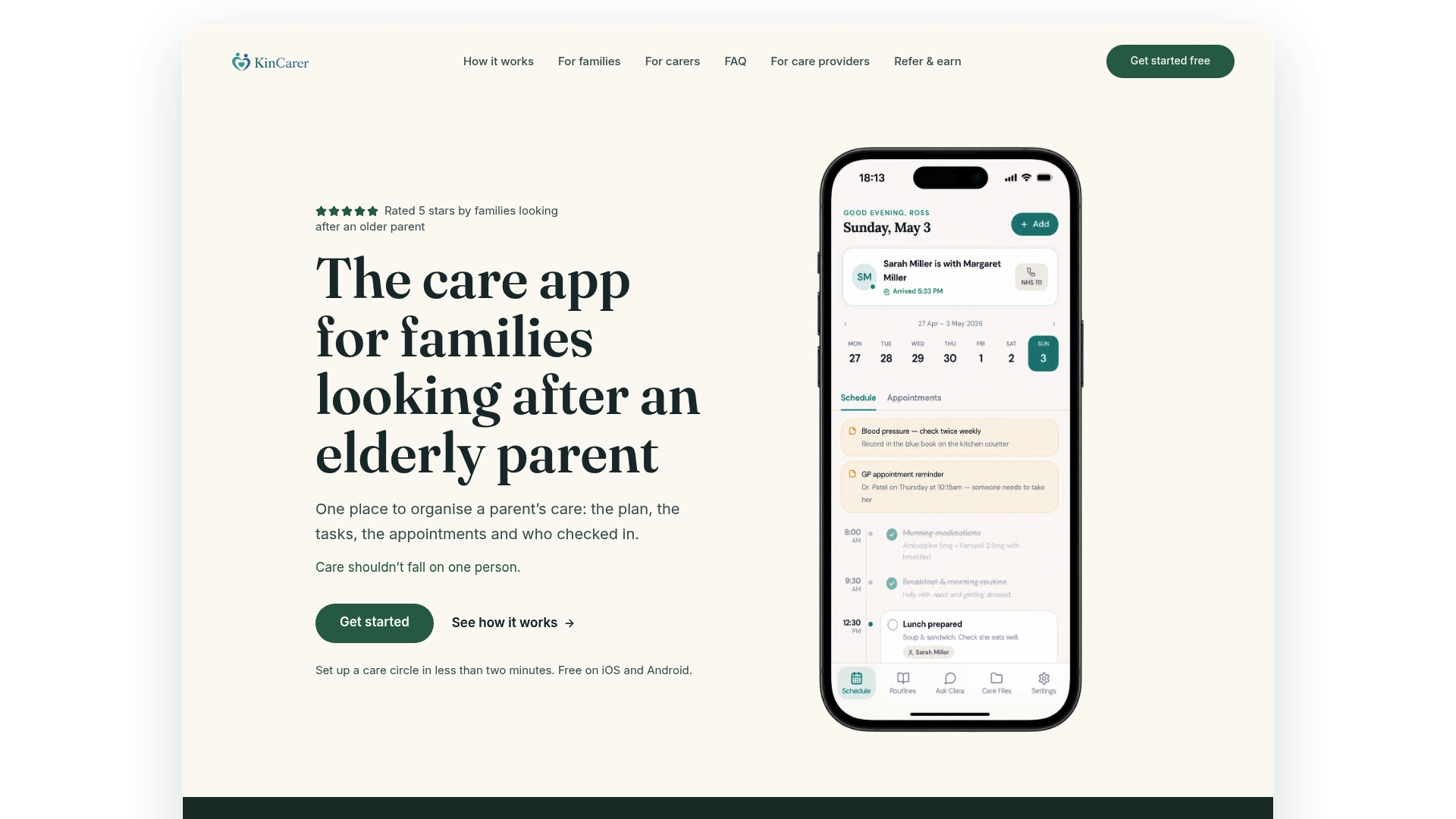
You can look at how it works on the KinCarer home page, and our guide on organising elderly care step by step will help you decide what to put in first. If you also have a job, our article on using your statutory rights and a one-page emergency plan covers the work side.
FAQ
How long does it take to make an emergency plan for an elderly parent?
A first version can take an evening: write down the ordinary day, list medicines and contacts, and ask people to agree to be named. It will not be perfect, and it does not need to be. Add details over the following weeks as you notice gaps.
Who should have a copy of the plan?
Give it to your backup carer and anyone named as a contact, and keep a copy prominently at home, as the Oxford Health guide suggests. Paid carers or a home care agency should have the relevant parts too. Make sure everyone has the latest version, not an old one.
Do I need a plan if my parent has carers coming in?
Yes. Paid carers may not know about family arrangements, and the family may not know what the agency can do at short notice. Write down what the agency does, who to ring out of hours, and what happens if a visit is missed.
What if my parent does not want a plan?
Start small and ask what worries her. Many people accept it once it is framed as keeping her independent and in control. If she has capacity, the decisions are hers, so record what she is happy to share. If you are worried about her ability to decide, speak to her GP.
Is this the same as a care plan?
Not quite. A care plan describes ongoing support and goals. An emergency plan is the shorter version that a stranger could follow in a crisis. The two should use the same information, which is why keeping them together saves effort.
Sources
- Do you help look after someone or give them support? (NHS carers guide)
- Advice for disabled persons and carers, Prepare
- Advice to help disabled people, carers and Deaf people (easy read)
- Emergency Planning Toolkit, Carers Together
- Healthy caring, NHS England
- Carer’s emergency plan, CFCS
- Emergency plan: what to include, Wokingham Borough Council
- Avoiding Crisis: A Survival Guide, Oxford Health NHS Foundation Trust
- Carer contingency planning recommendations, NHS England
- Household emergency plan, Harrow Council
- Household Emergency Plan, Worcestershire County Council
- Make an emergency plan for your home, Ready Scotland