
Set up a shared care plan in one meeting for UK carers
Set up a living shared care plan in one family meeting. Covers medication safety, smoother hospital handovers and arranging NHS proxy access.
By The KinCarer team ·
A shared care plan is a single, living record that keeps a family’s caring tasks, appointments, medications and preferences in one place, so nobody is left guessing. If you are caring for an elderly parent, the single most useful thing you can do today is create one master record and invite at least one other person, whether that is a sibling, a friend, or a paid carer, to see it too. Apps like KinCarer can host that record, though a notebook works just as well to start.
TL;DR:
- Creating a single, updated record that includes emergency contacts, medication details, and appointment information is critical for effective crisis management.
- Regularly scheduling family meetings, clarifying responsibilities, and recording agreements help prevent confusion and ensure everyone stays accountable.
- Pairing medication aids with logs and obtaining NHS proxy access allow multiple caregivers to manage medicines safely and access vital health information.
- Using shared digital tools like KinCarer consolidates tasks, handover notes, and reminders, reducing the risk of missed updates or miscommunications.
- Keeping the plan simple, focused, and regularly maintained makes ongoing caregiving more manageable and prevents document abandonment.
Table of Contents
- What to include in a shared care plan
- Setting up a shared care circle in one meeting
- Managing medication safely and getting NHS proxy access
- Handling handovers and hospital discharge well
- Sharing the load without burning out
- Paper, calendars or an app: what actually suits your family
- A note on keeping it simple
- How KinCarer keeps your family’s care plan current
- Where to go for further guidance
- Sources
- FAQ
What to include in a shared care plan
A shared care plan only earns its keep if it holds the details someone would actually need in a crisis, not just a general overview. Think of it as the document you would hand a paramedic, a locum GP, or a sibling stepping in for the weekend.
- Personal and emergency contact details, including your mum’s GP surgery and next of kin.
- One master medication list showing dosages, what each medicine is for, and how it should be taken.
- Appointments, transport arrangements and who is responsible for getting her there.
- Daily and weekly tasks with a named person attached to each, plus how often it needs doing.
- Preferences and routines, such as meal times or bedtime habits, alongside where legal and financial documents are kept.
- A note of where the physical master copy lives and what the digital version is called, so updates never get lost in duplicate files.
Keep the format simple. A cluttered plan gets abandoned within weeks, while a short, well-labelled one gets used.
Setting up a shared care circle in one meeting
Getting the whole family onto the same page rarely happens by accident. It usually takes one deliberate conversation, ideally in person, where everyone leaves knowing exactly what they are responsible for.
- Prepare: gather recent appointment letters, prescription lists and any existing notes before the meeting.
- Invite: decide who needs access, from siblings to a trusted neighbour, and ask your parent’s consent for what gets shared and with whom.
- Assign: agree simple, specific ownership of tasks rather than vague good intentions, and rotate duties where fairness matters.
- Schedule: set a short weekly check-in and put every appointment on a shared calendar everyone can see.
- Record: choose the master system, whether that is a paper folder or an app such as KinCarer, and agree who updates it and how often.
- Safeguard: agree in advance when to call in professional help, such as contacting the GP surgery directly if something feels beyond the family’s ability to manage.
Pro Tip: End the meeting by writing down who does what on one page and pinning it somewhere visible, so the agreement does not quietly dissolve after everyone goes home.
Managing medication safely and getting NHS proxy access
Medication mistakes are one of the easiest things to prevent with the right setup, and one of the most stressful to sort out after the fact. Pairing a physical aid with a written or digital log gives you a second layer of safety.
- Use a monitored dosage system or an automatic dispenser alongside a simple log of what has been taken and when.
- Keep a portable, printed medication list ready to hand over during any hospital admission.
- Speak to the GP or pharmacist about swallowing difficulties or formulation issues rather than adjusting doses yourself.
Pairing dispensers with a written log helps reduce missed or double dosing, according to NHS guidance for carers, which is worth following closely if several people are involved in giving medication.
Alongside this, it is worth arranging family and carer access through your parent’s GP surgery. Once approved, this lets you book appointments, order repeat prescriptions and view parts of the GP record on her behalf. The surgery will carry out identity and consent checks before granting it, so it is worth raising early rather than waiting until an urgent need arises.
Handling handovers and hospital discharge well
Care transitions are where information most often gets lost, particularly the small details that matter enormously at the time, like a changed dose or a new piece of equipment. A dedicated care diary or a shared digital note reduces the chance of anything slipping through.
At every handover, whether between siblings or after a hospital stay, record:
- Any medication changes, including new prescriptions or stopped ones.
- New equipment supplied and instructions for using it.
- Follow-up actions, appointments booked, and who is chasing them.
- Direct contact numbers for the ward, consultant or district nurse involved.
Attending discharge meetings in person, where possible, makes a real difference. According to Carers UK, using a designated notebook or master digital note at discharge helps capture instructions accurately rather than relying on memory afterwards. That same diary can later support a social care assessment, since it shows the scale and regularity of the caring you are doing.
A short handover entry might read: “Tuesday, 9am: GP increased blood pressure tablet to 10mg. New walking frame delivered, instructions in kitchen drawer. Follow-up appointment 14 March, transport needed.”
Sharing the load without burning out
Caring for a parent works best when it is genuinely shared, not just planned to look that way on paper. Agree honestly, early on, what each person can realistically manage, including time, distance and emotional capacity.
- Rotate tasks where you can, rather than letting one person default to everything.
- Register as a carer with your parent’s GP and ask your local council about a carer’s assessment.
- Keep a short, named emergency contact list everyone in the family can access.
- Ask for help with specific things, from a rota for shopping runs to short respite breaks or a local carers’ support group.
Pro Tip: A carer’s assessment is not an admission of failure. It is the route to practical support, and it also gives your caring role a formal record. Groups such as Carers UK offer practical guides on exactly this, alongside broader guidance on managing entitlements and carer claim best practices worth reading if money worries are adding to the pressure.
Paper, calendars or an app: what actually suits your family
There is no single right answer here, only what your family will actually keep using. A paper master folder works well for households that are not comfortable online, and it travels easily to hospital appointments. A shared digital calendar is a quick win for appointments and simple reminders, particularly across time zones or busy schedules.
- Paper folders: reliable, hospital-ready, but harder to update from a distance.
- Shared calendars: good for dates and reminders, weaker for detailed notes or medication history.
- Family care apps: built to hold tasks, appointments, medication logs and handover notes together, which reduces the chance of anything getting missed.
KinCarer, for example, lets a family set up a shared care circle where relatives and paid carers see the same tasks, appointments and medication reminders, with an optional assistant called Clara to help search and summarise notes. It is worth trying whichever format your family will genuinely stick with.
A note on keeping it simple
We built KinCarer because families kept telling us the same thing: the caring itself is hard enough without also carrying every detail alone. Our focus has always been on plain, living documents rather than complicated systems. If you take one thing from this guide, let it be small: pick one change, like starting a single medication list, and make it this week.
— KinCarer
How KinCarer keeps your family’s care plan current
Once you have decided what your shared care plan needs to hold, the next question is who keeps it updated and how everyone stays in the loop. KinCarer gives your family a shared care circle where tasks, appointments and medication reminders live in one place, visible to whoever you invite, including paid carers if you use one.
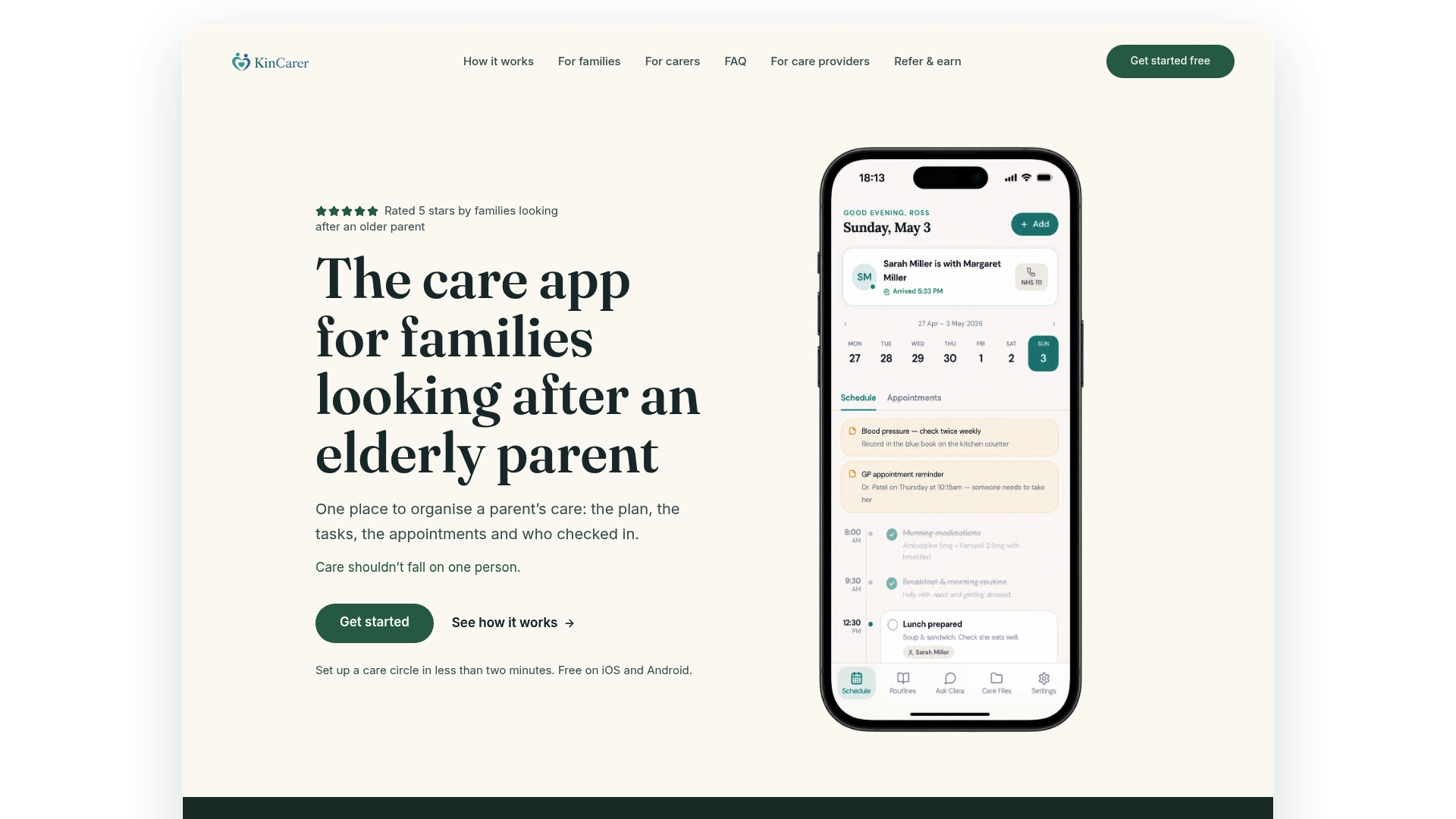
- Assign and track daily tasks so no single person carries the organising alone.
- Log medication reminders and appointments that everyone in the circle can see.
- Add handover notes after visits, so the next person knows exactly what happened.
- Ask Clara, KinCarer’s assistant, to search or summarise notes in the circle. Clara does not give medical, legal or clinical advice.
If you want to see how it works with your own family, the 14-day free trial is a straightforward place to start, and organisations supporting several families at once can look at the Family+ options.
Where to go for further guidance

For more detail, see the NHS pages on family and carer access, Carers UK’s practical guides, and Age UK’s guidance on care plans.
Sources
- Medicines: tips for carers - NHS
- Toolkit for support - Carers UK
- How to get care and support - Age UK
FAQ
What should a shared care plan for an elderly parent include?
A shared care plan should record contact and GP details, a single medication list, appointments and transport arrangements, daily tasks with named owners, and key preferences. It works best kept short and clearly labelled, whether on paper or in an app like KinCarer.
How do I get NHS family and carer access for my parent?
You apply through your parent’s GP surgery, which will carry out identity and consent checks before granting family and carer access. Once set up, it lets you book appointments, order repeat prescriptions and view parts of the GP record on her behalf.
How can families avoid medication mistakes when sharing caring duties?
Pairing a monitored dosage system or automatic dispenser with a written or digital log helps prevent missed or double doses, as recommended in NHS guidance for carers. Keep a portable master medication list ready for any hospital visit, and speak to the GP or pharmacist about any swallowing or formulation concerns.
What is a carer’s assessment and how do I request one?
A carer’s assessment is arranged through your local council to review what support you need in your caring role, separate from any assessment of your parent’s needs. Carers UK and Age UK both recommend registering as a carer with the GP first and then contacting the council directly to request one.