
3 Steps to Get Help in Days: UK Carer Support, GOV.UK and KinCarer
Call Carers UK, request a carer's assessment and check GOV.UK benefits. Try KinCarer with local respite and grants to coordinate care.
By The KinCarer team ·
If you’re looking after your mum, dad or another relative, start with three things today: call the Carers UK helpline for advice, request a carer’s assessment from your local council, and check your benefit eligibility on GOV.UK. These three steps open the door to practical, financial and emotional support, often within days rather than months.
TL;DR:
- Carer’s Allowance pays £86.45 when you provide 35 care hours weekly, your relative receives a qualifying disability benefit, and earnings remain below £204 after deductions.
- Carer’s Credit can protect your National Insurance record if you provide at least 20 care hours weekly, even when you do not qualify for cash support.
- In England, every unpaid carer can request a free assessment regardless of income or hours; ask separately about a financial assessment, which determines possible charges.
- Council funded respite usually requires assessments of both the person receiving care and the carer; private or charity funded options may fill gaps.
- Grant availability varies by location and circumstance, and discretionary funds can run out before the financial year ends, so search Turn2us and Carers Trust early.
Table of Contents
- Immediate help and national helplines
- Financial support: Carer’s Allowance, Carer’s Credit and grants
- Carer’s assessment: what it does and how to prepare
- Local and community support: respite, day centres and volunteer services
- Practical care-planning tools and coordination, including KinCarer
- How to get started: a short practical checklist
- System pressures and practical control points
- Another option: coordinating care day to day with KinCarer
- FAQ
- Sources
Immediate help and national helplines
When you’re not sure where to turn, a few trusted numbers and websites can save you hours of searching. Carers UK runs a free advice line covering benefits, employment rights and local services, while Age UK offers similar guidance with a particular focus on older people and their families. The NHS website is the place to check symptoms or treatment questions, and you should contact 111 or your relative’s GP directly for anything medical rather than searching generally online.
Your local council’s adult social services team is worth contacting early, even if you’re unsure what to ask for. Tell them you’re an unpaid carer and ask about a carer’s assessment. This single phrase tends to open the right conversation.
- Carers UK advice line: benefits, work rights, general caring questions.
- Age UK helpline: support geared towards older relatives and their families.
- NHS 111 or GP: medical concerns for the person you care for.
- Local council adult social services: ask specifically for a carer’s assessment.
Financial support: Carer’s Allowance, Carer’s Credit and grants
Money worries sit heavily on top of everything else, so it helps to know what’s actually available. Carer’s Allowance pays £86.45 per week to carers who provide at least 35 hours of care a week for someone receiving a qualifying disability benefit, provided your own earnings stay under £204 a week after certain deductions.
£86.45 a week is the current rate of Carer’s Allowance, a payment that can make a real difference if you’ve had to cut your working hours to care for a parent.
If you don’t meet the 35 hour threshold or the earnings rules you out, Carer’s Credit may still apply. It protects your National Insurance record if you’re providing at least 20 hours of care a week, which matters for your own future State Pension even when no cash payment is involved. Some applications need a Care Certificate signed by a health or social care professional when the person you care for doesn’t receive a qualifying disability benefit themselves.
Beyond these two, grants and discretionary funds can plug gaps that benefits don’t cover, from equipment to short breaks.
- Search Turn2us for grants you may be eligible for based on your circumstances.
- Check Carers Trust for small grants and local funding schemes.
- Apply early: many discretionary pots run out before the financial year ends.
Carer’s assessment: what it does and how to prepare
A carer’s assessment is free and every unpaid carer in England is entitled to one, regardless of income or how much care you provide. It’s not a test of whether you’re coping well enough, it’s a conversation about what would make caring more manageable for you specifically.
- Request it through your local council, by phone or online, stating clearly that you’re an unpaid carer.
- Attend the conversation, which usually covers your health, your caring routine, work or study commitments, and what support would help.
- Review the outcome, which might include a personal budget, direct payments to arrange your own support, or a referral for respite care.
- Ask about a financial assessment separately, since this determines whether any council-funded support is free or charged.
Pro Tip: Ask specifically for a ‘Carers in Case of Emergency’ plan during your assessment, so there’s a written record of who steps in for your relative if you’re suddenly unwell or unavailable.
Bring a rough note of your weekly caring hours, any health conditions of your own, and a sense of what’s currently unmanageable, the assessor works from what you tell them, not from guesswork.

Local and community support: respite, day centres and volunteer services
Respite comes in several forms, including services like ambulante Pflege zu Hause and Tagespflege that provide day care in specialized settings, and knowing the routes helps you ask for the right one (Pflege, Tagespflege & Krankenfahrten Kornwestheim | ReVivo). Council-funded respite, such as a short stay in a care setting or a few hours of homecare, usually follows both a needs assessment for your relative and a carer’s assessment for you. Charity-funded options and self-funded private care sit alongside these when council funding isn’t available or doesn’t stretch far enough.
- Age UK often runs day centres and befriending services locally.
- Carers Trust network centres provide sitting services, short breaks and peer contact.
- Royal Voluntary Service volunteers support with companionship and practical tasks in some areas.
To find what exists near you, start with your council’s adult social care directory, then check the Carers Trust service map and search for a local carers centre by name. Many areas also have smaller, lesser known charities that only show up in a local search rather than a national one.
Practical care-planning tools and coordination, including KinCarer
Alongside official support, many families find that the day to day coordination, who’s doing the shopping, who went to the last GP appointment, who’s picking up prescriptions, becomes its own source of stress. A shared system for tasks, appointments and notes can take some of that weight off one person’s shoulders.
There are apps designed to help families set up a shared care circle, assign tasks, track appointments, set medication reminders and leave handover notes so nothing depends on memory or a buried text thread. Some include optional AI assistants that help you search and summarise what’s already in the care circle, though they don’t give medical or legal advice.
- Shared care circles can help bring relatives and paid carers onto the same page.
- Medication reminders and appointment tracking can help reduce missed updates.
- Handover notes can mean nobody has to repeat the same explanation twice.
Pro Tip: Before choosing any care-planning app, check who can see what, how permissions work for each family member, and whether you can remove access easily if circumstances change.
How to get started: a short practical checklist
The next 72 hours matter more than a long term plan you never quite finish. Work through these in order and you’ll have the main pieces moving.
- Call Carers UK or Age UK for initial advice tailored to your situation.
- Contact your council and request a carer’s assessment, by phone or through their website.
- Use the GOV.UK benefits checker to see what you might be entitled to, including Carer’s Allowance or Carer’s Credit.
- Find your nearest Carers Trust centre and ask what local respite or peer support they offer.
- Search Turn2us for any grants that match your circumstances.
- Set up a shared place, whether a notebook, spreadsheet or an app, for appointments, medication and handover notes.
Keep a simple written record as you go: who you spoke to, what was agreed and the date. A one page emergency plan, listing medications, GP details and an emergency contact, is worth writing now rather than during a crisis.
System pressures and practical control points
We’d be doing you a disservice if we pretended the system runs smoothly. Carers UK research shows many carers go without a recent assessment, and workforce data points to real shortages in paid care. None of that means your own situation is hopeless. Requesting an assessment, writing an emergency plan and setting up basic coordination are steps that work even when wider support is stretched.
— KinCarer
Another option: coordinating care day to day with KinCarer
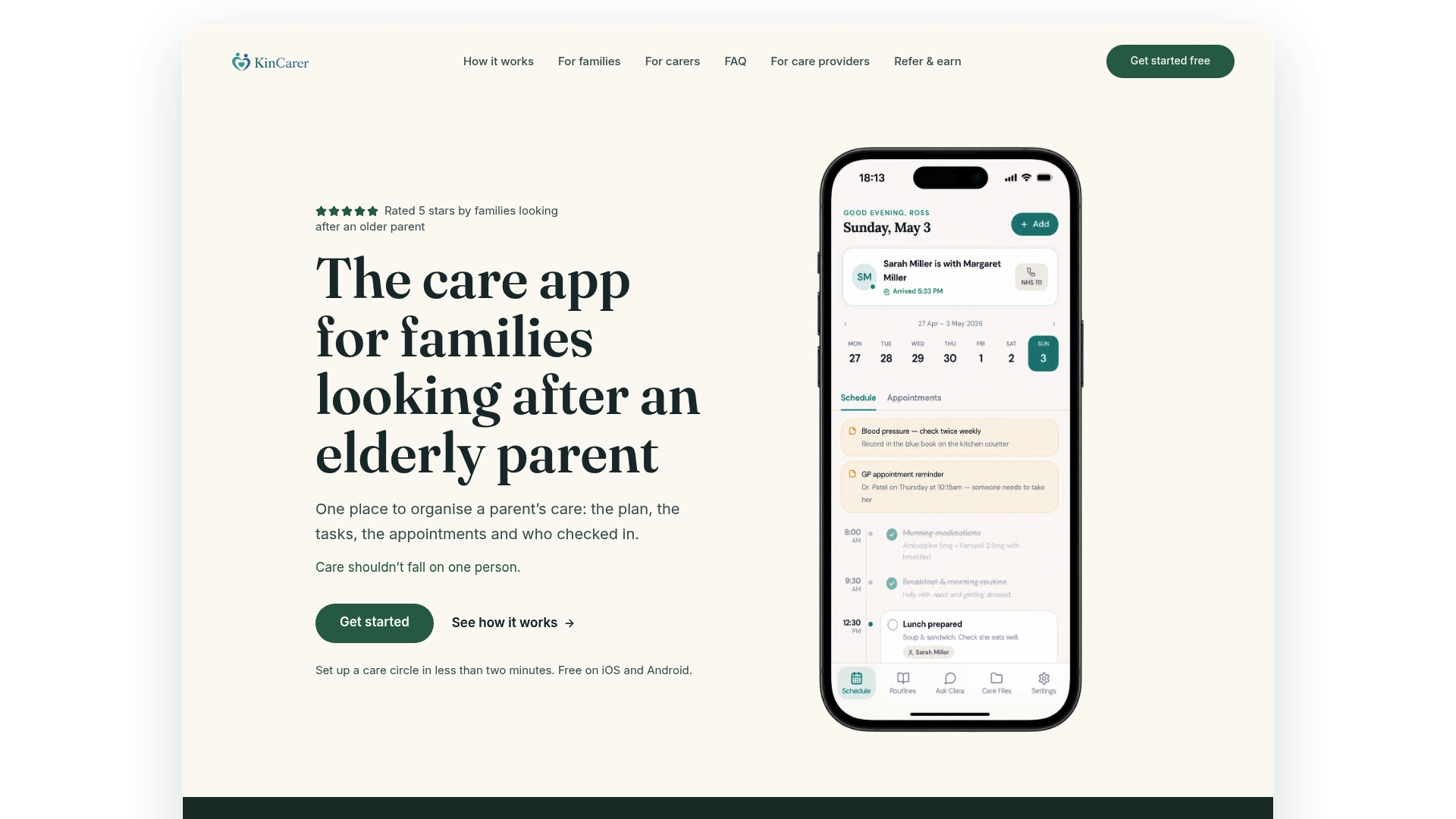
Official support matters, and nothing here replaces a carer’s assessment or a benefits application. What we’ve built at KinCarer sits alongside those, helping with the part that falls to families every single day: knowing who did what, what’s coming up, and what still needs doing. A shared care circle means your siblings or a paid carer can see the same medication reminders, appointments and handover notes you do, instead of everyone working from a different WhatsApp thread or a notebook left at your mum’s house.
- Shared tasks and appointments can help avoid duplication or forgotten jobs.
- Medication reminders can reduce the chance of a missed dose during a handover.
- Some apps offer AI features to help find and summarise information already stored in your care circle.
If you’re applying for an assessment or local support this week, it’s worth trying the KinCarer app alongside it, so the coordination side is sorted while you wait for everything else to come through.
This article is general information, not a substitute for advice from a qualified financial advisor. Consult a qualified financial professional about your own circumstances before acting on anything here.
FAQ
What resources and services are available for unpaid carers in the UK?
Unpaid carers can access a free carer’s assessment from their council, financial support such as Carer’s Allowance, and advice from charities including Carers UK, Age UK and Carers Trust. Local councils, the NHS and GOV.UK all offer starting points for benefits, respite and emotional support.
What grants are available for carers in the UK?
Grants vary by circumstance and location, so the best approach is searching Turn2us for schemes you may qualify for, alongside checking Carers Trust for smaller discretionary funds. Many are limited and allocated on a first come basis, so applying early in the financial year improves your chances.
What benefits can carers in the UK claim?
The main benefit is Carer’s Allowance, paid at £86.45 a week to those providing at least 35 hours of care weekly and meeting the earnings limit. Carers who don’t meet that threshold may still qualify for Carer’s Credit, which protects National Insurance contributions rather than paying cash.
What is the current situation with the shortage of carers in the UK?
Government workforce data shows adult social care employers reporting recruitment and skills shortages, which reduces the availability of paid care for families. This shortage is one reason unpaid family carers increasingly rely on a mix of council support, charity services and their own coordination to fill gaps.
How do I request a carer’s assessment?
You contact your local council’s adult social services team, by phone or through their website, and tell them you’re an unpaid carer. The NHS explains that the assessment is free and can lead to a personal budget, direct payments or a referral to respite care.