
Coordinate care remotely in 24–72 hours: name roles for UK families
A practical UK plan to coordinate care remotely: name an organiser, set permissions, centralise meds and appointments.
By The KinCarer team ·
To coordinate care remotely, centralise one current care plan, agree who has access, and use a shared digital system plus the NHS App where suitable. In the next 24 to 72 hours, call your relative and agree who will be the named organiser and who gets access to what, then set up a single shared document or care circle with a medication list and upcoming appointments already added.
TL;DR:
- Clear permission and responsibilities are essential, including designating who manages appointments, medications, and who has access to health records.
- Using a shared digital system or family care app helps centralize medication lists, appointment schedules, and handover notes to prevent information gaps.
- Proxy access to the NHS App and testing telecare devices are crucial but require proper setup, with early planning to avoid disruptions or crises.
- Legal arrangements like lasting powers of attorney should be in place before a crisis occurs to ensure decision-making authority and access to health and financial information.
Table of Contents
- Why coordinating from a distance feels different
- Build a family toolkit: responsibilities, schedules, documents and handovers
- Technology that helps (and where it falls short)
- Coordinating with medical and social care professionals
- Reduce carer stress and plan for emergencies
- When to bring in local professional support
- How a family care app fits the toolkit
- Strategies for effective communication among multiple caregivers
- Best practices for medication management from a distance
- Legal and financial considerations for remote caregiving
- Supporting emotional wellbeing on both sides
- Accessing community resources and support services remotely
- The one habit that actually reduces friction
- Try KinCarer as your shared care circle
- Sources
- FAQ
Why coordinating from a distance feels different
Caring for an elderly parent from another town or country creates a specific kind of strain. You are not there to notice the small things, so information has to travel to you instead, and that journey is where things go wrong.
Three patterns show up again and again in families managing care remotely:
- Appointments and medication changes get mentioned once, on the phone, and then forgotten by everyone.
- One sibling ends up holding all the information in their head then feels resentful when others ask basic questions.
- Nobody has agreed who can actually speak to the GP surgery or pick up a prescription, so a straightforward task stalls.
The real bottleneck is rarely a lack of apps. It is permission and clarity: who is allowed to see what, and who has agreed to do what. A missing spare key or an unnamed backup carer can turn a routine hospital discharge into a genuine crisis within hours.
Build a family toolkit: responsibilities, schedules, documents and handovers
A workable remote care setup does not need to be complicated. It needs to be written down, shared, and reviewed.
Start by dividing responsibilities clearly: name who does the weekly shop, who manages medication collection, and who is the first emergency contact. Give each task a backup person too, because illness and holidays happen to carers as well as to the person being cared for.
A simple weekly routine keeps everyone aligned:
- Update the medication list with any changes from GP visits or pharmacy deliveries.
- Review upcoming appointments and confirm who is attending or calling in.
- Confirm who visited in person that week and note anything that seemed different.
Centralise a small set of documents so nobody has to search for them under pressure: GP surgery contact details, the current medication list, any power of attorney paperwork, written care preferences, and a full emergency contacts list.
When care passes between people, a short handover note prevents things slipping through the gaps. Include the date and time, what was done, any concerns noticed, and what needs following up next.
Pro Tip: Keep handover notes short and factual rather than emotional; “Mum seemed low today, ate half her lunch” is more useful to the next person than a long account of the visit.
Technology that helps (and where it falls short)
Different tools solve different problems, and mixing them up leads to frustration. A shared calendar or task app is good for coordinating who does what and when. A dedicated family care app goes further, holding the medication list, appointments and notes in one reviewable place rather than scattered across messages.
For official health administration, the NHS App offers family and carer access so a relative can help manage appointments and repeat prescriptions. This proxy access usually requires both people to be registered at the same GP surgery, and the practice will carry out identity and safeguarding checks before granting it.
One development worth knowing about: NHS England has piloted a family access feature described as making switching profiles as simple as switching Netflix profiles in participating GP practices, cutting the admin involved in setting up proxy access.
Telecare and telehealth devices, such as pendant alarms or fall sensors, can support independence, but Age UK explains that alerts must be tested for local signal strength and a clear response route before you rely on them. The UK’s digital landline switchover may affect older telecare devices, so check compatibility before it happens rather than after.
Video calls work best with a light structure: a short agenda, one or two specific things to look for (colour, mobility, appetite), and a photo of the medication tray if a dose looks wrong.

Coordinating with medical and social care professionals
Health professionals need explicit permission before discussing a relative’s care with you. NHS England’s guidance on sharing information with unpaid carers stresses that consent should be specific, recorded, and revisited as circumstances change rather than assumed once and forgotten.
Practical steps that make this easier:
- Ask your relative to name explicitly what you may be told, and write that decision down somewhere everyone can see it.
- Contact the GP surgery directly to ask about proxy access or the NHS App’s family and carer access, and be ready to provide identity documents.
- Before a remote appointment, send a short written summary of recent changes so the clinician has context without needing you to repeat it live.
- On the call, stick to observable facts, such as sleep patterns or meals missed, rather than general impressions.
Virtual wards and integrated care systems are increasingly expected to treat unpaid carers as partners in planning, which means asking to be included early is a reasonable request, not an imposition.
Reduce carer stress and plan for emergencies
A resilient plan assumes something will go wrong eventually, and prepares for it in advance rather than in the moment.
- Name a backup person for every important task, and store instructions and spare keys somewhere secure and known to more than one person.
- Ask the local council for a carer’s assessment under section 10 of the Care Act 2014, which looks at your ability to keep caring, the impact on your own wellbeing, and what outcomes you want.
- Set up a carer’s emergency card or plan with the local council, so if you or the main organiser are suddenly unavailable, someone knows what to do.
Pro Tip: Ask your local council about respite options before you need them urgently; waiting lists exist, and having something arranged in advance takes pressure off during a crisis.
When to bring in local professional support
Some situations call for more than family coordination can reasonably manage. Watch for repeated safety incidents, an inability to manage medication correctly despite reminders, or your own health beginning to suffer under the strain.
Before engaging a home care agency or local support worker remotely, prepare a short briefing pack:
- Share the same medication list, appointment schedule and emergency contacts you use yourself.
- Confirm who responds to any alerts, how quickly, and what happens outside normal hours.
- Ask directly what training staff hold, since standards vary between providers, and the Care Certificate sets out the sixteen standards expected of new care workers in England.
How a family care app fits the toolkit
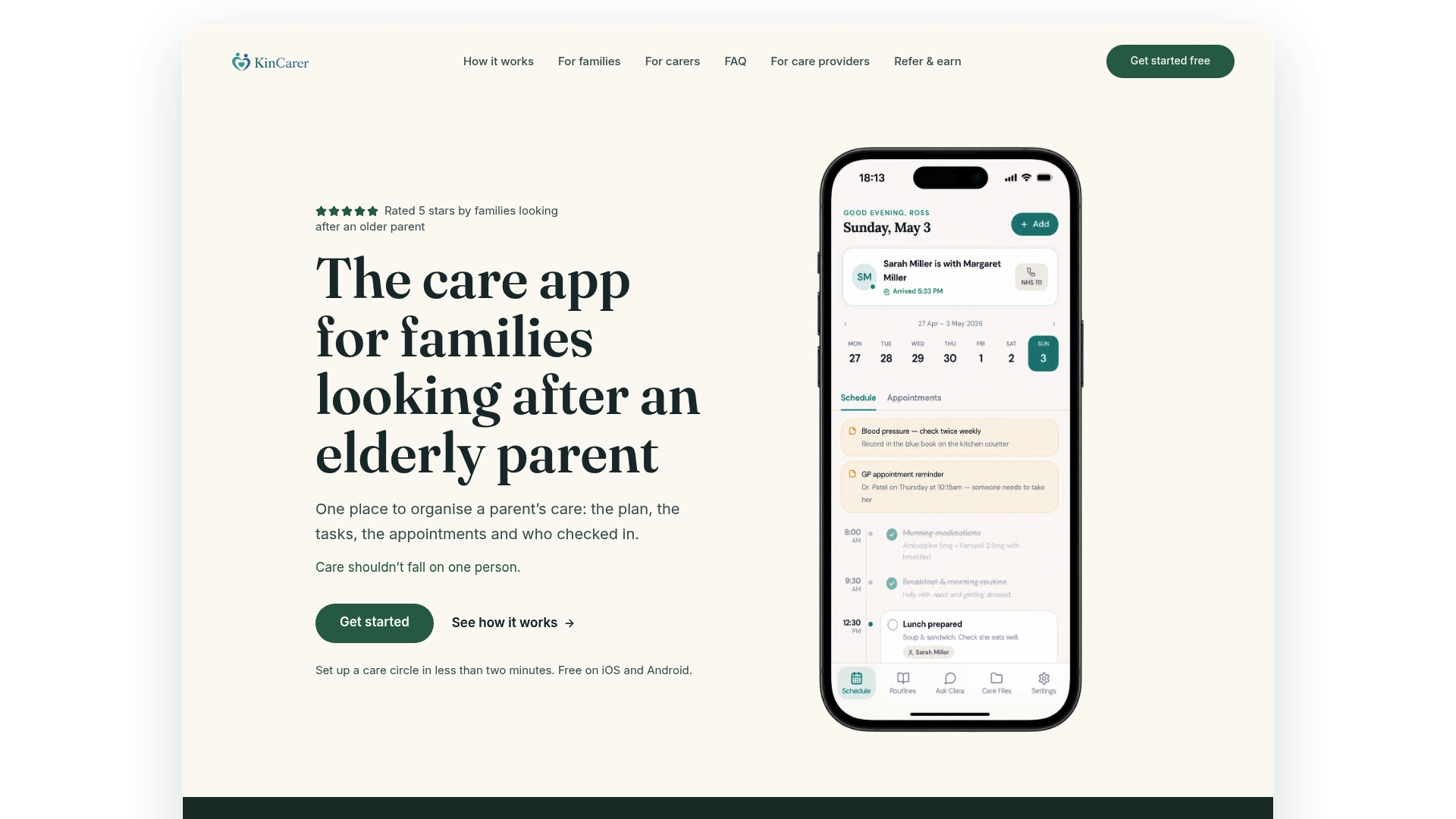
A family care app can hold most of this toolkit in one place rather than across calls, texts and paper notes. KinCarer works this way: shared care circles hold tasks, appointments, medication reminders, notes and handovers, so relatives and any local carer see the same information.
Its assistant, Clara, can search and summarise what is already in the circle, useful for catching a missed action in a long handover thread, though it does not give medical or clinical advice.
A simple setup takes a few minutes:
- Create a care circle and invite the people involved, including any local carer.
- Add the current medication list and upcoming appointments.
- Agree who can see and edit what, before anyone starts adding notes.
Strategies for effective communication among multiple caregivers
When several people are involved, communication tends to fail quietly rather than dramatically. Messages get buried in group chats, updates go to some people and not others, and nobody quite knows who has the latest version of anything.
The fix is structural rather than personal. Agree one place where care updates live, rather than a mix of texts, calls and emails, so nobody has to guess where the current information is. Assign one person as the point of contact for each healthcare provider involved, so the GP, the pharmacist and the district nurse are not fielding calls from three different relatives asking the same question.
Regular, short check-ins beat long infrequent ones. A five-minute weekly update from whoever visited in person keeps everyone roughly aligned without requiring a full family meeting every time. When something changes significantly, such as a new diagnosis or a hospital admission, that warrants a proper call involving everyone, but routine updates do not need the same weight.
Written notes also protect against the natural fading of memory. A verbal update passed from one sibling to another loses detail fast; a short written note, even two sentences, holds up much better weeks later when a query comes up about what was actually said or agreed.

Best practices for medication management from a distance
Medication is where small errors cause the most harm, and it is also where remote coordination struggles most, because nobody local is watching the tablets go in.
Keep one current medication list, not several versions held by different people, and update it the same day any change happens at the GP or pharmacy. Include the dose, timing and what each medication is for, since that context helps whoever is on the ground notice if something looks wrong.
Pharmacy multi-compartment dosage boxes help with adherence for relatives managing several medications, and a photo of the filled box sent after a visit gives everyone reassurance that the right doses went in. Where a local carer or relative attends in person, ask them to note anything skipped or refused, rather than assuming a full box means full adherence.
Flag any new medication or dosage change to everyone involved within the same day, since interactions and side effects are more likely to be missed when only one person knows about a recent change.
Legal and financial considerations for remote caregiving
Coordinating care from a distance often surfaces legal gaps that were easy to ignore when everyone lived nearby. A Lasting Power of Attorney (LPA) for health and welfare allows a named person to make decisions on your relative’s behalf if they lose the capacity to do so themselves, and a separate LPA for property and financial affairs covers money matters. Both need to be set up while your relative still has the mental capacity to agree to them, so this is not something to leave until a crisis forces the question.
Without an LPA in place, a family member has no automatic legal right to make decisions or access accounts on a relative’s behalf, even when everyone agrees informally that this makes sense. Applying through the Court of Protection after capacity has already been lost is slower and more difficult than setting up an LPA in advance.
It is worth checking with a solicitor whether your relative’s specific situation calls for both types of LPA, or whether existing arrangements such as joint bank accounts already cover some of what you need. This article describes the general principle rather than legal advice for your relative’s specific circumstances, and a solicitor or Citizens Advice can confirm what applies.
Supporting emotional wellbeing on both sides
Remote caring carries an emotional weight that is easy to underestimate until you are carrying it. Guilt about not being physically present, worry between updates, and the awkwardness of correcting a sibling’s version of events all add up quietly over time.
For your relative, isolation is often the bigger risk than any single medical issue. Regular video calls that are not just logistical, but include ordinary conversation, help maintain a sense of connection rather than feeling like check-ups. Local befriending services and community groups can fill some of the daily company that distance makes difficult for family to provide.
For you, as the remote organiser, it helps to name the strain rather than push through it. A short conversation with your GP about how caring is affecting you is a reasonable thing to have, and organisations such as Age UK offer advice specifically for carers rather than only for the person being cared for. Carrying the caregiving load alone, even from a distance, tends to catch up with people eventually.
Accessing community resources and support services remotely
You do not need to be local to tap into support that exists for your relative and for you. Local councils publish directories of community services, from meal delivery to befriending schemes, and most can be accessed and arranged by phone or online, without a home visit from you.
Age UK’s advice for carers frames distance caring in practical terms, including how to divide responsibilities fairly among family members to avoid the same negotiations recurring every few weeks. Many local Age UK branches and carers’ centres offer remote advice sessions by phone, which is useful when travelling to an office is not realistic.
Social prescribing schemes, increasingly offered through GP surgeries, can connect an elderly parent with local activities, transport help or benefits advice without you needing to research every option yourself. Asking the GP practice or social worker what is available locally is often quicker than searching independently.
The one habit that actually reduces friction
Skip the ad-hoc troubleshooting. A fifteen-minute weekly family review, checking the shared plan and updating what has changed, prevents more crises than any single app or gadget.
— KinCarer
Try KinCarer as your shared care circle
Everything in this guide, the shared medication list, the appointment tracker, the handover notes, works better when it lives in one place that everyone can reach. KinCarer was built for exactly this: a care circle where relatives and any local carer see the same tasks, reminders and notes, with Clara on hand to summarise a busy week or flag what has not been done yet.
- Start the 14-day free trial and set up your first care circle in minutes.
- Invite one local relative or carer so someone nearby is already inside the circle.
- Agree access permissions together before anyone starts adding notes.
If you are coordinating care on behalf of a local group or organisation, KinCarer’s organisational partnerships page covers that route. For families, get started here and see whether it fits how your family already works.
This article is general information, not a substitute for advice from a qualified doctor. Consult a qualified healthcare professional about your own circumstances before acting on anything here.
Sources
- Using family and carer access – NHS App help
- Sharing information with unpaid carers - NHS England Digital
- Care Act 2014, section 10
- Telecare and telehealth services explained | Age UK
FAQ
Do I need qualifications to be a care coordinator?
No formal qualifications are required to coordinate care for your own relative as a family member. Paid care workers do follow structured training, such as the Care Certificate standards, but organising a parent’s care yourself relies on clear communication and organisation rather than credentials.
What does remote care mean?
Remote care means managing a relative’s appointments, medication, tasks and wellbeing checks from a different location, usually with the help of phone calls, shared documents or apps and, where appropriate, telecare devices. It relies on someone locally being available for hands-on tasks while the remote organiser handles coordination.
Can you provide an example of coordinating care remotely?
A typical example is a daughter living several hours away who uses a shared care app to track her mother’s medication and appointments, calls weekly to check in, and has agreed with a local neighbour who holds a spare key and responds if a telecare alert goes off. The NHS App’s family and carer access lets her also manage prescription requests once registered at the same GP surgery.
Is a care coordinator a hard job?
Coordinating a relative’s care remotely is demanding emotionally and logistically, particularly when responsibility falls mainly on one person. Dividing tasks among several family members, agreeing backups for key responsibilities and requesting a carer’s assessment from the local council can make the role considerably more manageable.
category:care-planning