
UK Carer Check In Schedule: Copyable Blocks, Fewer Missed Checks
Create a UK carer check in schedule with copyable daily time blocks, clear family handovers and KinCarer coordination to help prevent missed check ins.
By The KinCarer team ·
A simple check-in schedule for most families looks like this: a morning visit or call (15 to 30 minutes), a midday check (5 to 15 minutes), an evening check (15 to 30 minutes), and a weekly admin session (30 to 60 minutes) for appointments and paperwork. Pick today’s first check-in time now, and tell one other family member what you’ve chosen.
TL;DR:
- Phone or video calls can cover midday checks and some evenings, but medication changes, mobility concerns, or a recent discharge call for an in person visit.
- Ask each family member and paid carer for genuinely available times, assign every check in, and schedule a review two to four weeks later.
- Record medication doses and times, contacts, allergies, mobility aids, recent changes, emergency contacts, and access instructions; keep copies accessible in print and shared digital storage.
- Review the plan monthly, or immediately after a hospital discharge, fall, or sudden health change, then confirm revised assignments with everyone involved.
- Choose two people who can step in, keep emergency and medication details together, and define who gets called if a check in is missed.
Table of Contents
- Recommended check-in schedule and time blocks
- Step-by-step: set up a shared schedule with family and paid carers
- Sample daily routines and ready-to-use templates
- What to record in a caregiver checklist and where to keep it
- Reviewing and adapting the schedule
- Contingency planning and emergency check-ins
- How KinCarer supports shared check-ins and coordination
- A family carer’s honest reflection
- Try KinCarer to set up shared check-ins quickly
- FAQ
- Sources
Recommended check-in schedule and time blocks
Each time block has its own job, and knowing what to look for makes every check-in faster and more useful.
Morning checks cover medication, breakfast, toileting, mobility and any overnight changes. This is when you’re most likely to spot something new: a fall, confusion, or a skipped dose from the night before.
Midday checks are shorter. Confirm your mum (or the relative you’re caring for) has had fluids and lunch, encourage a short walk or stretch if that’s part of her routine, and do a quick safety glance: doors locked, oven off, nothing left on the stove.
Evening checks focus on comfort and winding down safely: medication taken, dinner eaten, mood settled, and the home secure for the night.
Weekly admin is where you catch up on the bigger picture:
- Upcoming GP or hospital appointments and transport arrangements
- Prescription renewals and pharmacy collections
- Reading back through handover notes from other carers
- Household tasks like bills, shopping lists or repairs
Not every check-in needs a visit. Phone or video calls work well for midday checks and some evenings, but anything involving medication changes, mobility concerns or a recent hospital discharge is worth doing in person.
Pro Tip: Keep the morning and evening checks as close to the same time each day as possible. Elderly relatives often settle better with a predictable rhythm, and it’s easier for you to notice when something’s off.
Step-by-step: set up a shared schedule with family and paid carers
Getting everyone on the same page takes less time than it sounds, provided you work through it in order.
- Gather every task and appointment first. Before you schedule anything, list what actually needs doing: medications, appointments, meals, errands. Use the checklist categories further down this guide as your starting point.
- Map out who’s available when. Ask each family member (and any paid carer involved) what days and times genuinely work, rather than assuming.
- Agree who covers each check-in. Match people to time blocks based on proximity, work hours and what they can realistically commit to. Our guide to coordinating care remotely covers this in more detail for families split across different towns.
- Choose a shared tool. A shared calendar, a group chat, or a dedicated care app all work, provided everyone can see updates and gets notified when something changes.
- Draft a short handover note. A line or two covering what happened, what’s outstanding, and anything the next person should watch for.
- Set a first review date. Two to four weeks out, with a short agenda: what’s working, what isn’t, and who feels stretched.
Sample daily routines and ready-to-use templates
These templates are deliberately short. Copy them, adjust the names and timings, and use them as they are.
1. Morning visit (15 to 30 minutes)
- Confirm medication taken and note the time
- Check breakfast eaten and fluids taken
- Observe mobility: any stiffness, unsteadiness, or new pain
- Note anything unusual from overnight (sleep, confusion, falls)
2. Midday remote check (5 to 15 minutes) A short phone script works well here: “Hello Mum, just checking in. Is now a good time?” Then ask two or three direct questions: “Have you had lunch?”, “Did you take your midday tablets?”, “Is everything locked up alright?” If the answer to any safety question is unclear or concerning, that’s your cue to call a named family member or visit in person.
3. Evening wind-down (15 to 30 minutes)
- Confirm evening medication and dinner
- Check mood and general comfort
- Walk through the home: doors locked, lights appropriate, nothing left on
4. Weekly admin session (30 to 60 minutes) Set aside time each week to go through upcoming appointments, review the medicines list for anything due for renewal, check the shopping list, and read back through the week’s handover notes to spot anything that’s been missed.
What to record in a caregiver checklist and where to keep it
A good checklist means anyone stepping in, whether that’s a sibling, a neighbour, or a home care agency worker, can pick up what’s needed without having to ask you first.
Essential fields to include:
- Medications, with doses and times
- GP and pharmacy contact details
- Known allergies
- Mobility aids used and where they’re kept
- Recent changes in health or behaviour
- Emergency contacts, in order of who to call first
- Access instructions and keyholder details
For storage, a printed folder by the phone works for quick reference during a visit, a shared cloud folder means every family member can check it from anywhere, and a dedicated care app keeps everything updated in real time without anyone needing to print a new version each time something changes.
For each check-in itself, a simple record covering health, safety, mood, tasks completed and any follow-ups needed keeps the information consistent, whoever is writing it.
Reviewing and adapting the schedule
A monthly review is a sensible baseline, with government and carers’ guidance recommending regular reviews to check that no one involved is overwhelmed and that the plan still fits. Review immediately, rather than waiting for the monthly date, after a hospital discharge, a fall, or any sudden change in health.
Invite the whole care circle to a short review with a simple agenda: what’s working, what isn’t, who’s stretched too thin, and what needs to change now. Record any agreed changes in your shared tool straight away and confirm who’s picking up what, so nothing falls through the gap between meetings.
Contingency planning and emergency check-ins
Every schedule needs a backup plan for the days things don’t go as expected. Emergency plan guidance for carers recommends keeping medication lists, contact details and treatment notes centralised, which reduces pressure on a single lead carer if something happens suddenly.
At a minimum, your contingency plan needs:
- Two named stand-ins who can step in at short notice
- A full emergency contact list
- Clear notes on where keys and medication lists are kept
If a check-in is missed, have a simple call sequence ready: try the main contact first, then a stand-in, then a trusted neighbour if no one answers within an agreed time. Call emergency services if there’s genuine concern for safety and no one can reach the person directly.
Pro Tip: Keep a printed copy of your contingency plan at home and a second copy saved somewhere the whole family can access, so it’s still there if the internet or power goes down. Our printable emergency contact templates give you a ready-made starting point.
How KinCarer supports shared check-ins and coordination
A shared care circle in KinCarer lets everyone see the same tasks, appointments and medication reminders, so a check-in schedule doesn’t live only in one person’s head or a chain of missed texts. Handover notes attach directly to the day they’re written, meaning the next person to check in can read exactly what happened before they call or visit.
As an illustrative example, a family coordinating a relative’s first week home after a hospital stay could use shared tasks to assign each daily check-in, set medication reminders for new prescriptions, and log notes after every visit so nothing gets lost between family members. Our guide to setting up a shared care plan walks through getting a circle running in one sitting.

A family carer’s honest reflection
Before we shared a schedule, every check-in felt like guesswork, and I worried constantly about what I might be missing. Splitting the load with my brother didn’t just free up my evenings, it gave me permission to actually rest. Remember to book your own breaks into the plan too: a carer who never switches off isn’t sustainable for anyone.
— KinCarer
Try KinCarer to set up shared check-ins quickly
This app centralises tasks, medication reminders, appointments and handover notes, making them visible to everyone in a shared care circle instead of scattered across texts and sticky notes.
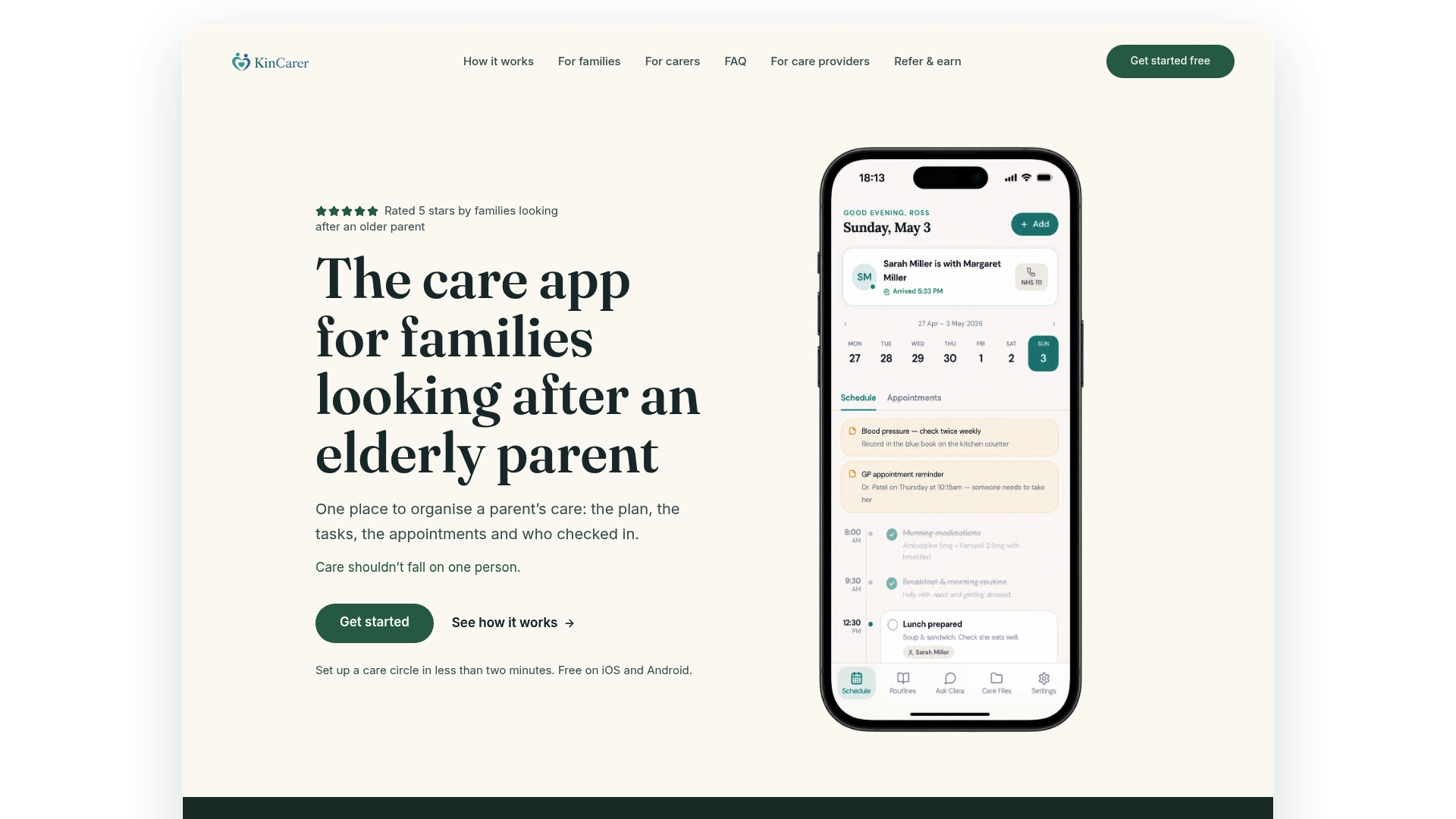
- Start a shared care circle and invite family members or a home care agency contact in minutes
- Set recurring reminders for morning, midday and evening check-ins
- Keep handover notes and documents in one place everyone can reach
Visit our care app for families to see how a care circle works. It starts with a 14-day free trial, then Family+ covers your whole family group, monthly or yearly.
FAQ
What should be recorded in a caregiver checklist?
A caregiver checklist should record medications with doses and times, GP and pharmacy contacts, known allergies, mobility aids, recent health changes, emergency contacts and access or keyholder instructions. Keeping these in one place, whether a printed folder or a shared app, means anyone stepping in can act without delay.
What is a good daily schedule for carers?
A workable daily schedule includes a morning check (15 to 30 minutes) for medication and mobility, a shorter midday check (5 to 15 minutes) for hydration and safety, and an evening check (15 to 30 minutes) for comfort and overnight safety. A practical guide for family carers recommends building this kind of routine around existing habits rather than a rigid timetable.
How many hours a week should a carer do?
There’s no fixed number that suits every family, since it depends on the person’s needs, how many relatives are sharing the load, and whether paid support is also involved. Carers UK’s guidance on looking after someone recommends requesting a carer’s assessment to work out a realistic level of support rather than guessing.
What are the five stages of caregiving?
Definitions vary across different guidance, and there isn’t one official framework that covers every family’s experience. Broadly, carers tend to move through noticing early needs, taking on regular tasks, adjusting routines as needs grow, managing more intensive or crisis periods, and eventually stepping back as circumstances change.
Sources
- Emergency plan guidance for carers
- Guidance for long-distance carers
- Supporting loved ones with health or care needs: your practical guide