
Stop sibling resentment: coordinate care with siblings using templates
Share one care plan, run a 60 minute family meeting, and use printable rota templates or KinCarer to cut sibling resentment and protect carers' wellbeing.
By The KinCarer team ·
Start by making and sharing a single care plan and agreeing one communication method, then book a 60-minute family meeting to assign roles. The plan should list emergency contacts, medications and weekly tasks so nobody is guessing who does what. From there, the quickest next step is simple: share one care list by email or app today, and sort the finer details afterwards.
TL;DR:
- Sharing a single, complete, and current care plan in one location reduces confusion and disagreements among siblings.
- Assigning roles based on realistic availability and time estimates helps balance workload and prevents unfair task distribution.
- Using one main communication channel like a shared app or folder minimizes missed messages and keeps everyone updated efficiently.
- Implementing a simple weekly rota and checklist ensures essential tasks, such as medication checks and appointments, are consistently covered.
- An app like KinCarer offers real-time sharing of tasks, medication reminders, and notes, which benefits families with scattered or complex care networks.
Table of Contents
- Set up a shared care plan: fields to include and where to keep it
- Divide responsibilities: practical rules to split tasks fairly
- Communication systems that actually work (low-tech first, then apps)
- Contingency planning and when to involve professionals
- Practical checklist and a weekly rota you can share
- How KinCarer maps to these steps: what the app offers families
- One lesson from coordinating care with a brother
- Try KinCarer: a practical next step
- FAQ
- Sources
- Authoritative documents and charities to read next
Set up a shared care plan: fields to include and where to keep it
A shared care plan only works if everyone can find it, trust it and update it. The GOV.UK practical guide recommends using templates and a structured family conversation to capture tasks, contacts and contingency steps in one place, rather than relying on memory or scattered messages.
Your plan does not need to be clever. It needs to be complete and current. Keep these fields together:
- Emergency contacts: GP surgery, out-of-hours number, nearest relative, key neighbour.
- Weekly tasks: shopping, laundry, bills, garden, dog walking, whatever actually happens.
- Medication summary: what is taken and when, written in plain terms, not clinical dosing advice.
- Appointment log: dates, who attended, what was discussed.
- Legal and financial notes: power of attorney status, main account holder, who pays which bill.
- Preferences and likes: favourite foods, routines, what helps when mum is anxious or in pain.
| Format | Best for | Watch out for |
|---|---|---|
| Printed folder | Quick reference at the house | Easy to lose, hard to update remotely |
| Shared cloud folder | Siblings who want one source of truth | Needs someone to keep it tidy |
| Shared app | Families spread across different towns | Requires everyone to actually open it |
Pick one home for the plan and stop duplicating it across three group chats. A single printed copy at your mum’s kitchen table, backed by a cloud version everyone can open, covers most families well. Whoever updates it last should date their entry, so a stale note from February never gets mistaken for this week’s reality.
Divide responsibilities: practical rules to split tasks fairly
Splitting tasks evenly on paper rarely feels even in practice, because some jobs take far longer than others. A weekly phone check-in takes ten minutes; a Tuesday hospital run can eat an entire afternoon. Balance by time, not by headcount.
- List every recurring task with a rough weekly time estimate, not just a name.
- Assign named roles, such as co-ordinator, finance lead and visiting lead, so nobody wonders who owns a decision.
- Agree each sibling’s realistic availability window, including work and childcare limits, before assigning anything.
- Set a simple swap rule: whoever cannot cover a slot finds a replacement or flags it 48 hours ahead.
- Hold a short weekly check-in to review what worked and adjust the following week.
Pro Tip: Review the rota every Sunday evening, while it is still fresh, rather than waiting for a problem to force the conversation.
Communication systems that actually work (low-tech first, then apps)

Pick one main channel and retire the rest, because three competing group chats guarantee that someone misses the message that mattered. Centralising notes, appointment logs and handovers in one place shifts family discussions from emotion toward facts, according to Carers UK, and that alone cuts down on a surprising number of arguments.
Match the medium to the message:
- Group chat: quick updates, reminders, photos from a visit.
- Shared calendar: appointments, visiting slots, who is covering what.
- Shared notes or care plan: anything that needs to stay findable later, not scroll past.
- Phone call: anything urgent, emotional or likely to be misread as text.
- Email: formal matters, like contacting a GP surgery or social worker.
A good handover note answers three things in under a minute: what happened, what to watch for, and what needs doing next. Keep medical and appointment details limited to those who need them, and get your mum’s consent, where she is able to give it, before sharing anything sensitive more widely.
Contingency planning and when to involve professionals
Every care arrangement needs a plan for the day the usual carer cannot get there, such as the ambulante Pflege zu Hause oder Tagespflege offered by ReVivo. Write a one-page, 24-hour contingency plan: who covers an emergency, which hospital, which medications matter most, and a phone list everyone can reach without hunting for it.
- Draft the contingency page together, then store it alongside the main care plan.
- Agree who calls the GP surgery or local authority if a needs assessment or carer’s assessment looks necessary. Age UK notes that local councils carry out these assessments and that they can unlock respite, equipment or other support for unpaid carers.
- If money changes hands informally between siblings or towards care costs, write down how much, why and when. The Office of the Public Guardian expects family care payments to be transparent and agreed with relevant family members, particularly where a deputy or attorney is involved, and recommends seeking legal or financial advice when the arrangement is significant.
Practical checklist and a weekly rota you can share
A visible weekly rota stops the same two people quietly absorbing everything. Keep it simple enough that anyone can read it at a glance.
| Day | Visiting slot | Phone check-in | Handover note |
|---|---|---|---|
| Monday | Sibling A | Evening | Sibling A updates plan |
| Wednesday | Sibling B | Morning | Sibling B updates plan |
| Friday | Sibling C | Evening | Sibling C updates plan |
| Sunday | Rotating | Midday | Week’s review added |
Beyond the rota, a short recurring checklist keeps the basics from slipping:
- Medication checked against the summary, not just assumed correct.
- Next appointment confirmed and added to the shared calendar.
- Shopping and essentials topped up before the weekend.
- Home safety check, including anything reported as broken or worn.
Run a 15-minute weekly review by phone or in person, the same format the GOV.UK guide recommends: note who attended, what changed since last week, tasks for the week ahead, and any red flags. Five minutes of structure saves hours of confusion later.
How KinCarer maps to these steps: what the app offers families
Everything above works on paper. It works faster inside a shared app once the care network gets complex or siblings live apart. We built KinCarer around exactly this structure:
- Shared care circles that hold the whole family, plus any paid carers, on one record.
- Tasks and appointment tracking that replace the rota and appointment log above.
- Medication reminders that keep the medication summary current without relying on memory.
- Handover notes that follow the what happened, what to watch, what’s next format.
- Clara, an optional assistant that helps you search and summarise what is already in your care circle. Clara does not give medical, legal or clinical advice.
An app earns its keep once medication lists grow complicated or siblings are scattered across different towns. For a small, local family with light needs, a printed plan and one group chat may well be enough.
One lesson from coordinating care with a brother
The week we finally wrote everything down on a single shared page, the arguments about who forgot what simply stopped. Not because the caring got easier, but because nobody was guessing anymore. Start small, review weekly, and let the plan grow with you.
— KinCarer
Try KinCarer: a practical next step
Once you have a care plan, a rota and one agreed communication channel, the next question is where it all lives so it does not fall apart in six weeks. That is the gap KinCarer is built to close: one shared circle for tasks, appointments, medication reminders and handover notes, instead of a plan buried in someone’s email.
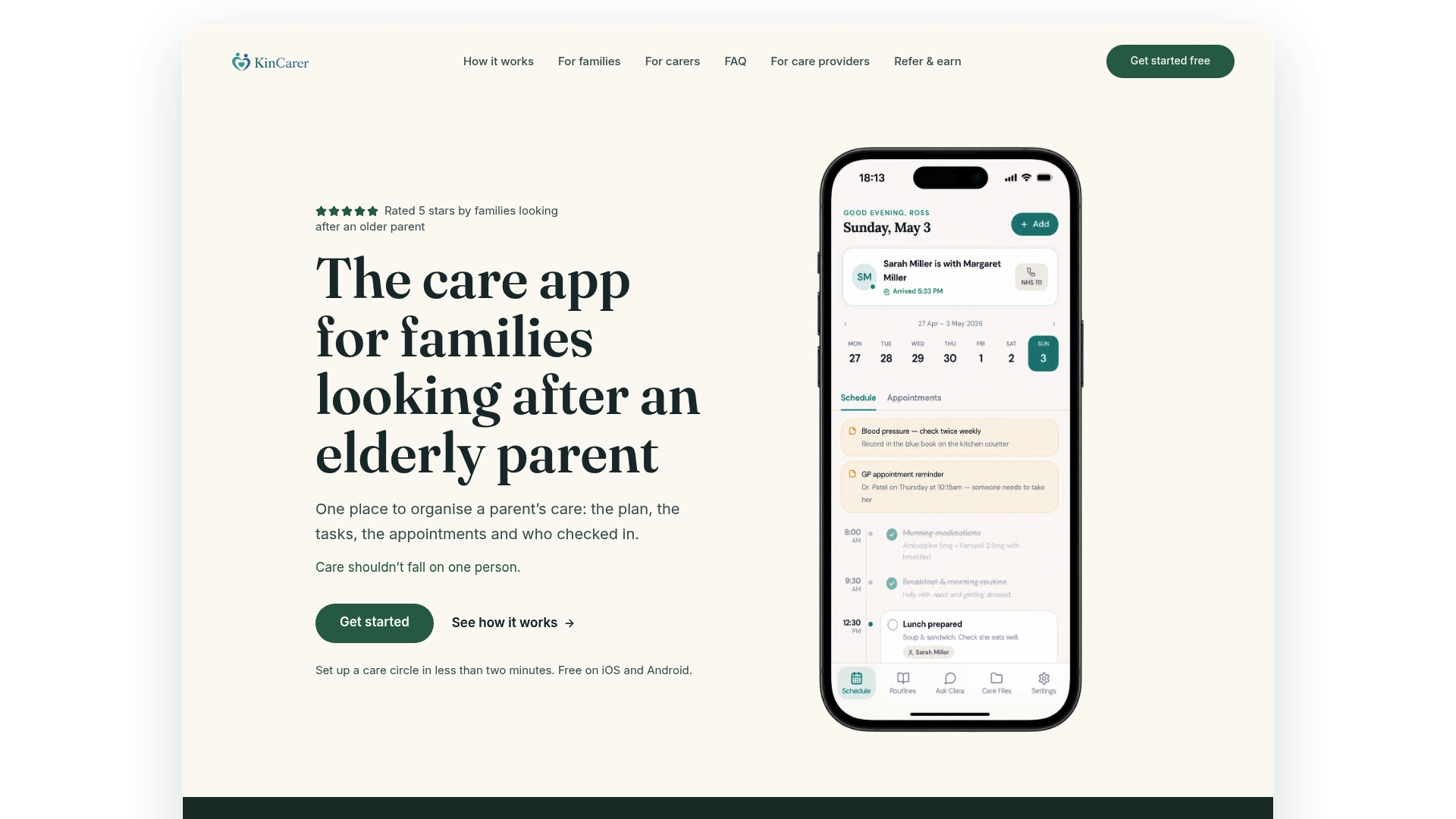
- Shared care circle for siblings and any paid carers, all seeing the same information.
- Medication reminders and appointment tracking that stay current without constant chasing.
- Clara, an optional assistant, to search and summarise your family’s care notes.
| Plan | Best for |
|---|---|
| 14-day free trial | Families trying a shared care circle |
| Family+, monthly or yearly | Families after the trial, and organisations buying it for the families they support |
Visit the KinCarer for families to see how a shared circle might work for your family, or explore Family+ if you support care for several households.
FAQ
Is it your responsibility to take care of your siblings?
Caring for an elderly parent is usually a shared family responsibility rather than one sibling’s sole job, even when one person lives closer or has more time. A written plan with named roles, as outlined above, helps distribute that responsibility fairly instead of leaving it with whoever shouts loudest or lives nearest.
How do you take care of a sick person in your family?
Start with a shared care plan covering contacts, medications and weekly tasks, agreed with the rest of the family. Keep a contingency plan for emergencies and know when to request a carer’s assessment through the local council, as Age UK explains.
How to foster a good relationship between siblings while caring for a parent?
Clear, written agreements and a shared record of tasks reduce the misunderstandings that commonly fuel resentment between siblings, according to Carers UK. A short weekly check-in, rather than letting frustrations build silently, keeps the relationship on steadier ground.
What are the reasons for caregiver resentment toward siblings?
Resentment usually builds from unequal task distribution and a lack of clear communication, not from any single disagreement. Carers UK research also links caring for more than one person to a higher risk of poor mental health, which makes sharing the load, rather than letting it concentrate on one sibling, genuinely important for everyone’s wellbeing.
Can an app really help siblings coordinate care?
Yes, particularly once siblings live apart or medication lists grow complicated, since a shared app keeps one accurate record instead of scattered notes. For lighter, local arrangements, a printed plan and one agreed communication channel may cover most of what a family needs.
Sources
- Carers UK — online tools to help with caring
- Supporting loved ones with health or care needs: your practical guide (GOV.UK)
- Age UK — advice for carers (information guide)
- Gov
Authoritative documents and charities to read next
For templates, assessments and official processes, these sources cover the ground this guide draws on: