
3 Copyable Daily Care Log Templates for UK Families, CQC & Shared Logs
Three ready to copy care log templates for family carers, plus clear CQC and Reg 17 guidance and shared log tips to prevent missed updates.
By The KinCarer team ·
A daily care log is a written or digital record of what happened during a care visit or day, including tasks completed, observations about mood and health, and anything that needs following up. The best approach is a consistent template, filled in at the time or straight after, with a timestamp and your initials or name. Templates and real examples follow below.
TL;DR:
- Accurate daily care logs must include date, time, tasks completed, medicines administered, and any urgent escalation needed, regardless of format.
- Digital records improve legibility, sharing, and real-time updates, but the quality of documentation matters more than the format used.
- For fluctuating conditions, maintaining a weekly diary helps show patterns that single entries cannot capture for better assessments.
- Family care sharing apps like KinCarer enable multiple users to log consistently, view updates instantly, and support coordinated care.
- Care logs are a legal requirement for registered providers but highly recommended for families to support safety, safeguarding, and assessments.
Table of Contents
- What counts as a daily care log
- Why daily care logs matter for safety and assessments
- Essential fields and three templates you can copy
- How to write clearer, person-centred notes
- Paper or digital: what to know about DSCRs
- Ready-to-copy examples for real situations
- Why we built shared logs into KinCarer
- Consider a shared care app for daily logs
- FAQ
- Sources
What counts as a daily care log
A daily care log goes by several names: daily care notes, an activity log, a care diary or a care card. Whatever you call it, it is the running record of what was done, noticed and needed during caring, and it becomes the shared memory for everyone involved in your mum’s or relative’s care.
These logs are kept by different people depending on the situation:
- Family carers, often informally, to track changes and share updates with siblings.
- Home care agency staff, who record each visit as part of their professional duties.
- Personal assistants or privately employed carers working directly for a family.
When a family’s informal notes start covering medication changes, falls or significant mood shifts, it is worth feeding that information into any formal records kept by a care provider, so professionals are working from the full picture rather than a partial one.
Why daily care logs matter for safety and assessments
Accurate daily notes do more than fill a diary. They catch patterns a single visit would miss, such as a parent eating less over several days or growing more confused in the evenings, and they become the evidence used in needs assessments, safeguarding enquiries and care reviews.
For registered care providers, this is not optional. Regulation 17 of the Health and Social Care Act 2008 requires secure, accurate, complete and contemporaneous records for each person receiving care, written at or near the time events happen rather than reconstructed later.
The point that matters most for carers: the Care Quality Commission focuses on the quality and use of records, not whether they are kept on paper or digitally. A messy digital system is no better than a clear paper diary, and a well-kept paper log is no worse than an app, so the format matters far less than the habit of writing things down properly.

Essential fields and three templates you can copy
Every entry, whatever template you use, should cover the same ground:
- Date and time of the visit or observation.
- Who is writing the entry.
- What you observed as fact, separate from your opinion.
- Mood, behaviour or anything out of the ordinary.
- Tasks completed, including meals, washing or mobility help.
- Medicines given or missed, if relevant.
- Any action needed from someone else.
- Whether anything needs escalating urgently.
- Signature, initials or digital identifier.
Three short formats cover most situations:
- SOAP (Subjective, Objective, Assessment, Plan): useful for health-related entries, such as “Mum says her hip aches more today (S). Walking slower than usual, wincing on stairs (O). Possible flare-up (A). Will call GP tomorrow if no improvement (P).”
- STAR (Situation, Task, Action, Result): good for behavioural episodes, such as “Became agitated before lunch (S), needed reassurance (T), sat with her and played her favourite music (A), settled within ten minutes ®.”
- DAR (Data, Action, Response): quick and practical for routine tasks, such as “Skin looked red on left heel (D), applied barrier cream and repositioned (A), no further redness by evening ®.”
How to write clearer, person-centred notes
Lead each entry with the key fact, then add context, rather than burying the important detail in the middle of a paragraph. “Fell in the bathroom at 7.15am” belongs at the start of the sentence, not the end.
SCIE’s recording guidance recommends person-centred language and, where possible, co-producing entries with the person you are caring for, following what it calls the PARTNERSHIP approach. That might mean asking your mum how she would describe her morning before you write it down, rather than only recording what you observed from the outside.
A few habits make the biggest difference:
- Write what you saw or heard, not just how you interpreted it, and if you do offer an opinion, note what led you to it.
- Record the time and your name or initials on every entry, whether on paper or in an app, so anyone reading it later knows exactly when and by whom it was written.
- Use plain, specific words: “ate half a sandwich” tells a future reader more than “ate a bit.”
Pro Tip: Before you leave a visit, spend 90 seconds checking your entry against the essential fields list, time, name, facts, actions, escalation, so nothing gets left for tomorrow’s memory to fill in.
Paper or digital: what to know about DSCRs
Paper logs are quick to start and need no technology, but they can get lost, become illegible, or sit unwritten until the end of a long day, by which point details fade.
Digital records solve some of those problems directly:
- Entries are legible and searchable, and can be shared instantly with other carers or professionals.
- Good systems create an audit trail, so every entry is timestamped and attributed automatically.
- Alerts can flag missed medication or overdue tasks before they become a crisis.
Gov sets out a list of assured solutions and explains features such as GP Connect integration, which lets a digital record link with wider NHS information for continuity of care. If you are choosing a digital option, check for security, permission controls, timestamping and the ability to export your records.
Ready-to-copy examples for real situations
Three short examples show how the same structure adapts to different moments:
- Morning visit: “8.10am, arrived, Mum dressed and had breakfast independently, no concerns, left at 8.40am (J.S.).”
- Medication: “12.30pm, gave morning tablets as prescribed, no issues swallowing, box checked against chart (initials).”
- Fluctuating day: “3.00pm, more withdrawn than usual, didn’t want to join the quiz, ate well at lunch, will check again this evening (initials).”
A simple one-line printable template reads: Date/time, name, what happened, action needed, initials, and can be copied straight into a paper diary or pasted into an app’s notes field.
For fluctuating conditions, SCIE’s practice guidance on fluctuating needs recommends keeping a running diary of good and bad days rather than relying on single snapshots, since assessors generally find a fuller record over weeks more persuasive than isolated entries. Keep dated copies and share them when an assessment is due.
Why we built shared logs into KinCarer
We built KinCarer because family caring usually involves more than one person, and a diary that lives in someone’s handbag or a single phone helps nobody else. Shared care circles let relatives and paid carers log the same entries in the same place so that all involved see the same information.
An optional AI assistant helps families search and summarise what has already been logged and, when asked, point out missed tasks, without ever offering clinical or medical advice.
— KinCarer
Consider a shared care app for daily logs
A daily care log works best when everyone caring for your mum or relative can see and add to it, rather than relying on texts that get buried or a notebook that stays at one address. Updates, tasks, appointments and medication reminders can be brought together into a single care circle, so handovers stop depending on memory.
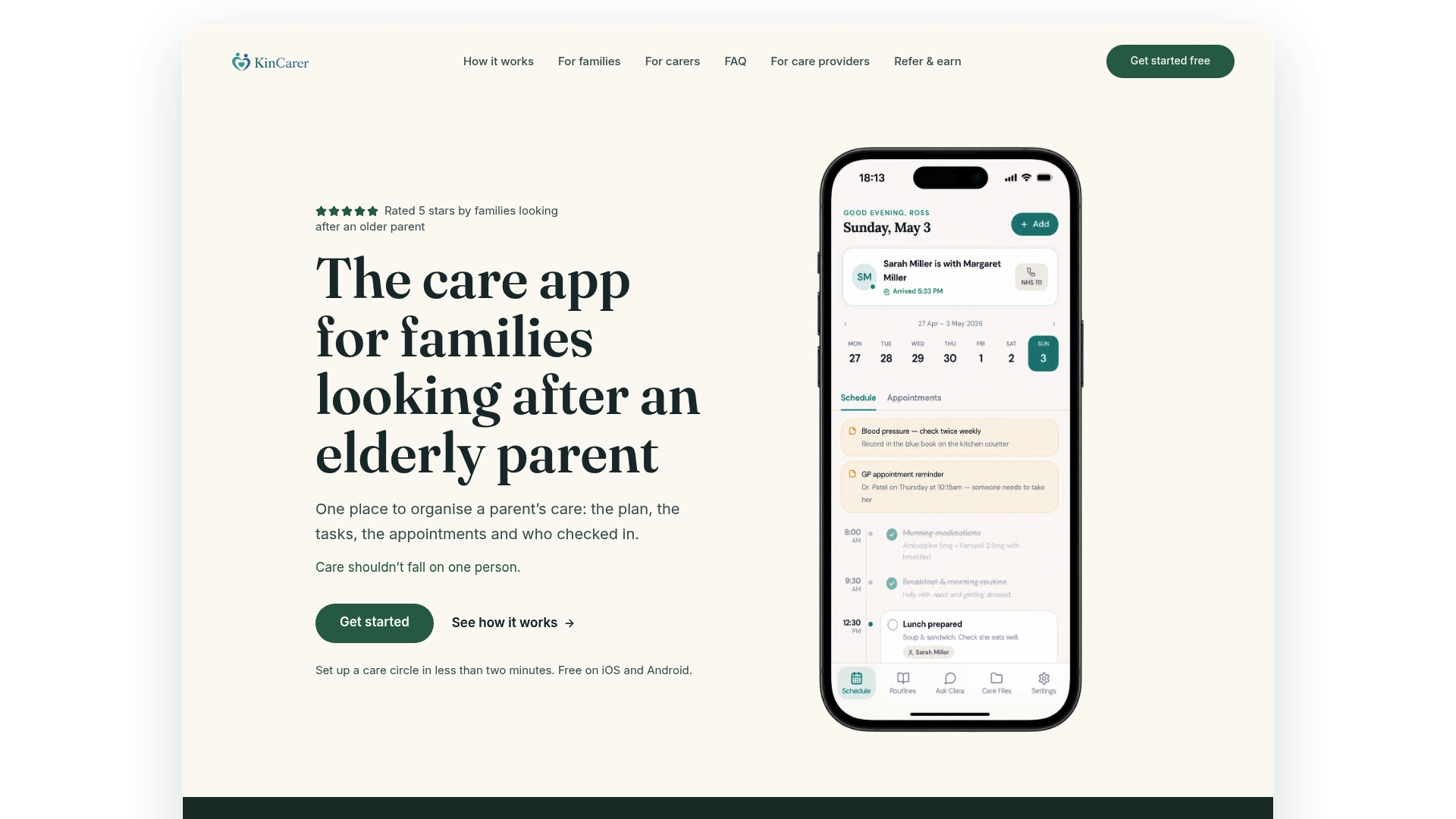
Families typically use our shared care circles to log a visit, flag something that needs following up, and let the next carer, whether a relative or a care organisation, see it immediately. One subscription covers everyone invited into the circle. Visit KinCarer to set up your family’s shared daily log today.
FAQ
What should I include in a daily care log?
A daily care log should include the date and time, who wrote the entry, what you observed, tasks completed, any medicines given, and actions still needed. Keeping these fields consistent makes entries easier to compare day to day and easier for anyone new to the caring role to follow.
Is a daily care log a legal requirement?
For registered care providers, Regulation 17 requires accurate, contemporaneous records, so logging is a legal duty rather than a suggestion. For families caring informally, there is no legal requirement, but a clear log supports assessments, GP conversations and safeguarding discussions if they arise.
Should I use paper or a digital care log?
Either works, since the Care Quality Commission judges the quality and use of records rather than the format. Digital tools such as a shared app can make sharing between family members and carers faster and reduce the chance of notes getting lost.
How long should I keep daily care notes?
There is no single fixed rule for family carers, but keeping a running diary across weeks or months gives a fuller picture for assessments of fluctuating needs than a handful of scattered entries. Dating each entry clearly makes it easier to hand over a relevant stretch of notes when an assessment or GP appointment comes up.
Can KinCarer replace a professional care provider’s records?
No, KinCarer is built for families coordinating care between relatives and paid carers, not as a replacement for a registered care provider’s own formal records. It works alongside those records by giving families a shared, contemporaneous log of what has happened and what still needs doing.