10 September 2026
5 Copy Ready Care Notes for UK Family Carers That Cut Repeat Calls
Five copy ready care notes that keep your parent informed, cut repeat calls, and reduce sibling friction. Plus simple storage and app tips.
5 Copy Ready Care Notes for UK Family Carers That Cut Repeat Calls
A care note is a short, shared update covering five things: completed tasks, observations, questions, promised next steps, and the next check-in time. Here is one you can copy right now: “Tasks done: Mum had lunch and her 2pm tablets. Observations: Seemed tired, mentioned her hip aching. Questions: Has she had her hip checked recently? Next steps: Sarah to call the GP tomorrow. Next check-in: Tom visiting Thursday evening.”
TL;DR:
- Using a care note structure with five headings prevents repetition and ensures important details like tasks, observations, questions, next steps, and check-in times are consistently recorded.
- Keeping notes factual, objective, and in the person’s own words minimizes disagreements and helps build trust among family members and caregivers.
- A shared care app or digital document helps avoid version confusion and keeps all parties up to date, especially when managing multiple caregivers or distant relatives.
- Clearly defining who can read or edit the notes and maintaining a respectful, person-centered approach supports a collaborative care environment.
- Regularly reviewing and updating notes reduces phone calls and ensures everyone stays informed, particularly when multiple caregivers are involved.
Table of Contents
- Five care notes examples you can copy today
- How to write a care note that people actually read
- Where to keep notes, and who gets to read them
- How five headings cut down the phone calls in our family
- Our view on what actually makes care notes work
- Try a purpose-built app instead of piecing it together yourself
- Sources
- FAQ
Five care notes examples you can copy today
Every family caring for an ageing parent eventually faces the same challenge: someone visits, something happens, and details get lost before being shared. A consistent structure fixes that. Practitioner guidance on family handoff notes recommends exactly five headings so whoever reads next can scan it in under a minute: completed tasks, observations, open questions, promised next steps, and the next check-in.
Below are five care notes examples built around situations most families recognise. Each one is dated, attributed to whoever wrote it, and deliberately brief.
1. Daily visit note
Monday 12 October, 3.15pm, written by Priya
- Tasks done: Helped Dad shower and dress, made his lunch, watered the plants he asked about.
- Observations: In good spirits, ate all of his lunch, mentioned he slept badly on Sunday night.
- Questions: Should we ask the GP about a sleep review?
- Next steps: Priya to mention the sleep issue at Wednesday’s GP appointment.
- Next check-in: Mark visiting Wednesday morning.
2. Medication prompt note
Wednesday 14 October, 9am, written by Tom
- Tasks done: Gave Mum her morning tablets with breakfast, checked the pillbox for the week.
- Observations: Took the tablets without any fuss, said she felt fine.
- Questions: The blood pressure tablets are running low, roughly five days left.
- Next steps: Tom to collect the repeat prescription on Friday.
- Next check-in: Sarah calling Friday evening.
3. Transport arranged note
Thursday 15 October, 11am, written by Sarah
- Tasks done: Booked hospital transport for the cardiology appointment on 22 October.
- Observations: Mum seemed anxious about the appointment when we spoke on the phone.
- Questions: Does anyone want to go with her, or is transport enough on its own?
- Next steps: Sarah to confirm with Mum by Monday whether someone is accompanying her.
- Next check-in: Whoever confirms will update the note by Monday evening.
4. Meal and household task note
Saturday 17 October, 5pm, written by Mark
- Tasks done: Cooked and froze four meals, put the bins out, changed the bed sheets.
- Observations: Kitchen bin was overflowing before I got there, worth checking more often.
- Questions: Does the cleaner still come on Tuesdays, or has that changed?
- Next steps: Mark to check with the cleaner directly.
- Next check-in: Priya visiting Tuesday.
5. Night check note with a possible clinical concern
Sunday 18 October, 10.30pm, written by Tom
- Tasks done: Checked in before bed, made sure the front door was locked.
- Observations: Mum said her ankle had been swollen since this morning and was warm to touch. She hasn’t mentioned an injury.
- Questions: Has anyone else noticed this, and for how long?
- Next steps: Tom to call the GP surgery in the morning rather than wait. This is not something to guess about at home.
- Next check-in: Whoever speaks to the GP will update the note straight after the call.
Notice what none of these notes do: they don’t guess, diagnose, or editorialise. They record what was seen or heard, who is doing what next, and when someone else will pick up the thread.
How to write a care note that people actually read
Each heading earns its place. Completed tasks stops duplicate effort, so nobody re-does what’s already been handled. Observations captures the small changes that matter over time, like appetite or mood. Questions flags anything unresolved before it gets forgotten. Next steps names an owner, because a task with no name attached rarely gets done. Next check-in tells everyone when to expect the next update, which stops the anxious follow-up call.
Three phrasing rules keep a note useful and calm:
- Attribute what you say. Write “Mum said her hip was aching” rather than “Mum is in pain.” One is an observation, the other sounds like a diagnosis you’re not qualified to make.
- Avoid labels. Words like “confused,” “difficult,” or “stubborn” describe a moment, not a person, and they tend to start arguments rather than solve problems. Adapted clinical handoff standards like SBAR and I-PASS work precisely because they stick to observable facts.
- Use her own words where you can. Quoting “my hip’s been niggling since Tuesday” tells the next reader more than any paraphrase would.
Here’s the compression in action. A typical WhatsApp message might read: “Just left Mum’s, she seemed a bit off today, didn’t finish her dinner and was going on about her knee again, I said I’d mention it to someone, anyway she’s watching telly now so should be fine, will check tomorrow.” That’s forty words of useful information buried in eighty.
Compressed into the five-heading format: Tasks done: Cooked dinner, tidied the kitchen. Observations: Left half her dinner, mentioned knee pain again (third time this week). Next steps: Sarah to ask GP about the knee at Thursday’s call. Next check-in: Tomorrow evening.
Pro Tip: Read the note back to your parent before you leave, if she’s able to hear it. It catches errors on the spot and means she stays part of the conversation about her own care, not just its subject.
Where to keep notes, and who gets to read them
Paper notebooks work for one household but fall apart the moment three people need the same information at once. Nobody can update a page that’s sitting on someone else’s kitchen counter, and there’s no way to search back through old entries when a pattern starts to matter.
A shared document (Google Docs, a family WhatsApp pinned message, a shared spreadsheet) solves the access problem but creates a new one: version confusion, entries buried under chat noise, and no natural structure forcing anyone to stick to the five headings. A family care app keeps notes, tasks, and reminders in one place with a consistent format, which matters most once more than two or three people are involved.
Whichever method you choose, agree a short permissions checklist early:
- Who can read the notes (usually the full family, sometimes including a home care agency)?
- Who can edit or add entries?
- Are there topics kept off the shared note entirely, such as finances or a diagnosis someone isn’t ready to share?
- How will access be removed if someone’s role changes, such as after a divorce or falling out?
Anything that repeats on a fixed schedule, like a Tuesday cleaner visit or a monthly GP review, belongs on a shared calendar rather than cluttering the notes. Notes are for what happened; calendars are for what’s coming.
How five headings cut down the phone calls in our family
Before we settled on a format, updates arrived as fragments: a text here, a voicemail there, someone’s memory of what someone else said. Once everyone started using the same five headings, the repeat calls dropped almost immediately, because nobody needed to ask “so what actually happened today?”
The etiquette that made it stick was simple: read the latest note, act on whatever’s assigned to you, then add one line confirming it’s done. That’s it. Structured updates like this reduce the back-and-forth that usually falls hardest on whoever lives nearest, and families using KinCarer’s shared care circles report the same pattern: fewer duplicated questions, and everyone working from the same version of events.
Our view on what actually makes care notes work
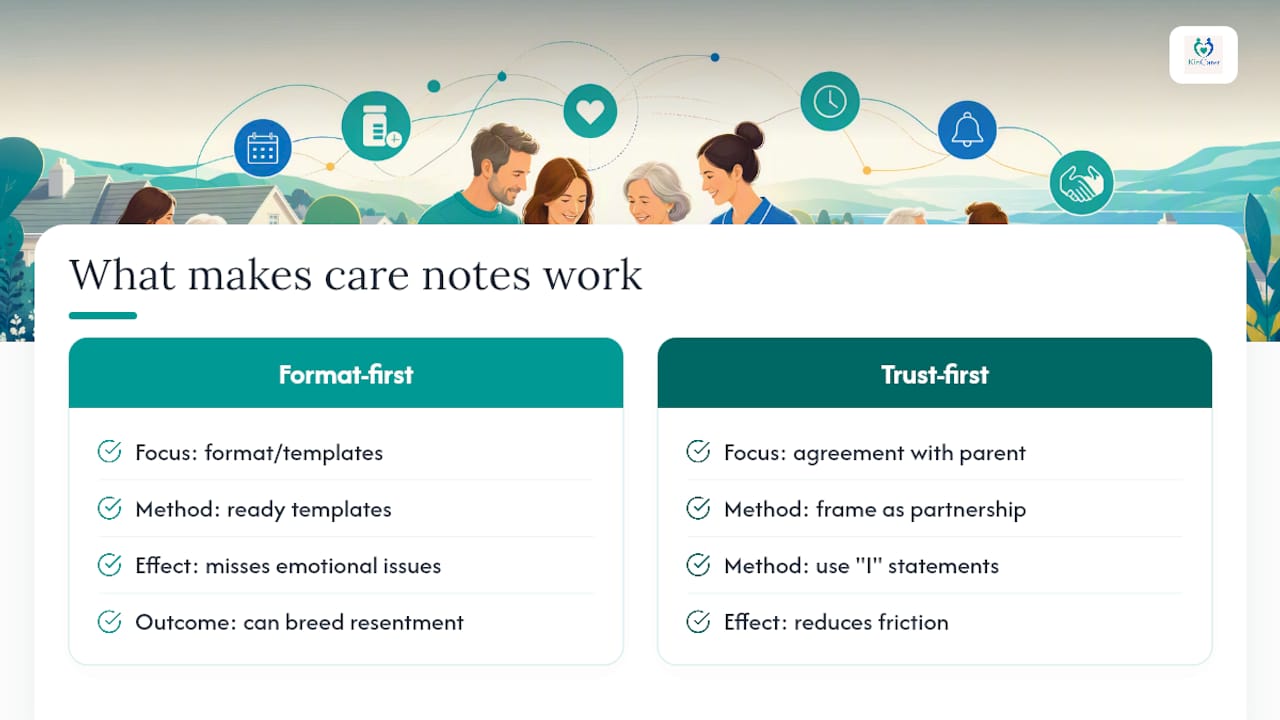
Most advice on this topic focuses on the format, and format matters, but it isn’t the hard part. The hard part is emotional: guilt about not doing enough, resentment about doing too much, and an ageing parent who understandably doesn’t want to be talked about like a project. Psychology-based guidance on sibling caregiving backs this up, noting that framing conversations as partnerships and using “I” statements does more to reduce friction than any template ever will.
So prioritise this first: agree, out loud, that your parent gets a say in what’s written down and who reads it. A five-heading note built on that agreement will hold up under pressure. One imposed without it, however neatly formatted, tends to breed resentment the first time someone reads something they weren’t expecting. Get the trust right, and the template takes care of itself.
— KinCarer
Try a purpose-built app instead of piecing it together yourself
A dedicated app gives families a home for exactly the kind of notes covered above, so nothing gets lost in a WhatsApp thread or a paper notebook someone else is holding. Such apps are built around shared care circles where relatives and, where relevant, a home care agency can all see the same tasks, appointments, medication reminders, and handover notes.
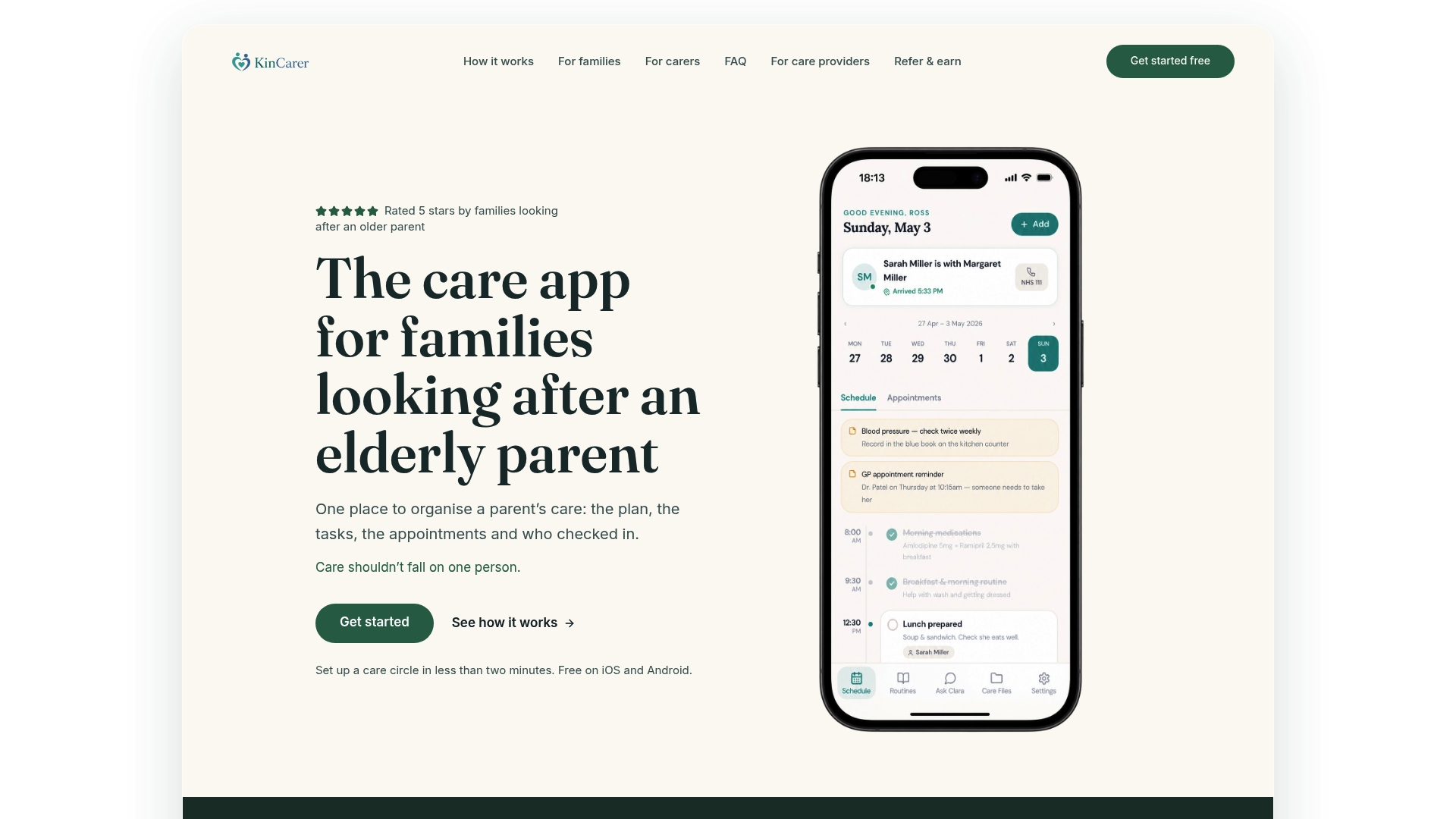
Families juggling several siblings, a long-distance relative, or a rotating set of visits tend to get the most out of it, since everyone opens the same circle rather than five different message threads. Getting started typically takes three steps: create a care circle for your elderly parent, agree on the five headings as your house style, then invite the people who need to see it. Some apps include an optional assistant that can help you search or summarise what’s already been recorded, though these assistants do not offer medical, legal, or clinical advice.
If you’re tired of chasing updates or repeating yourself on the phone, set up a family care circle on KinCarer and see whether a shared structure takes the pressure off the person currently carrying it alone.
Sources
- Family care visit handoff note for older adults — All Seniors
- When siblings need to care for elderly parents — Psychology Today
FAQ
What should a family care note always include?
The five essentials are completed tasks, observations, open questions, promised next steps, and the time of the next check-in.
How long should a care note be?
Short enough to read in about a minute, typically five or six lines under the five headings rather than a full paragraph.
Should I write down what my parent said or what I think is wrong?
Write what she said or what you observed, not a diagnosis or a label, since attributed facts are far less likely to spark disagreement between relatives.
Where’s the best place to store shared care notes?
Paper works for one household, shared documents suit small families, and a dedicated app like KinCarer suits families juggling several people, appointments, and reminders at once.
Who should be allowed to read or edit the notes?
Agree this with your parent directly wherever possible, then set clear permissions covering who can read, who can edit, and which topics stay off the shared note.
Keywords: care notes examples, care notes template, nursing care documentation, how to write care notes, patient care notes, examples of care plans, effective care notes, patient observation notes, care note examples for nurses, clinical care documentation, category:care-planning