
CareZone Alternatives: Check Privacy Before UK Families Switch
Compare CareZone alternatives for UK families, from shared care to NHS tools. Check privacy and trial an app before changing how your family coordinates care.
By The KinCarer team ·
If you’re looking for a CareZone alternative, we’d point you first to KinCarer, built for UK families coordinating care for an elderly parent through shared care circles, medication reminders and check-ins. Beyond us, MyTherapy, Caretaker, the NHS App, Careology and Jointly each cover a different piece of the puzzle. The comparison and checklist below will help you work out which to trial first.
TL;DR:
- MyTherapy is free and focuses on medication, with barcode prescription entry and refill alerts; choose it when reminders matter more than shared care coordination.
- Caretaker flags missed calls or doses and supports phone or text contact, but runs only on iOS and places some features behind a subscription.
- NHS App proxy access needs GP approval and usually requires the same surgery; access varies, so use a family app for daily care tasks.
- Careology is available only to people receiving cancer treatment through participating NHS services, so eligibility depends on whether their treating service offers it.
- Before choosing, test whether reminders reach the person receiving care, confirm relatives can access notes, and check how the app stores and deletes personal data.
Table of Contents
- Comparing KinCarer against other CareZone alternatives
- How to choose the right CareZone alternative
- Where NHS tools fit: the NHS App and proxy access
- A family carer’s note on trying a new app
- Why KinCarer might be the right fit for your family
- FAQ
- Sources
Comparing KinCarer against other CareZone alternatives
Choosing a replacement for CareZone usually comes down to one question: what is the one thing your family keeps dropping? For some families it’s medication, for others it’s who’s visiting mum this week, and for a smaller group it’s staying on top of official NHS paperwork. Here’s how the main alternatives stack up against each other.
KinCarer sits at the centre of day-to-day coordination: the shared care circle means relatives and any paid carers see the same tasks, appointments and notes instead of one person holding it all in their head. Medication reminders, check-ins and document storage cover the practical load, and Clara, our optional AI assistant, can search and summarise what’s already in the circle so nobody has to scroll back through weeks of messages to find a GP’s name or a dosage change. Clara does not give medical, legal or clinical advice, so it sits alongside your own judgement rather than replacing it.

MyTherapy stays focused on one job and does it well: it’s a free app built around medication reminders, with a barcode scanner for adding new prescriptions and stock alerts that flag when a refill is due. It suits anyone who mainly needs dependable pill reminders without wider care coordination features.
Caretaker leans into timed check-ins rather than messaging. It notifies a carer if a scheduled check-in or medication dose is missed, includes an emergency widget on the lock screen, and offers SMS and phone-based check-ins for relatives who don’t always have reliable data access. It’s iOS-only, with some features sitting behind a subscription.
The NHS App handles what no family app can: official prescriptions, appointment bookings and, where granted, family and carer access to another person’s GP record.
Careology is narrower still, built specifically for people having cancer treatment through participating NHS services, with symptom tracking and medicine reminders tied to that treatment pathway.
Jointly rounds out the list as a straightforward shared list and notes app, popular in carer communities for its simplicity rather than any clinical depth.
- KinCarer and Jointly both work well for general family coordination. KinCarer offers medication reminders and an AI summary assistant.
- MyTherapy and Caretaker focus on medication and check-ins respectively, rather than full care coordination.
- The NHS App and Careology have different NHS service links, and eligibility conditions apply.
How to choose the right CareZone alternative
Picking the right app is less about finding the one with the most features and more about matching it to how your family already communicates. A few criteria make the decision faster:
- Shared care circles and permissions: can you control who sees what, and can unpaid family carers join without extra cost?
- Medication workflow: does it remind, log doses, and flag refills, or just send a single daily alert?
- NHS alignment: if proxy access matters to you, check whether the app works alongside the NHS App rather than trying to replace it.
- Document storage and handover notes: can you upload a GP letter or care plan and find it again in a hurry?
- Emergency contact features and platform reach: does it run on both iOS and Android, or on the web, for every relative involved?
A short, practical trial beats reading feature lists for hours. Try this order:
- Install the app and create a test care circle.
- Invite one relative and confirm they can see tasks and notes.
- Set a medication reminder and check the notification actually arrives.
- Upload one document, such as a GP letter, and confirm you can retrieve it later.
- Test revoking a carer’s access to see how permissions work in practice.
Before committing, it’s worth asking a few direct questions: how is proxy access approved, can you invite unpaid carers without extra cost, and where is your data stored if you decide to delete your account later.
Pro Tip: Run your trial with the person you’re caring for included from day one, so you can confirm they can actually see and respond to reminders, not just that the app works for you.
Where NHS tools fit: the NHS App and proxy access
The NHS App lets patients in England and the Isle of Man request repeat prescriptions, track them and view appointments, and it can extend family and carer access so a relative sees some of that information too. That access, often called proxy access, depends on the GP surgery granting permission, and both people usually need to be registered at the same surgery.
- Proxy access is not an automatic full handover of someone’s medical record.
- Access levels and safeguarding checks vary by surgery, so what one family gets may differ from another.
- Many families use the NHS App for prescriptions and official records, then use a family coordination app for the daily reminders, check-ins and notes that sit outside the NHS record.
A family carer’s note on trying a new app
We’d suggest testing any alternative in one care circle for a while and watching whether missed updates actually fall, not just whether the app looks promising on day one. Include the person you’re caring for in that test wherever you can, so you see whether they respond to reminders or check-ins rather than assuming they will. Use the trial to confirm notifications arrive reliably, and practise inviting and removing a carer before you need to do it for real.
— KinCarer
Why KinCarer might be the right fit for your family
We built KinCarer around the job most families actually have: keeping everyone looking after mum or dad working from the same information, without one person carrying it all. Shared care circles, medication reminders, check-ins and document storage sit in one place, and Clara can summarise or search the circle’s notes when you need an answer quickly rather than scrolling back through old messages.
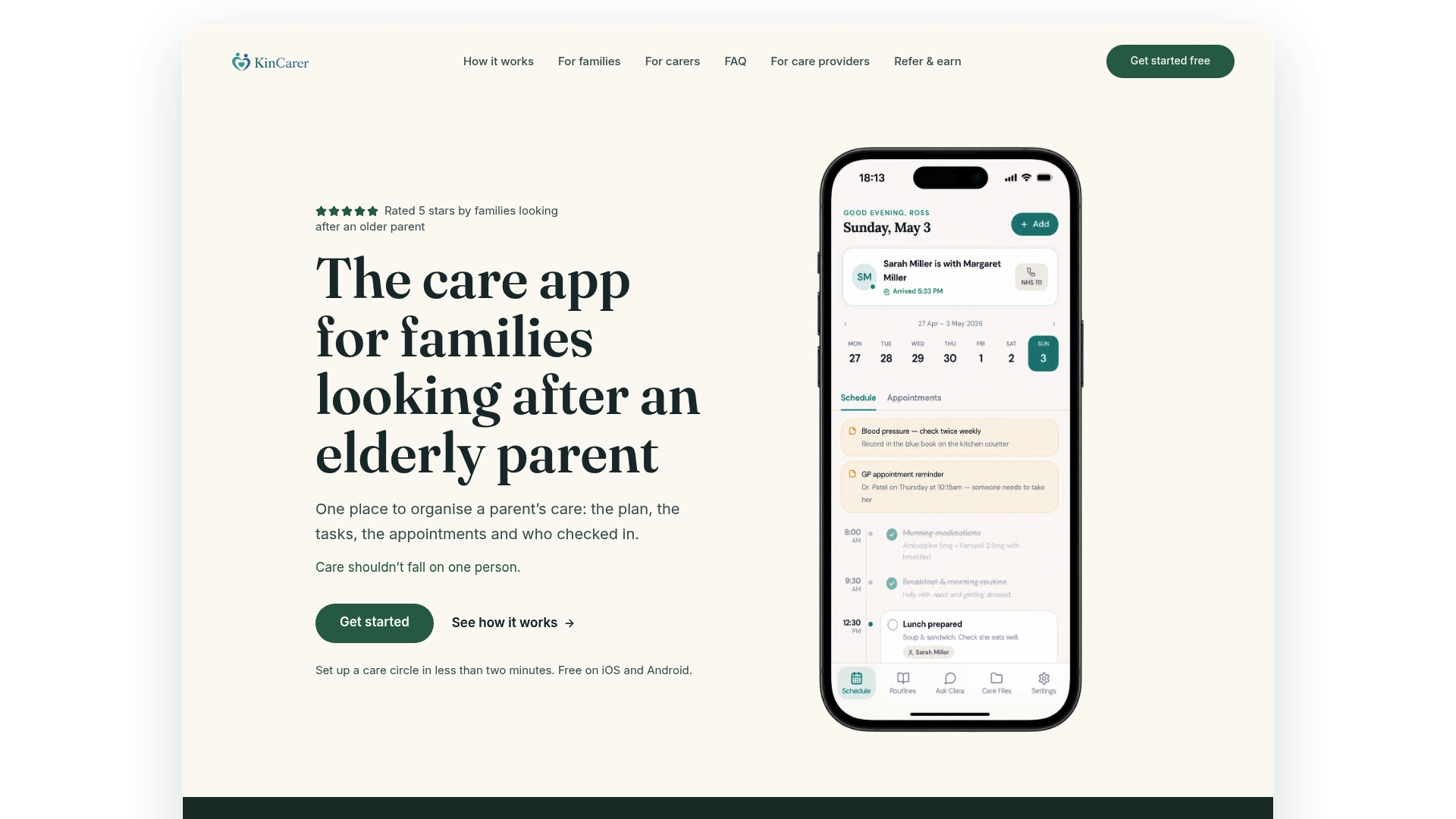
- Invite relatives and any paid carers into one circle so updates stop getting buried in separate chats.
- Set medication reminders for the care circle.
- Store a GP letter, care plan or emergency contact list where everyone invited can find it.
If any of that matches what you’ve been trying to patch together with CareZone, it’s worth seeing how it fits your own circle. Start with the 14-day free trial of the KinCarer app to test invitations and medication reminders, or look at Family+ through the organisations page if you’re coordinating care alongside a wider group.
FAQ
Is there a free alternative to CareZone for medication reminders?
Yes. MyTherapy is free and focuses on medication reminders, barcode scanning and refill alerts. KinCarer is paid: it starts with a 14-day free trial, then Family+ monthly or yearly, and includes medication reminders alongside shared care circles and check-ins.
Can I use the NHS App instead of a family care app?
The NHS App handles official prescriptions, appointments and, where a GP surgery agrees, family and carer access to another person’s record. It isn’t designed for day-to-day task sharing or handover notes, so most families use it alongside a coordination app rather than instead of one.
How does proxy access work with the NHS App?
Proxy access lets a carer view some of another person’s NHS record, such as prescriptions or test results, once the GP surgery grants permission. Both people usually need to be registered at the same GP surgery, and access levels vary depending on the surgery’s own checks.
Is Careology available to everyone?
No. Careology is offered through specific NHS services to people having cancer treatment, so eligibility depends on whether your treating service offers it.
What should I check before trusting an app with a relative’s health information?
Look for a clear explanation of how the app stores and shares data, and remember that NHS-integrated tools usually grant specific, limited access rather than full control over a medical record. It’s worth checking how to delete your data before you commit to any app.