
UK carers at work: use your statutory rights and a one page emergency plan
Workplace first steps for UK carers: use your statutory rights, make a one page plan, and centralise care coordination via a shared app.
By The KinCarer team ·
The verdict: use your statutory rights, make a short contingency plan, and centralise the coordination so nothing depends on your memory alone. Do three things this week: tell your manager you need a short conversation about flexible working; write a one-page emergency plan; and check your eligibility for Carer’s Allowance or book a carer’s assessment. Small structural changes like these, not heroics, are what make caring for a parent alongside a job sustainable.
TL;DR:
- Ensuring tasks are clearly delegated and mapped helps prevent reliance on memory and streamlines caregiver coordination among family and support networks.
- Requesting flexible work arrangements and applying early for benefits like Carer’s Allowance or assessments can provide crucial financial and practical support.
- Building a written contingency plan with key contacts, medication details, and routines offers reliable emergency support and reduces last-minute stress.
- Using shared care tools for task management, appointment tracking, and document storage minimizes mental load and avoids duplication or missed responsibilities.
- Recognizing legal protections through discrimination law related to caregiving, and openly communicating aims, can improve workplace support and progression opportunities.
Table of Contents
- 1. Practical day to day strategies that free up time
- 2. Workplace rights and how to request flexible working or carer’s leave
- 3. Money, benefits and assessments to check now
- 4. Contingency planning and respite options that actually work
- 5. How shared care planning and simple tech reduce coordination time
- 6. Legal protections against discrimination for carers in the workplace
- 7. How caring affects career progression, and what to do about it
- 8. Support networks and community resources for working carers
- Why small changes matter for long-term balance
- A practical tool for shared care coordination
- Authoritative resources to act on now
- Sources
- FAQ
1. Practical day to day strategies that free up time
Most of the stress in working and caring comes from constant interruption, not from the tasks themselves. Block scheduling helps: batch GP visits, pharmacy runs and care calls into set windows so they do not chip away at your working hours all day.
Delegation is the other lever. Even a small care network, a sibling, a neighbour, a home care agency, works better when tasks are named rather than assumed. Nobody “helps out generally”; someone books appointments, someone does the weekly shop, someone handles medication collection.
- Map everyone involved and write down exactly what each person owns.
- Create a shared appointments folder so nobody double-books or misses a follow-up.
- Use a simple handover note template each time care responsibility passes between people.
- Hold a short weekly family check-in, ten minutes is often enough, to catch anything slipping.
Setting realistic expectations matters too. You will not manage a full-time job, a caring role and a spotless house. Something has to flex, and deciding in advance which non-essential tasks you are dropping is far less draining than deciding it in a crisis.
Pro Tip: Keep the handover note to five fixed fields (meds, mood, meals, appointments, concerns) so anyone can fill it in without thinking twice.
2. Workplace rights and how to request flexible working or carer’s leave
Employees have a statutory right to request flexible working from their first day of employment, and employers must consider the request reasonably and give written reasons for any refusal. Separately, the Carer’s Leave Act gives eligible carers one week of unpaid leave every twelve months, which can be taken flexibly rather than in one block.
Raising this with a manager feels harder than it needs to be. A short, structured approach works better than an emotional appeal:
- Ask for a specific meeting rather than raising it in passing.
- Come with a proposal, not just a problem: suggest a trial period, perhaps six weeks, with a clear way to review it.
- Show how you will mitigate any gap, cover arrangements, adjusted hours, or catching up async.
- If refused, ask for the reasons in writing, as employers are required to give them.
- If the conversation stalls, ACAS or your union can advise on next steps.
Most managers respond well to a plan rather than a request in the abstract.
3. Money, benefits and assessments to check now
Financial support for carers is narrower than most people expect, so it is worth checking eligibility early rather than assuming you will not qualify. Carer’s Allowance requires providing at least 35 hours of care a week, weekly earnings below £204 after tax and allowable deductions, and that the claimant is 16 or over and not in full-time education.
A carer’s assessment looks at your needs, not just theirs: it can unlock respite care, direct payments or council support, and is arranged through your local authority or, for the person you care for, alongside their own care needs assessment.
Before applying for either, gather:
- A simple log of your weekly caring hours, even a rough diary is enough.
- Any existing benefit letters for you or the person you care for.
- ID and contact details for both of you.
- Details of your GP and any care providers already involved.
4. Contingency planning and respite options that actually work
A written plan you can hand to someone else in a crisis is worth more than good intentions. Build it in four steps:
- List key contacts: GP, pharmacy, one or two named backup carers, and your local council’s adult social care line.
- Write out current medication, doses and timing exactly as prescribed.
- Note key daily routines, meals, mobility needs, anything a stand-in carer would need to know within minutes.
- Share the plan with everyone in your care network, not just the person most involved.
Respite ranges from a few hours of volunteer sitting to short residential stays, usually arranged through your council after an assessment. For lighter, more immediate cover, a neighbour rota, a local carers’ group, or an emergency carer card scheme can bridge the gap while longer-term respite is arranged.
5. How shared care planning and simple tech reduce coordination time
A lot of the mental load in caring is not the tasks themselves but tracking who did what and what still needs doing. Shared care planning tools handle that layer: shared task lists, appointment tracking, medication reminders, handover notes and a central place for documents that would otherwise live in someone’s inbox or a paper folder.
A typical weekly workflow looks like this:
- Set the coming week’s tasks and appointments in one shared view.
- Assign each task to a named person, not the group.
- Use a standard handover note each time care responsibility changes hands.
- Keep one emergency document everyone in the circle can access.
Pro Tip: Treat any coordination app as a shared notebook, not a decision-maker. It should make information easier to find, not tell you what to do medically. An AI assistant can summarise notes and flag missing updates, but it does not give medical or legal advice, and no tool replaces a GP or a carer’s assessment.
6. Legal protections against discrimination for carers in the workplace
Carers are not a protected group in their own right under discrimination law, but protection often applies indirectly through association with someone who has a disability. If you are treated unfairly because you care for a disabled parent, that can amount to discrimination by association, which is unlawful.
In practice, this covers situations such as being passed over for a role, denied training, or subjected to unreasonable pressure specifically because of your caring responsibilities linked to a relative’s disability. It does not automatically cover every caring situation, for instance where the person you care for has no disability, so the specifics matter.
If you believe you are being treated unfairly, the practical route is usually the same regardless of the exact legal category: raise it formally with HR, keep a written record of what happened and when, and seek advice from ACAS or your union before deciding whether to take it further. Most disputes are resolved at this stage, long before any tribunal is involved. Knowing the protection exists, even in this narrower form, changes the tone of a workplace conversation considerably.

7. How caring affects career progression, and what to do about it
Caring responsibilities often coincide with the years people expect to be pushing hardest for promotion, and something usually has to give. ONS analysis of sandwich carers shows that those providing more hours of care are more likely to reduce their working hours and see their income fall as a result.
That does not mean progression has to stop, but it usually means being deliberate rather than passive. A few things help:
- Be explicit with your manager about your ambitions, not just your constraints, so caring does not become the only thing they associate with you.
- Look for roles or projects with flexible delivery rather than fixed presence, output matters more than hours in many jobs now.
- Keep a record of your achievements as you go, since caring often coincides with career gaps that are easy to underplay later.
- Revisit your working pattern every few months rather than assuming the current arrangement is permanent.
Progression rarely stops entirely for working carers, but it often slows, and naming that honestly, to yourself and your employer, tends to produce better outcomes than pretending nothing has changed.
8. Support networks and community resources for working carers
You do not have to work this out alone, and most areas have more support than people realise until they go looking. Local carers’ centres offer practical advice, peer support groups and sometimes short breaks or sitting services. Carers UK provides guidance on rights, benefits and contingency planning, alongside a helpline for one-off questions.
Within work, some employers now have carer networks or trained managers who can advise proactively on flexible arrangements, and NHS guidance recommends this kind of manager training as it improves retention of staff with caring responsibilities. Online, condition-specific charities, for dementia, stroke or Parkinson’s, for example, often run their own carer forums with people managing very similar day-to-day problems.
Finding the right group sometimes takes a couple of attempts. A general carers’ group might not match your situation as closely as a condition-specific one, and that is worth persevering through rather than giving up on the idea of peer support altogether.

Why small changes matter for long-term balance
Nobody manages this perfectly, and the exhaustion that comes with juggling work and caring is real, not a sign you are doing it wrong. What tends to help is not a single big fix but a handful of small trials: one flexible working arrangement, one respite session booked, one tool tried for a fortnight. If a change does not work, adjust it rather than abandoning the whole effort. Carers UK and your local carers’ centre are worth contacting early, not just in a crisis, for both practical and emotional support.
— KinCarer
A practical tool for shared care coordination
If the hardest part of caring for your mum or another relative is keeping everyone informed, a shared care app solves a specific, ordinary problem: too much information living in someone’s head or a buried WhatsApp thread. Some care coordination apps let you set up a care circle where relatives and any paid home care agency staff can see the same information.
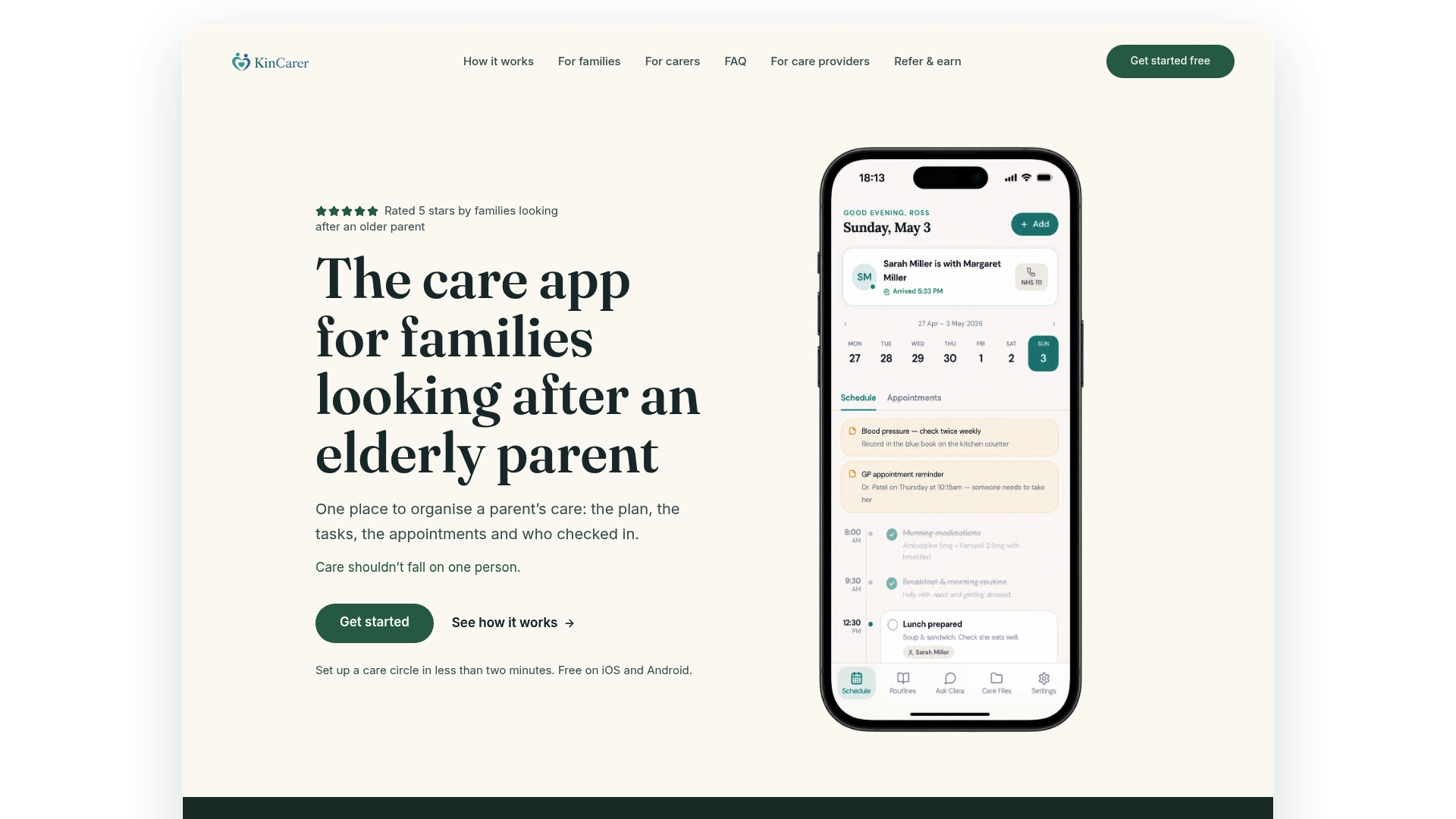
- Shared tasks and appointment tracking so nothing depends on one person remembering.
- Medication reminders and handover notes that travel with the care circle, not one phone.
- Cloud-based document storage for the paperwork that usually ends up scattered.
- Clara, an AI assistant that can summarise notes and, when you ask, point out missed tasks, without giving medical or clinical advice.
It suits families sharing the coordinating role, or anyone tired of duplicated calls and missed handovers. You can start the 14-day free trial or see the full KinCarer app to decide if it fits how your family already works.
Authoritative resources to act on now
- Carer’s Allowance eligibility and how to apply.
- Applying for flexible working at GOV.UK.
- Carers UK guidance on contingency planning and emergency support.
- Contact your local carers’ centre or your employer’s HR team for immediate, personal advice.
Sources
FAQ
How to balance work and caregiving?
Combine your statutory rights, such as requesting flexible working or taking carer’s leave, with a written contingency plan and a clear division of tasks among family or friends. Centralising appointments, medication reminders and handover notes in one place, whether a notebook or a shared app, cuts down the daily coordination load significantly.
What are the symptoms of caregiver fatigue?
Caring fatigue usually shows up as constant tiredness, irritability, trouble sleeping and a sense of being unable to switch off from planning and worrying. Carers UK’s State of Caring 2025 report found that 52% of unpaid carers were providing more hours of care than the previous year, which tracks closely with rising reports of exhaustion.
What are the signs and symptoms of caregiver resentment?
Resentment often builds quietly through repeated small frustrations: feeling taken for granted, doing more than other family members without acknowledgement, or dreading calls and visits you once welcomed. It is common and rarely a sign of not loving the person you care for, but it is worth naming early, since raising it with family or a carer’s group tends to ease it faster than staying silent.
What is post-caregiver syndrome and what are its symptoms?
There is no single clinical definition of “post-caregiver syndrome,” but people commonly describe a mix of grief, loss of identity and exhaustion after a caring role ends, sometimes alongside guilt or a strange sense of purposelessness. If these feelings persist, speaking to a GP or a bereavement or carers’ support service is a reasonable next step, since ongoing low mood after such a demanding role is common and treatable.