7 September 2026
One Page Fix for Caregiving Information Overload for UK Family Carers
Stage based tactics for UK family carers. Create a one page emergency summary, use a shared record, and follow a one week plan to cut admin and stress.
One Page Fix for Caregiving Information Overload for UK Family Carers
Caregiving information overload happens when a carer receives more advice, paperwork, and conflicting guidance than they can process, leaving decisions stuck and admin piling up. The fastest fix is not reading more; it’s making one page that holds only the essentials and picking a single trusted source to call when you’re stuck. Do that today, and the daily noise from leaflets, forums, and well meaning relatives stops running the show.
TL;DR:
- Most caregiving information overload stems from fragmented sources that do not communicate, leading to duplicated efforts and inconsistent guidance.
- Fixed-timing delivery of leaflets and forms at diagnosis and discharge overwhelms carers unprepared for the volume and complexity of information.
- Building a single, one-page emergency summary and batching admin into scheduled slots are immediate steps that significantly reduce daily noise and decision fatigue.
- Using a shared care app with task assignment and a central record helps prevent duplication errors and ensures everyone has access to the latest information.
- Prioritize expert sources like NHS, dementia charities, or specialist helplines over unverified online advice, and seek quick confirmation to avoid acting on outdated or irrelevant guidance.
Table of Contents
- What does caregiving information overload look like?
- Why it happens: causes and system-level barriers
- Immediate practical steps to reduce overload today
- Organising and curating information: simple systems that stick
- Applied example: how a shared care app reduces the load
- Trusted UK support: who to call and what they help with
- How to ask for and accept help without it falling apart
- Self-care and preventing burnout while managing overload
- Your one-week action plan
- Strategies for managing digital information overload
- Long-term information management as care needs evolve
- Coordination over consumption
- A simpler way to keep everyone on the same page
- Sources
- FAQ
What does caregiving information overload look like?
Information overload rarely announces itself. It shows up as small friction that builds until you can’t make a simple decision without feeling paralysed.
The most common signs among family carers include:
- Decision fatigue: struggling to choose between two reasonable options, even small ones like which pharmacy to use.
- Sleep disruption: lying awake running through appointments, medication times, or something a nurse said that didn’t quite make sense.
- Admin backlog: forms, letters, and benefit paperwork stacking up because opening them feels like starting a second job.
- Inability to act: knowing you need to book a carer’s assessment or call a helpline, but never quite getting to it because there’s “too much to figure out first”.
Dementia care makes this worse at two very specific moments: diagnosis and hospital discharge. At diagnosis, families are often handed a stack of leaflets covering legal power of attorney, symptom progression, local support groups, and benefits, all at once. A qualitative study on caregiver counselling found that information delivered in standardised bundles, rather than matched to what a carer actually needs at that stage, creates measurable cognitive load and reduces how well it’s retained. The same pattern repeats at discharge, when a hospital team hands over medication changes, follow up appointments, and care instructions in a single conversation, often while everyone involved is exhausted.
Quick self-check: if you’ve missed a bill, forgotten which relative said they’d help with Tuesday’s appointment, or found yourself reading the same charity page for the third time without absorbing it, you’re likely already in overload. That’s not a personal failing. Research into family carers’ information needs found that both too little and too much information create genuine barriers to coping, and the difficulty in finding guidance specific to your exact situation is a documented problem, not something you’re doing wrong.
Why it happens: causes and system-level barriers
Overload isn’t really about how much you’re reading. It’s about how that information arrives and who’s sending it.
Several structural issues stack up against carers from day one:
- Fragmented sources: your GP surgery, the hospital, the local council, and two or three charities each hold a different piece of the picture, and none of them talk to each other.
- Fixed-timing information packs: care packs and leaflet bundles get issued at set milestones (diagnosis, discharge, annual review) rather than when you’re actually ready to use them.
- Administrative sludge: repeating the same story to five different services, filling out overlapping forms, and chasing replies by phone all multiply the time each task takes.
- Duplication: the same medication list gets rewritten for the GP, the pharmacist, and the district nurse because there’s no single shared version.
The emotional layer matters just as much as the practical one. Guilt is a powerful driver here. Many carers feel that if they don’t read every leaflet, attend every webinar, and research every possible symptom, they’re somehow failing at the role. That instinct is understandable, but it’s also the exact trap that produces overload. Perfectionism turns “stay informed” into “consume everything”, which is neither realistic nor useful when you’re also managing appointments, medication, and your own life.
There’s a fix built into how information gets delivered well: match it to the stage you’re actually at, not the stage the system assumes everyone reaches at the same time. Guidance from dementia-specific advice networks backs this, suggesting that staged, sequenced information improves uptake compared with handing over everything at once. You can apply the same logic yourself: decide what you need answered this week and let the rest wait.
Immediate practical steps to reduce overload today
You don’t need a perfect system before you start. You need one document and one rule for handling anything new that lands on your desk.
- Pick one critical item and protect it. For most carers, that’s the medication list or the emergency contact card. Everything else can wait a day; a missed dose or an unreachable contact can’t.
- Build a one-page emergency summary. List allergies, current medications, GP details, next of kin, and any critical instructions (for example, “confused when woken suddenly” or “diabetic, insulin at 8am and 6pm”). Pin it to the fridge and add a copy to your shared family record.
- Batch your admin into fixed slots. Rather than answering letters and emails as they arrive, set two or three short windows a week. Carers who’ve shared their own routines describe batching admin and using shared storage as one of the most effective changes they made, because it stops small tasks from interrupting everything else.
- Triage new information with a simple rule. When something new lands, whether it’s a leaflet, an email, or a forwarded article, decide in ten seconds: read now, save for later, or discard. Most things belong in the second or third category.
- Make delegation specific, not vague. “Could you help sometimes?” produces nothing. “Could you handle Thursday’s pharmacy pickup every week?” produces a commitment you can rely on.
The triage rule matters more than it sounds. Most carers’ instinct is to keep every leaflet “just in case”, which means the pile never shrinks and nothing ever gets marked as done. Deciding immediately whether something needs action now, needs filing, or can be binned removes the low-value background noise that makes everything else feel heavier.
Pro Tip: Keep a small notebook or a note on your phone titled “Agreed help”, and log every commitment as soon as someone makes it, including the day and frequency. Vague offers evaporate within a week; written-down ones tend to stick because you can gently remind people what they said.
Delegation works best when the ask is time-bound and specific. Carers UK’s own guidance on looking after someone recommends making tasks concrete rather than open-ended, because a defined frequency turns a favour into a routine. If your sister says “let me know if you need anything”, respond with “can you do the Saturday morning check-in call, every week?” That single sentence does more to reduce your load than a dozen general requests for support.
Organising and curating information: simple systems that stick
The goal isn’t a beautiful filing system. It’s one place that holds the truth, so nobody has to guess or ask twice.
Start with five folders, whether they’re physical, digital, or both: emergency, medications, appointments, finances, and legal. Keep them shallow. A carer who has to dig through twelve subfolders to find a GP letter will stop using the system within a fortnight.
If more than one person is involved in caring for your mum or another relative, agree a few basic rules early:
- One version of each document is the canonical one; everyone edits that copy, nobody keeps a personal duplicate.
- Files get a consistent naming pattern (date, then subject) so anyone can find them without asking.
- Updates get logged somewhere visible, even briefly, so the next person doesn’t have to reconstruct what happened.
On tools, it helps to think in categories rather than chasing the “best” app. Shared notes apps solve the problem of scattered messages. Medication reminder tools solve missed or doubled doses. Cloud storage solves the “which folder is that in” problem. You don’t need all three from day one; add each only when the gap it fixes is actually causing you pain.
Three templates are worth building once and reusing indefinitely:
| Template | What it holds | When to use it |
|---|---|---|
| One-page emergency summary | Allergies, medications, GP, next of kin, key instructions | Pinned at home, shared with anyone who might need to step in unexpectedly |
| Weekly handover note | What happened this week, what’s outstanding, what’s next | Shared between family members or with paid carers each week |
| Medication list | Drug name, dose, time, prescriber | Updated whenever a GP or pharmacist changes anything |
Carers UK’s practical guidance on caring for someone with dementia specifically recommends a laminated one-page summary containing only the most critical contacts and notes, precisely because it removes the guilt of unread leaflets sitting in a drawer. You’re not ignoring the rest of the material; you’re deciding it doesn’t need to live in your head.
Applied example: how a shared care app reduces the load
A shared care circle solves a specific problem: it gives everyone involved one place to check, instead of five different WhatsApp threads and a stack of paper nobody else can see.
A shared care planning app works from that same principle. Rather than every family member holding a slightly different version of what’s happening, a shared care circle keeps tasks, appointments, medication reminders, and handover notes in one record that updates for everyone at once. If one person updates the GP’s new instructions, another carer sees the same version, not a text message that got buried an hour later.
Some care planning apps include an optional AI assistant that helps you search and summarise what’s already in your care circle, and flags gaps such as an appointment with no outcome logged. These assistants don’t give medical, legal, or clinical advice; they work with your family’s own records to save you re-reading everything from scratch when you just need to know what happened last Tuesday.
Setting this up takes less time than most carers expect:
- Invite the people actually involved in day-to-day care, including a paid carer if one is helping regularly.
- Set recurring tasks for things that repeat weekly, like medication pickups or check-in calls, so they don’t need re-arranging every time.
- Pin your one-page emergency summary somewhere everyone in the circle can find it in seconds.
- Agree, out loud, who updates what, so two people aren’t duplicating the same note.
Pro Tip: Assign one person as the “keeper” of the medication list specifically, even if several people help with other tasks. A single point of accountability for medication changes prevents the most dangerous kind of duplication error.
Trusted UK support: who to call and what they help with
Knowing which service to call for which problem saves hours of searching through pages that don’t quite answer your question.
Admiral Nurse Dementia Helpline offers free access to specialist dementia nurses, and it’s worth calling before you spend another evening searching forums for an answer a nurse could give you directly. The Admiral Nurse Dementia Helpline can be reached on 0800 888 6678 or by email, and also offers virtual clinic appointments if you need a proper conversation rather than a quick answer.
Alzheimer’s Society and Dementia UK both run local groups and forums where carers swap practical, lived experience rather than clinical theory. Alzheimer’s Society’s guidance on getting help and support as a carer explains what health and social care professionals can and can’t do, which helps you know what to actually ask for when you contact them.
NHS support starts with your GP. Tell them explicitly that you’re a carer, since that single sentence often unlocks referrals and support that wouldn’t otherwise be offered. NHS guidance on looking after someone with dementia recommends requesting a formal carer’s assessment, which can open access to respite care, day centres, and home adaptations depending on what your local authority offers.
Carers UK and local carers’ organisations focus heavily on the admin side: benefits guidance, practical rights, and connecting you to services near you. Their own advice is refreshingly blunt: make information accessible and ask for help early, rather than waiting until a crisis forces the conversation.
How to ask for and accept help without it falling apart
Vague offers of help almost always evaporate. Specific requests almost always get honoured.
- Name the task, the day, and the frequency. “Can you do the school run on Wednesdays?” works. “Can you help with the kids sometime?” doesn’t.
- Use a simple script for family and friends: “I need someone to sit with mum every Tuesday from 2 to 4pm, starting next week. Can you commit to that?”
- Use a similar script for care agencies: “I’m looking for two hours of support, twice a week, focused on personal care and a light meal. Can you confirm availability and a start date?”
- Write down every agreement the moment it’s made, including in your shared family record, so it becomes a scheduled commitment rather than something you have to chase or remind people about.
Specific, recurring requests convert goodwill into dependable cover, which is exactly why they reduce the need for constant re-coordination once they’re in place. The moment help becomes routine rather than a favour, your mental load drops sharply, even if the actual amount of support hasn’t changed.
Pro Tip: If someone offers “let me know if you need anything”, treat that as an invitation to make a specific ask within the same conversation. Waiting until you’re desperate to follow up almost always means the offer has quietly expired.
Self-care and preventing burnout while managing overload
Generic advice to “take time for yourself” rarely survives contact with a real caring schedule. What actually works is smaller and more specific.
Short, scheduled breaks beat vague good intentions almost every time. A practical UK guide on preventing carer burnout found that structured, small breaks built into the week have more impact than open-ended promises to “relax more” that never get scheduled and therefore never happen. Fifteen minutes with a cup of tea and no phone, protected daily, beats a hoped-for spa day that keeps getting cancelled.
A few realistic anchors worth building in:
- Micro-rests: a genuine five to ten minute break, away from admin and phone notifications, at the same point each day.
- Sleep hygiene basics: a consistent wind-down routine, even if the night itself gets interrupted by caring duties.
- A GP visit for yourself, not just for the person you’re caring for, if you notice persistent low mood, exhaustion that doesn’t lift with rest, or anxiety that’s affecting daily function. Talking therapies are available through NHS referral and are worth exploring rather than dismissing as “not for me”.
- A carer’s assessment, which can formally open the door to respite care, giving you scheduled time off rather than relying on ad hoc favours.
Peer support groups, whether run by Alzheimer’s Society, Dementia UK, or a local carers’ organisation, offer something structured self-care alone can’t: other people who understand the specific texture of your situation without needing it explained. Expectations matter here too. Group-based stress reduction approaches adapted for carers tend to help most when carers attend consistently over several weeks, rather than expecting one session to fix chronic exhaustion.
Your one-week action plan
A week is short enough to commit to and long enough to see whether a system actually holds up under real life.
- Day 1: Write your one-page emergency summary. Keep it to essentials only: allergies, medications, GP, next of kin, key instructions.
- Day 2: Set two fixed admin slots for the coming week and put them in your calendar as non-negotiable.
- Day 3: Make one specific delegation request, using the who, what, when format, and log the answer.
- Day 4: If something dementia-specific is weighing on you, call the Admiral Nurse Dementia Helpline rather than searching online for another hour.
- Day 5: Book a GP appointment for yourself if you haven’t had one recently, and mention you’re a carer when you call.
- Day 6: Request a carer’s assessment from your local council if you haven’t already had one this year.
- Day 7: Review what worked. Which admin slot got used? Did the delegation actually happen? Adjust anything that didn’t stick before repeating the week.
When you attend appointments during the week, bring your emergency summary and a short written list of questions, then record the outcome in your shared record straight afterwards, while it’s still fresh. That single habit prevents the same information from having to be dug out of memory a month later.
At the end of the week, be honest about what needs changing. If the admin slots got skipped twice, the timing is probably wrong, not the idea. If nobody responded to your delegation request, the ask may have been too vague or aimed at the wrong person. Small corrections here matter more than starting over.
Strategies for managing digital information overload
Digital noise has its own specific fixes, separate from paperwork.
Turn off notifications for anything that isn’t urgent, and set specific times to check email and messages rather than reacting to every alert as it arrives. NHS England’s own practical guidance for carers points to telecare and simple digital tools as genuinely useful additions, but only when they’re chosen deliberately rather than piled on top of each other.
The most common digital mistake carers make is adopting three or four separate apps: one for messaging, one for medication reminders, one for shared calendars, and one for notes. Each one solves a real problem, but managing four separate logins and four separate places to check creates its own overload. Where possible, consolidate into fewer tools that cover more ground, rather than adding a new app every time a new problem appears.
Group chats deserve a particular warning. A family WhatsApp thread feels convenient at first, but important updates get buried under casual conversation within days, and there’s no way to search reliably for “what did the GP say last month”. A shared, structured record, separate from casual chat, solves this far more reliably than scrolling back through months of messages.
Long-term information management as care needs evolve
What works today probably won’t work in a year, and building in review points from the start saves you from rebuilding your whole system from scratch later.
Care needs shift, often unpredictably. A relative who’s independent today may need daily medication supervision within months, particularly with progressive conditions like dementia. Build a habit of reviewing your systems every few months, not just when something breaks. Ask whether your one-page summary still reflects reality, whether the people in your shared record are still the right people, and whether new needs (mobility, finances, legal decisions) have appeared that your current folders don’t cover.
As new people join the caring effort, whether a sibling moves closer or a paid carer starts, resist the urge to rebuild everything for them. Bring them into the existing shared record and existing folder structure rather than creating a parallel system just for their sake. Consistency matters more than customisation here.
Finally, keep your legal and financial documents reviewed alongside your medical ones. Power of attorney, benefits entitlements, and financial arrangements often need updating as a condition progresses, and they’re easy to forget because they don’t feel urgent the way a missed medication dose does.
Coordination over consumption
We built Kincarer around a specific belief: carers don’t need more information, they need one place where the right information already lives. Every feature in the app, from the shared care circle to Clara’s summaries, exists to reduce how much a family has to read, re-read, and repeat to each other.
The conventional advice tells carers to “stay informed”, as though the answer to overload is more research. We think that’s backwards. The families who cope best aren’t the ones who’ve read the most; they’re the ones who’ve agreed, clearly, who does what and where the truth lives. Pick one small task today, medication list, emergency contact, next appointment, and put it somewhere everyone can see it. That’s the whole method, really.
— Kincarer
A simpler way to keep everyone on the same page
Everything covered above points to the same underlying fix: one shared, trustworthy record beats five scattered ones. Kincarer builds that record for you, so your family stops relying on memory, buried messages, and whoever happens to answer the phone that day.
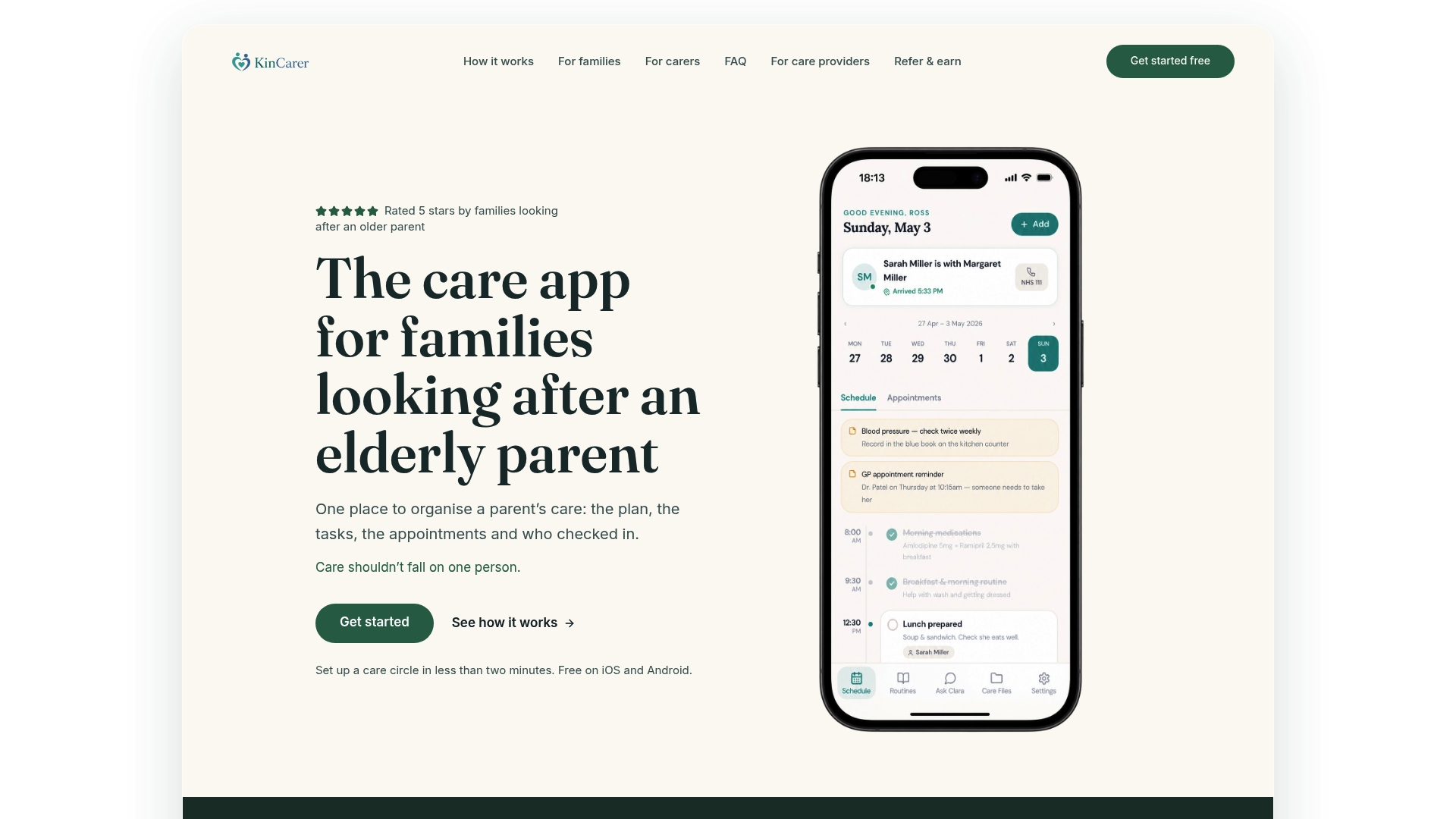
Inside a shared care circle, families get:
- A shared record everyone can see, so nothing depends on one person remembering to pass it on.
- Task assignment, so delegation becomes a scheduled entry rather than a vague request that fades.
- Appointment tracking and medication reminders, kept in one place instead of scattered across notebooks and phones.
- Some apps may offer an optional AI assistant that summarises what’s in the circle and flags missing actions, without offering medical or clinical advice.
If your family is juggling an elderly parent’s care between three phones, two notebooks, and a WhatsApp group nobody can search properly, it’s worth seeing what a shared care planning app looks like in practice. Start by inviting one other family member and setting up your first shared task; the rest of the system builds naturally from there.
Sources
Not every source deserves the same trust, and knowing the difference saves you from acting on advice that doesn’t fit your situation.
Prioritise sources tied to named organisations with a clear mandate: the NHS, established dementia charities, and carer support organisations. These groups publish guidance that’s been checked and updated, and they’re accountable if something is wrong. Be more cautious with forum posts, anecdotal social media threads, and unbranded advice pages, even when they sound confident. They may describe a real experience, but one family’s situation rarely maps cleanly onto another’s.
Check three things before you act on new information: who published it, when it was last updated, and whether it applies to your specific situation (type of dementia, stage of care, your relative’s other conditions). A leaflet written for early-stage dementia won’t necessarily apply once symptoms have progressed, and generic advice for “carers” broadly can miss details that matter for your particular circumstances.
When in doubt, a short call to a specialist helpline beats an hour of reading. A quick conversation with an Admiral Nurse or a query to your GP can confirm or correct something you’ve read far faster than working through several conflicting web pages trying to reconcile them yourself.
- Admiral Nurse Dementia Helpline - Dementia UK
- Looking after someone with dementia - NHS
- Identifying barriers to information needs of family caregivers to … - PMC
- Looking after someone - Carers UK (2026-27)
FAQ
What causes caregiving information overload?
The main causes are fragmented information across multiple services, standardised care packs delivered at fixed points rather than tailored to your stage, administrative duplication, and the guilt-driven urge to read everything available rather than what you actually need right now.
What are examples of caregiving information overload?
Common examples include receiving a stack of unrelated leaflets at diagnosis, being handed multiple discharge instructions after a hospital stay, and juggling conflicting advice from a GP, a charity website, and a family forum on the same issue.
How do you deal with caregiving information overload?
Build a one-page emergency summary, pick one trusted source such as the Admiral Nurse Dementia Helpline or your GP, and triage new information with a simple read, save, or discard rule rather than trying to absorb everything at once.
What are the symptoms of caregiving information overload?
Typical symptoms include decision fatigue, disrupted sleep, a growing admin backlog you can’t face, and a sense of being unable to act even on decisions you know you need to make.
Can a care app actually reduce information overload?
Yes, when it consolidates scattered messages, medication lists, and appointments into one shared record. Kincarer’s care circle and its optional Clara assistant are designed specifically to reduce the reading and re-checking that drives overload in the first place.
Keywords: caregiving information overload, caregiver stress management, overwhelmed by caregiving, information overload in caregiving, how to handle caregiver anxiety, navigating caregiving resources, tips for family carers, category:care-planning