12 September 2026
Secure a Named PDNS: Parkinson's Care Coordination for UK Families
Secure a named PDNS and a shared one page care plan to make Parkinson's care coordination work. Aligned with UK guidance, practical steps and simple...
Secure a Named PDNS: Parkinson’s Care Coordination for UK Families
The single move that makes Parkinson’s care coordination work is securing a named point of contact, usually a Parkinson’s Disease Nurse Specialist, and agreeing a written care plan everyone can see. From there, keep a simple log of symptoms and medication timing, share it with your care team, and use one accessible method, paper or app, for handovers between family and paid carers. Contact Parkinson’s UK or your local NHS service if that point of contact doesn’t exist yet.
TL;DR:
- Having a designated Parkinson’s Disease Nurse Specialist as a clear point of contact streamlines communication and reduces care coordination burdens.
- A shared, written care plan should outline medication schedules, symptom priorities, and emergency contacts, with regular reviews to stay current.
- Keeping a detailed symptom and medication log, and sharing it across the care team, improves safety and decision-making between appointments.
- Family-held summaries and digital tools help prevent information gaps during hospital admissions or transfers, ensuring medication safety.
- Structured family care apps can support ongoing coordination, task tracking, and handover processes, easing caregiver fatigue and enhancing consistency.
Table of Contents
- Who’s actually on a Parkinson’s care team?
- Why the PDNS is the hub, not just another appointment
- A step-by-step coordination checklist between appointments
- Records, communication and the tools that hold it together
- How shared family tools ease the handover strain
- The part of caring nobody warns you about
- Try a lighter way to keep everyone on the same page
- Where to find official guidance and support
- Sources
- FAQ
Who’s actually on a Parkinson’s care team?
Parkinson’s disease rarely stays within one specialism for long, which is exactly why coordination becomes the family’s job as much as the NHS’s. Knowing who does what stops you ringing the wrong department when symptoms shift.
The movement-disorder specialist or neurologist leads diagnosis and the bigger medication decisions, particularly when symptoms become harder to control or surgical options like deep brain stimulation come into view. The Parkinson’s Disease Nurse Specialist (PDNS) does the ongoing monitoring, adjusts medication timing between clinic visits, and is usually the person families ring first. Your GP handles routine prescriptions, general health monitoring and referrals into social care. Beyond that, the team widens as needs grow:
- Physiotherapy for balance, gait and a tailored exercise programme
- Occupational therapy for home adaptations, daily living aids and fall prevention
- Speech and language therapy for communication changes and swallowing difficulties
- Mental health support for depression, anxiety or cognitive changes, which affect a large share of people with Parkinson’s over time
- Dietetic, continence and palliative care specialists, brought in as specific symptoms demand
- Social care for practical support, respite and care assessments
Not every person needs every specialist at once. Parkinson’s UK is clear that successful coordination means moving beyond fragmented one-off appointments towards genuinely integrated, multidisciplinary management, where each professional knows what the others are doing.
Why the PDNS is the hub, not just another appointment
NICE guidance recommends every adult with Parkinson’s has a comprehensive care plan, agreed jointly by the person, their family carers and their clinicians, with regular review and an accessible point of contact. In practice, that point of contact is almost always the PDNS.
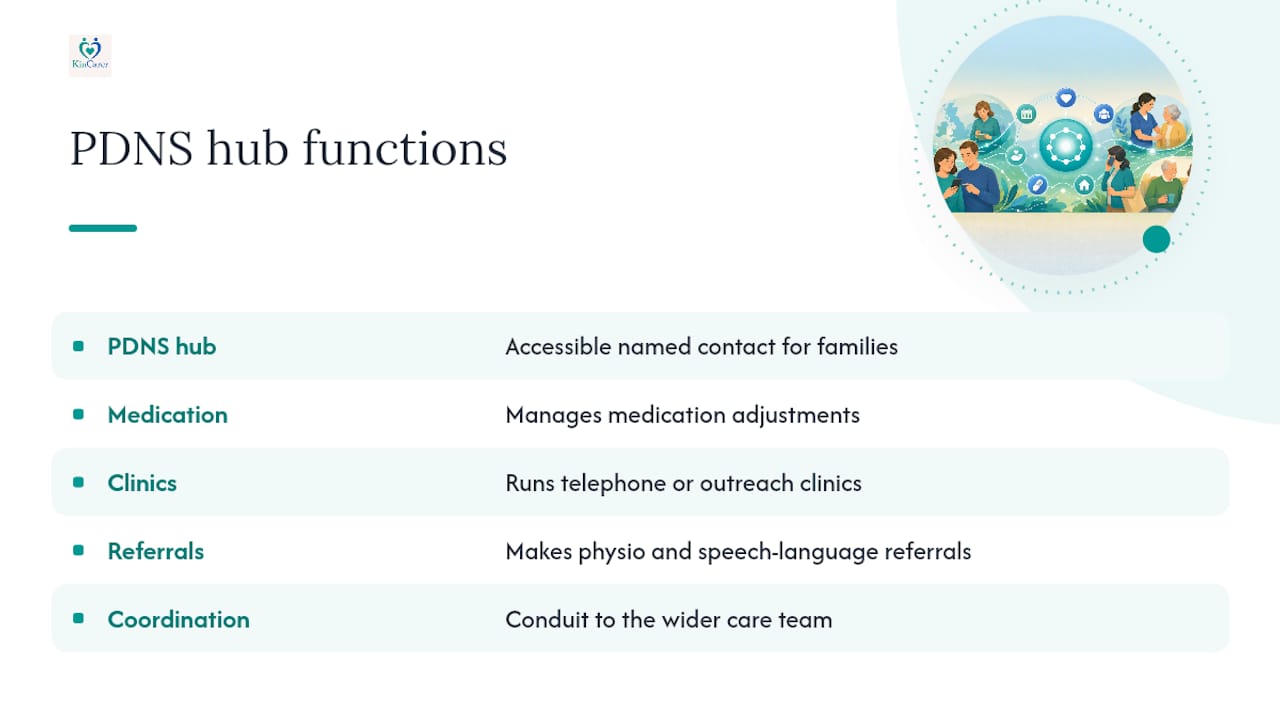
Parkinson’s nurses typically manage medication adjustments, run telephone or outreach clinics, make referrals into physiotherapy or speech and language services, and act as what Parkinson’s UK calls a conduit of care between the person, the family and the wider team. A qualitative study in BMC Nursing found this person-centred role genuinely reduces coordination burden and improves carers’ confidence, precisely because families stop having to chase five departments separately.
If there’s no PDNS locally, ask your GP or consultant for a referral to one, or ask whether the service has a Parkinson’s adviser instead. Where capacity is thin, nominate a single named clinician as your contact and ask about patient-initiated follow-up, so you can trigger a review when things change rather than waiting for the next scheduled slot.
Pro Tip: Bring a one-page medicine timing and symptom snapshot to every appointment, even a five-minute GP call. It turns a rushed consultation into a useful medication review instead of a repeat of last time’s conversation.
A step-by-step coordination checklist between appointments
Good coordination happens in the gaps between clinic visits, not just during them. Here’s a practical sequence to work through:
- Write the care plan down. Agree who does what, the current medication schedule, top symptom priorities and emergency contacts, then set a date to review it.
- Log symptoms and doses as they happen. Record date, time, medication taken, the symptom observed, its severity and how it affected daily life. A templated log for telehealth visits works on the same principle: structured, timestamped notes save clinicians time and sharpen decisions.
- Protect medication timing across settings. Hospital wards and care homes don’t always know Parkinson’s medication needs exact timing, not just the right dose. Keep a written copy of levodopa times ready to hand to admitting staff.
- Ask about patient-initiated follow-up. Some services let you trigger a review yourself when something changes, rather than waiting months for the next appointment.
- Loop in the PDNS and GP on every referral. Ask specialists to copy them into referral letters so nobody is working from a partial picture.
Two smaller habits make the whole system hold together:
- Request joint or MDT appointments when several issues overlap, rather than separate visits weeks apart.
- Keep one master copy of the care plan, updated after every significant appointment, not five slightly different versions on different phones.
NICE quality standard QS164 also expects carers to be included in conversations about medication risks, including impulse control issues linked to some Parkinson’s drugs, so don’t hesitate to ask directly what to watch for.
Records, communication and the tools that hold it together
Most NHS systems don’t talk to each other well. Parkinson’s UK notes that clinicians often can’t see notes from other departments, which is why a family-held summary matters so much.
A useful one-page care passport includes the diagnosis summary, current medications with exact timings, allergies, swallowing or mobility risks, and emergency contacts. A symptom diary works best when it’s timestamped and specific: what happened, what medication had been taken, what the observed effect was, and any objective measure you can attach, like a fall count or a walking distance.
A family-held one-page medication timing summary is one of the fastest ways to improve safety during a hospital admission and cut missed levodopa doses, according to NICE.
Digital tools bring real advantages here: everyone sees the same version, reminders reduce missed doses, and handovers leave an audit trail instead of vanishing into a text thread. The trade-off is that clinicians won’t treat an app as the official medical record, and any shared tool needs sensible privacy habits.
- Record who has consented to see what
- Share only the information a clinician or carer actually needs
- Remove sensitive documents promptly when a paid carer’s involvement ends
How shared family tools ease the handover strain
Where a PDNS has limited capacity, Parkinson’s UK notes that families often end up holding the organisational load themselves, and a structured shared record prevents information falling through the gaps between services.
This is exactly the gap a family coordination tool fills, without stepping anywhere near clinical decisions. In practical terms, that looks like:
- A shared care circle everyone in the family and any paid carers can see
- Appointment and medication reminders that don’t rely on one person’s memory
- Handover notes so nobody has to retell the same update three times
- An optional AI assistant that summarises what’s been logged, without giving medical or clinical advice
Start small: one shared summary, one weekly handover note, then expand once it earns its place. The tool organises information. Your clinicians’ own records remain the authoritative medical record, always.
The part of caring nobody warns you about
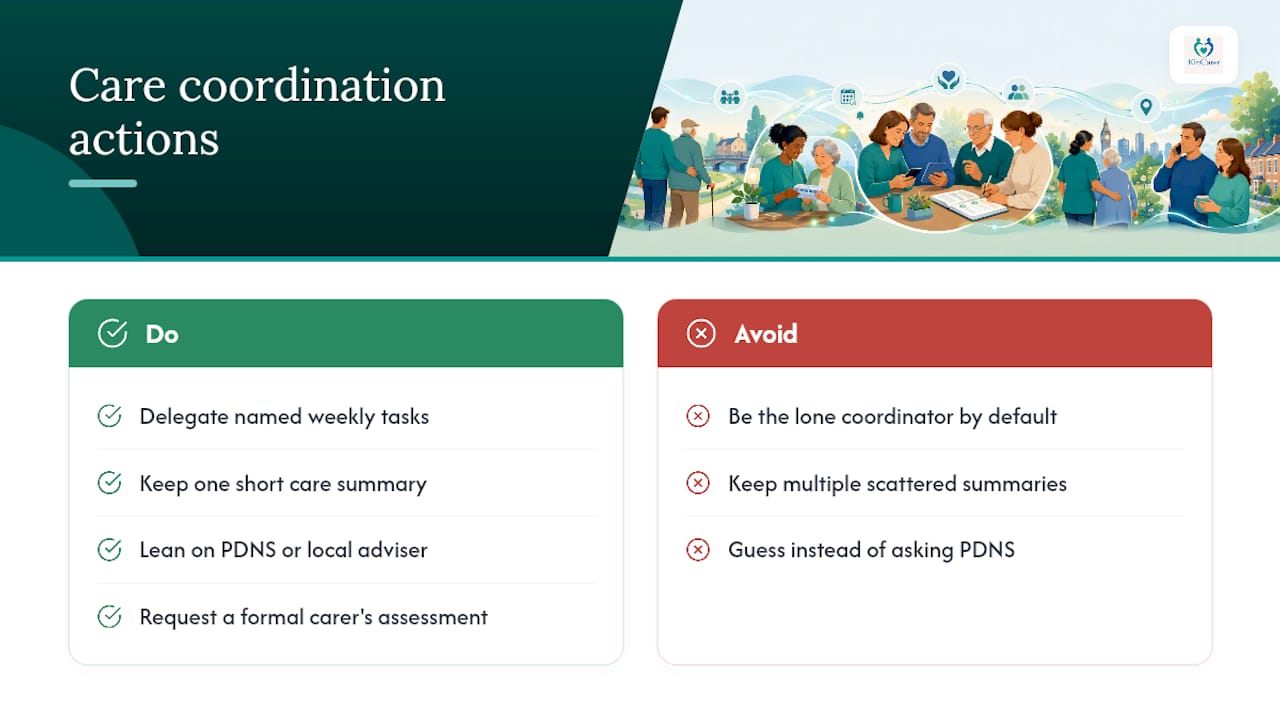
Coordination fatigue is real, and it usually lands on one person by default rather than by choice. Nobody sits a family down and says “you’ll be the one chasing referrals and remembering dosage changes at 11pm,” but that’s often how it ends up.
The way out isn’t heroics. It’s small, repeatable structure: delegate named weekly tasks so it’s not always you, keep one short care summary rather than five scattered ones, and lean on the PDNS or local Parkinson’s adviser rather than guessing alone. If you haven’t asked for a formal carer’s assessment yet, that’s worth doing sooner rather than later.
— KinCarer
Try a lighter way to keep everyone on the same page
There are other ways to hold this together, a shared spreadsheet, a family WhatsApp group, a notebook by the kettle, but they tend to break down exactly when things get busiest, which is when Parkinson’s coordination usually matters most. A family care coordination app gives families one shared care circle instead: tasks and appointments in one place, medication reminders that don’t depend on memory, and handover notes so nothing gets buried in fifty unread messages.
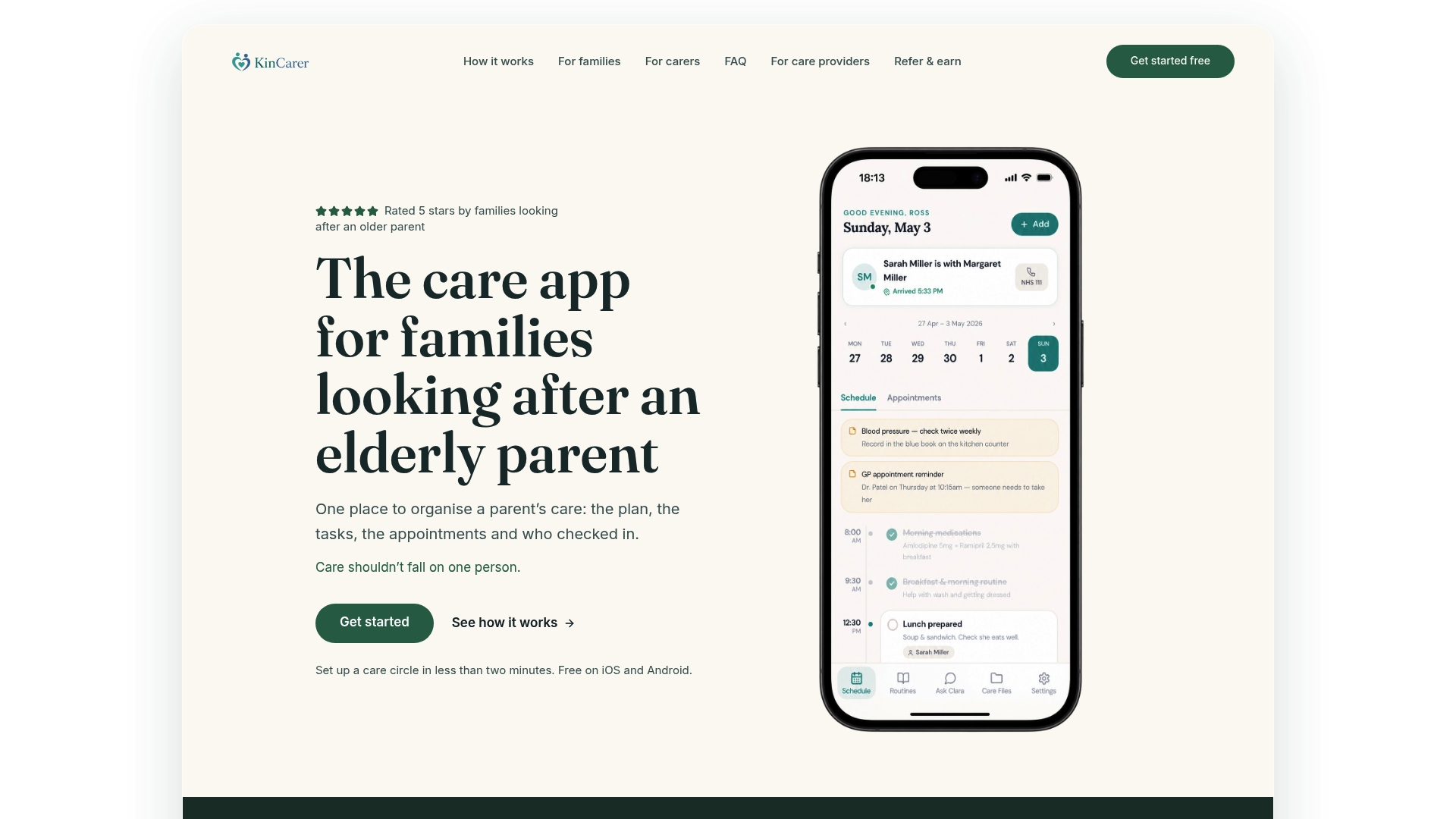
The core features are simple: a shared care circle for the whole family, task and appointment tracking, medication reminders, handover notes, and an optional assistant that summarises what’s logged and flags gaps, without ever giving clinical advice. Start on a free plan, invite relatives, and use it for a weekly handover note before expanding further. Keep clinicians’ own records as the medical source of truth, and go to the PDNS or GP for anything clinical. Explore the Kincarer family care app to see how it fits your situation, or look at Kincarer for care organisations if paid carers are part of the picture too.
Where to find official guidance and support
- NICE guidance on Parkinson’s care planning
- Parkinson’s UK: getting the right healthcare
- Parkinson’s UK: Parkinson’s nurses
- Gov
This article is general information, not a substitute for advice from a qualified doctor. Consult a qualified healthcare professional about your own circumstances before acting on anything here.
Sources
- Recommendations | Parkinson’s disease in adults | Guidance | NICE
- Getting the right healthcare | Parkinson’s UK
- Parkinson’s nurses | Parkinson’s UK
FAQ
What is the 5:2:1 rule for Parkinson’s?
There’s no single clinically recognised “5:2:1 rule” in official NICE or Parkinson’s UK guidance. If you’ve seen it referenced elsewhere, treat it cautiously and check symptom or exercise targets directly with your PDNS or physiotherapist.
How does Parkinson’s disease affect coordination?
Parkinson’s affects the brain’s movement pathways, which can disrupt balance, fine motor control and gait, making everyday tasks like buttoning a shirt or turning safely more difficult. Physiotherapy and occupational therapy input, arranged through your care team, are the main ways this is addressed.
Can I get a free TV licence if I have Parkinson’s?
Free TV licences in the UK are based on age and Pension Credit eligibility, not a specific diagnosis, so having Parkinson’s alone doesn’t qualify someone. Check current eligibility rules directly with TV Licensing or via Gov.
What are good coordination exercises for Parkinson’s?
Physiotherapists commonly prescribe balance and gait-focused exercise, sometimes alongside boxing-style or dance-based movement programmes, tailored to the individual’s stage and mobility. Ask your PDNS for a physiotherapy referral rather than starting an unsupervised programme, since exercises need to suit your specific balance and fall risk.
How do I start coordinating Parkinson’s care as a family?
Begin with a named point of contact, usually a PDNS, and a written care plan agreed with clinicians and family carers, as NICE recommends. A shared tool like Kincarer can then hold the day-to-day tasks, reminders and handover notes that keep everyone aligned between appointments.
Keywords: parkinsons care coordination, Parkinson’s disease support, care team for Parkinson’s, Parkinson’s treatment coordination, managing Parkinson’s care, coordinated Parkinson’s support, Parkinson’s caregiver guidance, how to coordinate Parkinson’s care, category:care-planning