One Page Handover Notes Examples Families Can Copy in Five Minutes
Handover note examples and a one page template with five headings families can copy in five minutes, plus how to write a handover note that gets read.
By The KinCarer team ·
A useful handover note has five short, dated headings: what was completed, what we noticed, a question or concern, a promise with a named owner and date, and the next check-in. Write the date, time and your initials at the top, name one clear next action with who owns it, and keep the whole thing brief. Always check what your elderly parent is comfortable sharing before it goes further than you.
TL;DR:
- Writing a handover note should only take a few minutes, focusing on five key parts: what was completed, observed, concerns, promises, and next steps.
- Every note must include the date, time, writer’s name, a specific next action with a named person, and attribution of observations to avoid diagnosing or vague instructions.
- For effective continuity, notes should be factual and specific, clearly assigning responsibilities and avoiding assumptions that someone else will follow up.
- Digital care tools like KinCarer can streamline updating and sharing notes, ensuring consistent, accessible information for all involved caregivers.
- Urgent issues such as falls or medication errors require immediate phone calls to healthcare professionals, not notes, which are only for routine updates and follow-up.
Table of Contents
- What do good handover notes examples actually look like?
- A copy-ready handover notes template you can print or paste
- How to write a handover note: dos and don’ts that save follow-up calls
- Who should see the note, and when do you escalate instead?
- KinCarer’s view on keeping handover notes current
- What the research gets right, and what it leaves out
- If you want a digital option: try KinCarer
- Sources
- FAQ
What do good handover notes examples actually look like?
Handover notes are short written updates passed from one person caring for someone to the next, so they know what happened, what changed and what still needs doing. Every strong handover note follows the same five-part shape, whether it is written on a scrap of paper by the kettle or typed into a shared document. Structured, contemporaneous notes with a date, time and carer name reduce the chance that something important gets missed between visits, and that principle applies just as much to family carers as it does to professional ones.
Here are three examples you can adapt straight away.
Routine day update
- 14 March, 3:40pm, written by Sarah (daughter)
- Completed: Mum had lunch (soup, most of it eaten), took her 1pm tablets, had a short walk to the postbox
- Noticed: seemed a bit more tired than usual, napped for 40 minutes after lunch
- Question: is the tiredness linked to the new blood pressure tablet, or just a quiet day?
- Promise: Sarah to ask the GP receptionist on Monday, 17 March
- Next check-in: Tom visiting Thursday evening
Post-appointment note
- 10 March, 11:15am, written by Priya (daughter-in-law)
- Completed: took Dad to the podiatrist, nails trimmed, no infection found
- Noticed: podiatrist mentioned his circulation looked “a little sluggish” but didn’t seem worried
- Question: should we mention this at his diabetes review next month, or ask sooner?
- Promise: Priya to call the diabetes nurse this week (by 13 March) to check
- Next check-in: update the family chat once she’s spoken to the nurse
Non-urgent concern
- 22 March, 7:05pm, written by James (son)
- Completed: evening visit, helped with dinner and medication
- Noticed: Mum mentioned her left knee has been “aching more than usual” for about three days
- Question: is this worth mentioning to the physio at her next session?
- Promise: James to note it in the file for the physio appointment on 28 March
- Next check-in: whoever visits Sunday to ask how the knee is doing
Each example gives a time, a name, one observation worth flagging and exactly one next step. That’s the whole job of a handover note. It doesn’t need to explain the day, defend a decision, or read like a diary entry.
A copy-ready handover notes template you can print or paste
A one-page handover note sample only needs five fields, each with a one-line example so you know what “done” looks like. Printable one-page handoff notes with prompts for date, time, mood and a clear next step can genuinely be filled in under five minutes, which is the whole point.
- Date, time, written by — e.g. “16 March, 6:20pm, written by Anna”
- What was completed — e.g. “Breakfast, morning tablets, GP call about repeat prescription”
- What we noticed — e.g. “A bit more breathless than usual walking to the bathroom”
- Question or concern — e.g. “Is the breathlessness worth mentioning before the next check-up?”
- Promise and next check-in — e.g. “Anna to call the surgery Tuesday; Dan checking in Wednesday evening”
Use this format every time someone visits, calls, or takes over a caring task, even if nothing much happened. A blank “Completed: nothing new, all as usual” note is still worth writing, because it confirms someone checked in.
Keep the template somewhere it will actually get used. A printed copy on the fridge works if one person visits most days. A shared document or note in a family chat works better once two or more people rotate visits. Whatever you choose, the format matters more than the tool.
How to write a handover note: dos and don’ts that save follow-up calls
Getting the format right the first time saves everyone a string of “wait, what happened?” messages later. A handover update format works best when it’s factual and specific rather than interpreted.
Do:
- Write the date and time as soon as you write the note, not from memory later
- Name yourself as the writer, every time, even in a small family
- Assign the next action to one named person with a date, not “someone should”
- Record what was said or observed, attributed to whoever said it (“GP said…”, “Mum said her knee hurt”)
Don’t:
- Turn an observation into a diagnosis in the note itself (“she’s dehydrated” instead of “drank less than usual, seemed thirsty”)
- Leave a concern sitting in a note with no owner and no date attached
- Use the family note as a substitute for calling emergency services or the GP when something needs urgent attention. Family handover notes shouldn’t be used to diagnose or treat; route anything urgent through the right professional channel instead
Pro Tip: Before you send a note, read it back and ask: “Does this tell the next person exactly what to do, and by when?” If the answer is no, add one line rather than leaving it vague.
Who should see the note, and when do you escalate instead?
Ask your parent, early on, who they’re comfortable having read these updates, and revisit that agreement if a new sibling or paid carer joins the rota. Access settings on a shared record need reviewing regularly so privacy stays appropriate as the caring circle changes.
Where you store notes depends on how many people are involved:
- Paper note — simple, private, but only useful if one person visits most days and physically sees it
- Shared document — works for a few family members, though it can get messy without a consistent format
- Group chat — fast, but updates get buried and it’s hard to find “what happened last Tuesday”
- Care app — built for shared access with more control over who sees what
Skip the note entirely and call 999, or your parent’s GP or district nurse directly, for anything urgent: a fall, sudden confusion, chest pain, or a medication error. A handover note is for continuity, not for emergencies.
KinCarer’s view on keeping handover notes current
A handover note only works if it survives contact with real life: busy evenings, forgotten passwords, someone assuming somebody else already wrote it. That’s the gap a shared care circle is built to close. KinCarer lets family members and paid carers sit in the same care circle, so a handover note isn’t buried in one person’s phone; everyone invited can see what was done, what’s outstanding, and who owns the next step.
An optional AI assistant can search and summarise notes already in the circle so you’re not scrolling back through weeks of updates. Such assistants don’t give medical, legal or clinical advice; anything genuinely worrying still goes to a GP or district nurse, not to an app.
Whichever method you choose, pick the simplest one your family will actually keep using every time.
What the research gets right, and what it leaves out
Most guidance on handover notes focuses on format, and rightly so. Structure prevents the vague, anxious messages that clog up family group chats (“is Mum ok??”). But format alone doesn’t solve the harder problem: getting everyone to actually write the note, every time, even on the boring days.
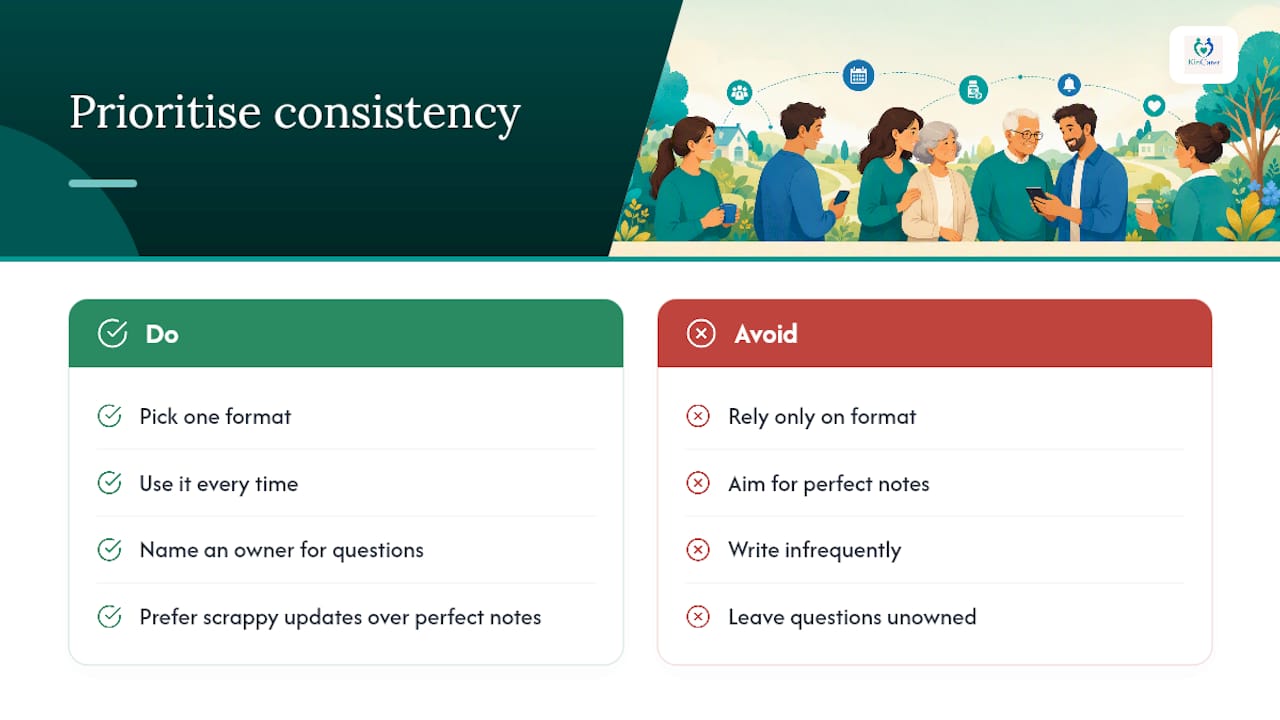
The conventional advice undersells consistency. A beautifully structured note written once a fortnight is less useful than a scrappy three-line update written every visit. Perfection is the enemy here, not brevity.
Prioritise this: pick one format, use it every single time, and name an owner for every open question. That habit matters more than any template’s design. Families who skip formal handover notes entirely often aren’t lazy, they’re just juggling too many channels to keep one going. A shared care app helps because it puts the format in one place everyone already checks, rather than relying on memory or a document nobody opens.
— KinCarer
If you want a digital option: try KinCarer
Kincarer is the alternative to juggling paper notes, group chats and forgotten documents. It puts every handover update, task, appointment and medication reminder in one shared care circle, so nothing depends on one person remembering to pass it on.
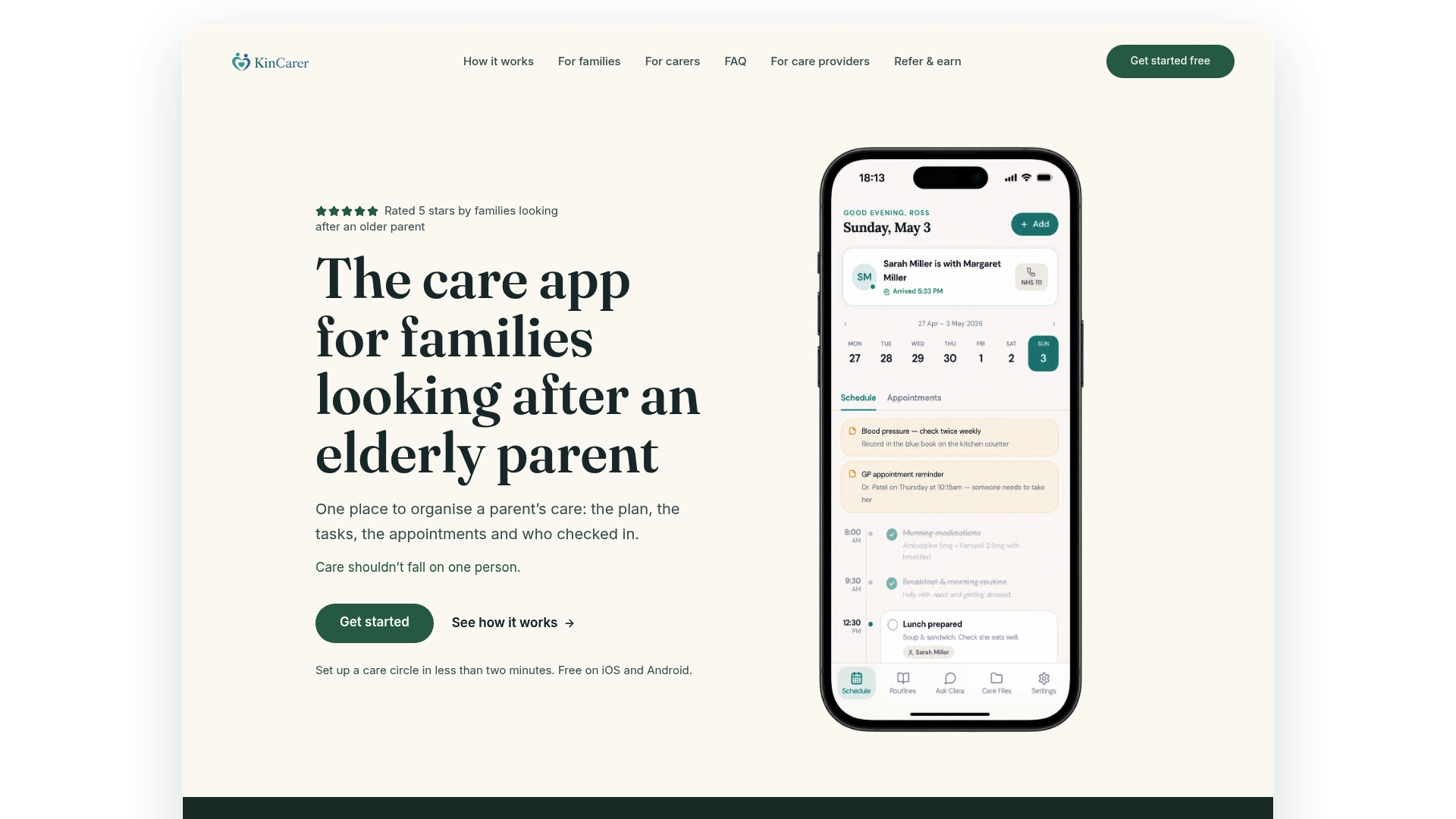
Getting started takes a few minutes. Try KinCarer free for 14 days, invite one relative or your parent’s home care agency to the circle, recreate the five-heading template above as a note, and run your first handover this week. If your family is coordinating with a paid care provider alongside relatives, the Family+ option is built for that mixed setup. Either way, the goal is the same: one note, one place, everyone sees it.
Sources
- Family Care Visit Handoff Note for Older Adults
- Caregiver handoff notes printable guide
- How to write daily care notes: examples, standards, and what auditors look for | Birdie Blog
FAQ
What should a handover note always include?
A good handover note always includes the date and time, who wrote it, what was completed, anything noticed that’s worth flagging, and one clear next action with a named owner. This five-part shape, drawn from family handoff note guidance, keeps notes short and genuinely useful.
How long should a handover note take to write?
A well-structured handover note should take under five minutes to write, since it only needs a handful of short lines rather than a full account of the visit. Printable one-page templates are designed specifically around that speed.
Should I ask my parent before sharing handover notes?
Yes. Ask your elderly parent what they’re comfortable having recorded and who should see it, and revisit that agreement whenever a new relative or paid carer joins the rota. This matters even more once notes move onto a shared document or app that more people can access.
What’s the difference between a handover note and a care app like KinCarer?
A handover note is the content: five short headings capturing what happened and what’s next. KinCarer is a shared place to store and access those notes alongside tasks, appointments and medication reminders, so the whole family sees the same information without hunting through separate messages.
When should I escalate instead of writing a note?
Skip the note and call for help immediately if there’s a fall, sudden confusion, chest pain, or a medication error, contacting 999 or your parent’s GP or district nurse rather than waiting for the next handover. Handover notes are for continuity, not for urgent or clinical concerns, which need a professional straight away.