9 September 2026
Make Handovers Fail Safe: Care Notes Template for UK Family Carers
Copy a one page care notes template, see six before and after examples, follow CQC and PRSB guidance, and try KinCarer for shared records.
Make Handovers Fail Safe: Care Notes Template for UK Family Carers
A short structured template beats a blank page every time: date and time, who was there, what you observed, what you did, the outcome, and who needs to know. Below you’ll find that exact template in printable and digital form, six before-and-after examples, and the standards inspectors and family carers both rely on to judge whether a note is good enough.
TL;DR:
- Precise timing, factual observations, and complete documentation are essential to ensure clarity, continuity, and effective handovers in care notes.
- Using a standardized template with fields for date, observer, action, outcome, and follow-up minimizes errors and reduces gaps in care communication.
- Digital record systems with shared access can improve legibility and real-time updates, especially when involving multiple family members and care providers.
- Recording details like who was informed and the exact times of actions helps build legal and safeguarding evidence while supporting compliance with standards.
- Consistently applying a clear, structured approach across a care circle simplifies handovers, detects changes early, and lowers family stress during the caregiving process.
Table of Contents
- What are care notes, and why do they matter?
- Three rules that instantly improve your notes
- The care notes template you can copy today
- Six real examples: bad notes rewritten properly
- How care notes support compliance and which standards to follow
- Paper or digital records: which suits your family?
- A one-page checklist to run through before you finish any entry
- Why standardising notes across a family care circle actually reduces stress
- How Kincarer helps you keep one consistent care record
- Sources
- FAQ
What are care notes, and why do they matter?
Care notes are the brief-written record of what happened during a visit or shift: what you saw, what you did about it, and what happened next. For an ageing parent living at home, they’re often the only thread connecting a Tuesday morning carer, a Thursday evening family visit, and a GP appointment three weeks later.
Good notes serve three groups at once. Family carers use them to spot patterns, like whether mum’s appetite has quietly dropped over a fortnight. Paid carers use them to hand over safely between shifts. Health professionals use them as evidence when something changes and a decision needs explaining.
Done well, care notes deliver three things immediately:
- Continuity — the next person to visit knows exactly where things stand, without ringing round for an update.
- Early warning — small changes get written down before they become emergencies.
- Evidence — if a GP, social worker, or safeguarding team ever asks “what happened”, you have a contemporaneous answer, not a guess reconstructed from memory.
Three rules that instantly improve your notes
Most poor care notes fail for the same three reasons: they’re vague about timing, they blur fact with opinion, and they either say too little or ramble. Fix those three things and your notes become genuinely useful.
- Be specific about time, place and context. “This morning” is weaker than “8.15am, kitchen, after breakfast.” Precise timing matters because it lets anyone reading the note later work out what changed and when.
- Record what you observed, not what you assume. Write “Mum said her hip hurt when standing” rather than “Mum seems to be in pain again.” The first is a fact you can defend; the second is your interpretation, and interpretations get challenged.
- Be concise but complete. Every entry should cover the action taken, the outcome, and who was told. Three short sentences that cover all three beat one long paragraph that covers none properly, an approach CPD Online’s guidance on carer record keeping backs consistently.
Pro Tip: If you’re ever unsure whether a line belongs in the note, ask yourself: “Could someone who wasn’t there understand exactly what happened from this sentence alone?” If not, add the missing detail.
The care notes template you can copy today
This is the field structure worth building every entry around, whether you’re filling in a paper diary or typing into an app.
- Date and time — the exact moment of the observation or action, not “later that day.”
- Carer name — who was present, so anyone reading later knows who to ask.
- Visit length or shift — short check-in, full visit, or overnight stay.
- Observation — what you actually saw, heard, or were told, in plain factual language.
- Action taken — what you did in response, even if that was simply “monitored.”
- Outcome — what happened as a result, however small.
- Escalation or follow-up — who else needs to know, and by when.
- Signature or initials — who is accountable for the entry.
| Field | What to write | Example |
|---|---|---|
| Date/time | Exact time, not a vague slot | “14 Feb, morning” |
| Carer name | First name plus initial | “Sarah T.” |
| Observation | Fact, not interpretation | “Left slightly swollen, warm to touch” |
| Action | What you did | “Elevated leg, checked again after 20 mins” |
| Outcome | Result of the action | “Swelling unchanged, no pain reported” |
| Follow-up | Who was told, and when | “District nurse informed by phone, 8.05am” |
For a two-minute check-in, you can drop the visit length field and keep the rest. For a full visit or a handover between family and a paid carer, use every field, because that’s exactly when gaps cause confusion. Printable versions work fine for carers who prefer paper, as long as someone transcribes anything urgent into a shared record quickly, a point [Birdie’s guidance on daily care notes](https://www.birdie.care/blog/daily-care-notes-examples) makes when discussing why templates reduce missed information.
Six real examples: bad notes rewritten properly
Seeing a weak entry next to its fix teaches you more than any rule list. Here are three common ones.
- Personal care. Bad: “Helped with washing, seemed fine.” Improved: “9.10am, assisted with washing and dressing. No skin redness observed. Mum said she felt ‘a bit tired but okay.’”
- Meals and fluids. Bad: “Ate a bit of lunch.” Improved: “12.30pm, ate half a sandwich and a yoghurt. Drank one cup of tea. Left most of the soup, said it was ‘too hot.’”
- Fall or near-miss. Bad: “Nearly fell, caught her in time.” Improved: “3.45pm, mum lost balance reaching for the kettle. Steadied by carer before contact with floor. No injury reported. GP surgery informed same day.”
The difference between these pairs isn’t length. It’s that the improved version answers questions nobody has asked yet: how much did she actually eat, was anyone told, is there an injury. A note that survives a follow-up question is a note doing its job.
The same logic applies to a mood change (“appeared withdrawn” versus “declined to join family call, said she ‘didn’t feel like talking,’ checked again at 6pm, no change”) and a medication refusal (“wouldn’t take tablets” versus “9am, refused morning tablets twice, said she felt nauseous, GP surgery called at 9.20am for advice”). Each rewrite adds the missing time, the missing fact, and the missing follow-up.
How care notes support compliance and which standards to follow
Care providers registered with the Care Quality Commission must keep accurate, complete, and contemporaneous records under CQC Regulation 17, which means writing the entry at the time, or as close to it as possible, rather than reconstructing it days later from memory. Family carers aren’t regulated in the same way, but writing to that standard protects everyone if a dispute or safeguarding question ever arises.
Two other frameworks shape what good notes look like in practice:
- The PRSB’s “About me” standard recommends including a person’s preferences, strengths, and goals, not just their tasks and problems, so care stays person-centred.
- SCIE’s recording guidance recommends co-producing records with the person and family where possible, which builds trust and catches misunderstandings early.
On sharing records, consent and any Lasting Power of Attorney arrangement affect who can access notes, something NHS Digital’s guidance on sharing information with unpaid carers sets out clearly, and it’s worth checking before assuming every family member should see everything.
Paper or digital records: which suits your family?
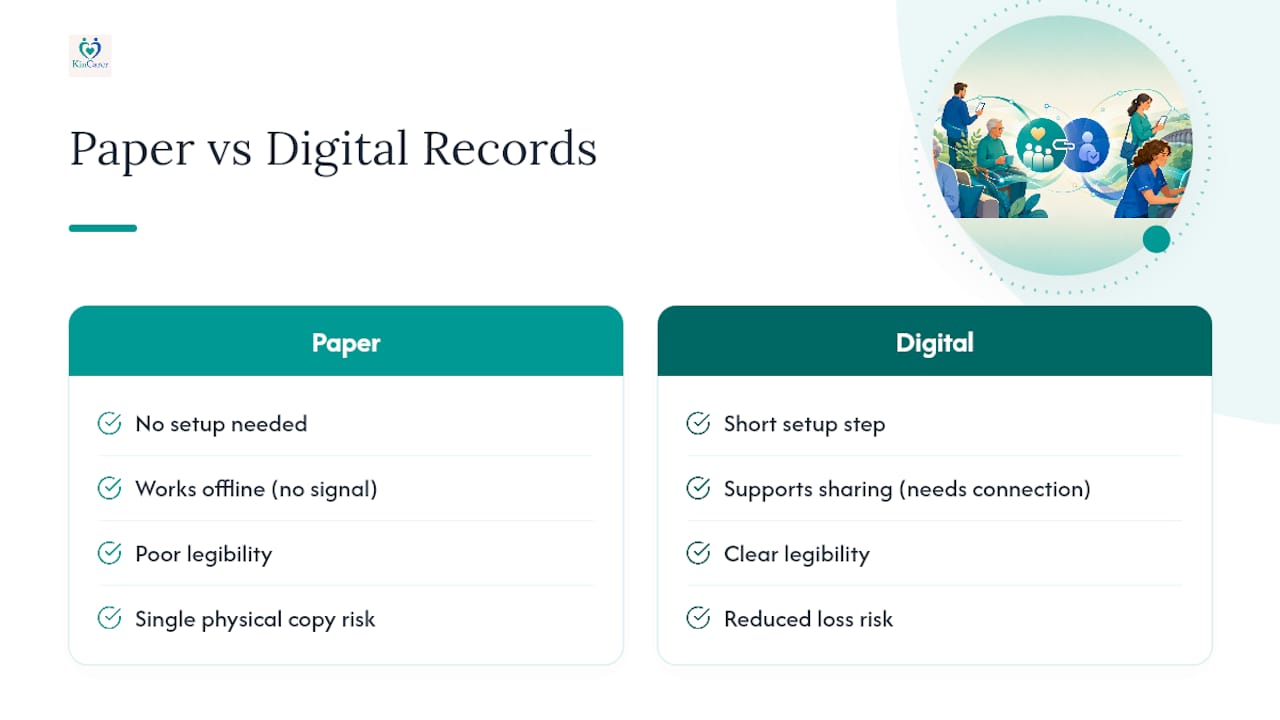
Paper notebooks are cheap, need no setup, and work when you’re offline in a spare room with no signal. Their weakness is legibility, and a single physical copy that gets left at a relative’s house or lost in a bag is a genuine risk for continuity.
Digital records solve the legibility and loss problem, and CQC guidance on digital record systems favours them for security and real-time sharing between family and paid carers. The trade-off is a short setup step and a genuine need to think about who sees what.
This is where a shared family app earns its place. A suitable app lets everyone in a care circle, adult children, siblings, and any paid home care agency staff, see the same notes, reminders, and handover updates instead of hunting through a WhatsApp thread. An optional AI assistant can summarise recent entries so nobody has to scroll back through a week of updates to catch up.
Pro Tip: If your family is split between a paper diary at mum’s house and messages on three different phones, that’s the exact gap a shared digital record closes; pick one, not both, or updates will keep going missing.
A one-page checklist to run through before you finish any entry
Run through this before closing any note, on paper or in an app.
- Date and time recorded exactly, not as a vague slot.
- Your name or initials included.
- What you observed, written as fact, not opinion.
- Action you took, even if it was just checking again later.
- Outcome noted, however minor.
- Follow-up person named, if anyone needed telling at the time
- Signature or initials at the end for accountability.
If you need to correct an entry, never delete it. Draw a single line through the mistake, write the correction beside it, then sign and date the correction, exactly as you would for the original entry.
Why standardising notes across a family care circle actually reduces stress
Families who agree on one simple template, rather than everyone improvising their own shorthand, catch changes earlier and hand over more cleanly between visits. Fewer tasks get missed because nobody’s guessing what “seemed a bit off” meant three days ago. Adapt the fields above to your own routine, but keep the structure consistent.
— KinCarer
How Kincarer helps you keep one consistent care record
A suitable app gives your family the one place a scattered notebook and a buried WhatsApp thread can’t: a shared care circle where every note, medication reminder, appointment, and handover update sits in the same timeline, visible to everyone who needs it, whether that’s your sibling in another city or the home care agency carer who visits on Wednesdays.
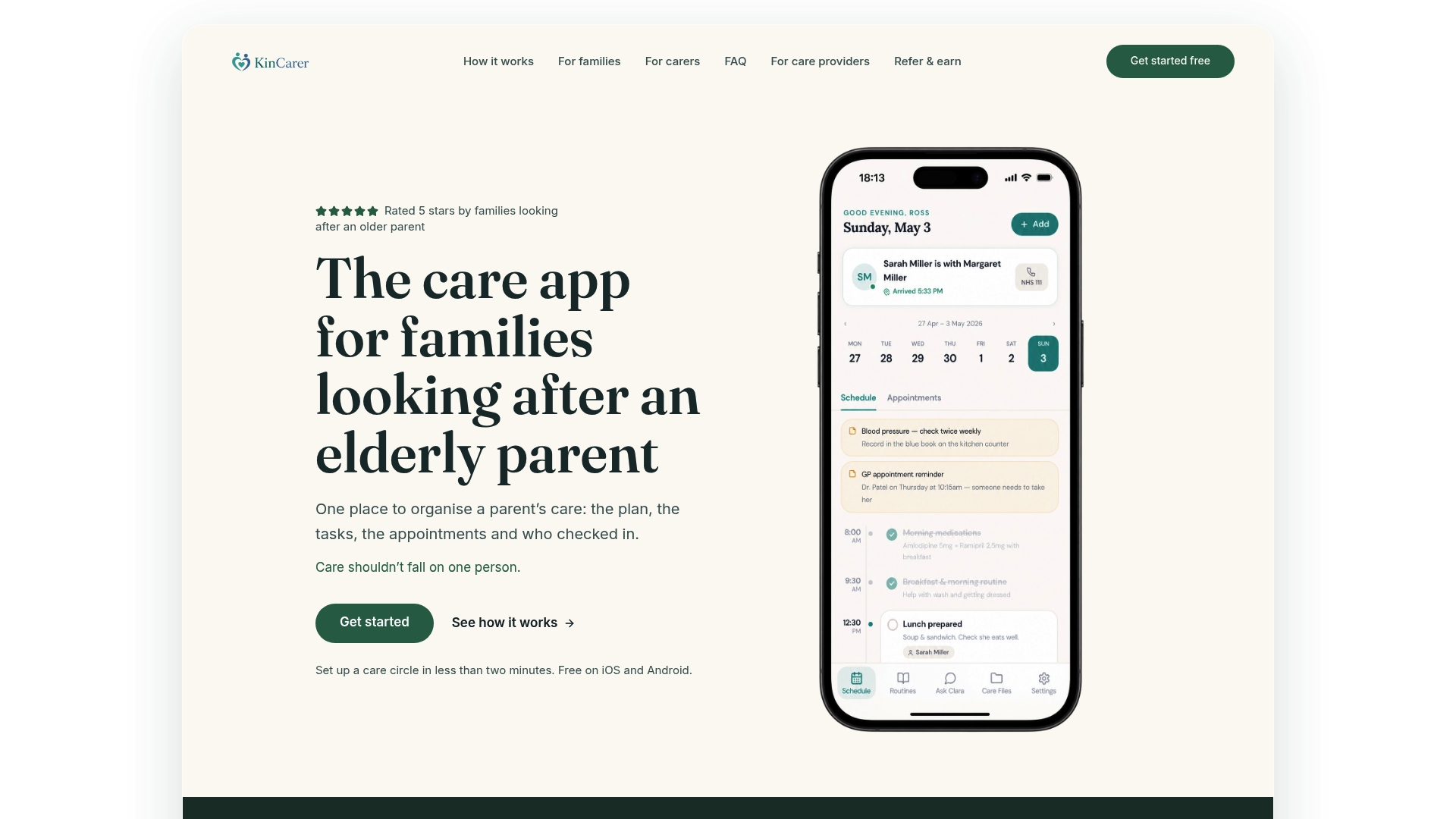
You can add tasks, log a quick observation after a visit, or ask Clara, the optional AI assistant, to summarise what’s changed over the past week without scrolling back through days of entries. Clara doesn’t give medical, legal, or clinical advice; it simply helps you find and understand what your family circle has already recorded. Start with the free family plan on the KinCarer app to see whether a shared record fits how your family already communicates, or look at KinCarer’s options for care organisations if you’re coordinating alongside a paid home care agency.
Sources
For deeper reading beyond this template, the PRSB’s “About me” standard explains person-centred recording, CQC’s Regulation 17 page sets out the legal record-keeping duty, and SCIE’s recording guidance covers co-production in practice. Families dealing with benefit claims alongside caring duties may also find Ask Rose’s guide to DWP carer claims useful for understanding LPA and consent implications.
- PRSB: About me
- SCIE: Social care recording
- NHS Digital: Sharing information with unpaid carers
- CPD Online: Effective carer record keeping
FAQ
How do you write a good care note?
Record the date and time, what you observed as fact rather than opinion, the action you took, the outcome, and who else was informed, following the structure set out in the template above.
Can you give an example of a caregiver’s note?
A strong example reads: “9.10am, assisted with washing and dressing. No skin redness observed. Mum said she felt ‘a bit tired but okay.’” It’s specific, factual, and complete.
How do you write a care plan note?
A care plan note should reference the person’s preferences and goals alongside the task, in line with the PRSB’s “About me” standard, rather than logging tasks in isolation.
How do carers write daily notes in practice?
Most carers use a short template covering time, observation, action, outcome, and follow-up, filled in either on paper or through a shared digital record such as Kincarer, so the same information reaches everyone who needs it.
What’s the difference between paper and digital care notes?
Paper needs no setup and works offline, but risks illegibility and loss; digital records are searchable, time-stamped, and shareable in real time, which CQC guidance favours for accuracy and security.
Keywords: care notes template, care notes examples, care plan template, patient notes template, daily care notes, nursing care documentation, how to write care notes, care record template, category:care-planning