Shared medication schedule: Template and UK checklist for 5+ meds
Get a copy ready shared medication schedule plus a UK checklist of multi-user digital features, consent and safety steps, and quick setup tips.
By The KinCarer team ·
A shared medication schedule works because it puts everyone caring for the same person in front of the same information at the same time. It synchronises reminders and dosing records so nobody doubles up a dose, misses one, or turns up at a GP appointment without the full picture. Families juggling complex polypharmacy, or coordinating care across siblings who live hours apart, tend to see the biggest difference. The rest of this guide gives you a copy-ready template and a checklist for setting one up properly.
TL;DR:
- Families with complex medication regimens or multiple caregivers should use an accurate, shared schedule to prevent missed or duplicate doses and improve coordination.
- Building the schedule involves a formal medicines review, clear role assignment, selecting an accessible tool, and tracking PRN doses and missed doses carefully.
- Digital tools with multi-user access, timestamped logs, exportable reports, and privacy controls enhance adherence and reduce caregiver anxiety.
- A current printable or digital medication list should be linked to emergency plans, hospital information, and legal considerations like capacity and consent.
- Managing polypharmacy safely requires regular reviews and a comprehensive, shared record to prevent drug interactions and ensure proper care.
Table of Contents
- What is a shared medication schedule and who needs one?
- A copy-ready shared medication schedule template
- How do you set up a shared medication schedule?
- Which digital features actually matter for shared schedules?
- Roles, consent and safety: what you’re legally expected to record
- Quick, evidence-based tactics to cut errors and carer burden
- Connecting the schedule to your emergency care plan
- Why a shared schedule changes how families actually cope
- How KinCarer supports your family’s shared medication schedule
- Sources
- FAQ
What is a shared medication schedule and who needs one?
A shared medication schedule is a single, agreed record of what someone takes, when, and who’s responsible for giving it and logging it. It replaces the scattered mix of a paper diary on the fridge, a WhatsApp group, and whatever the last carer remembers from Tuesday. The formal term for the paper or digital version of this record is a home medication administration record, sometimes shortened to MAR chart, and you’ll see it used in professional care settings as well as family ones.
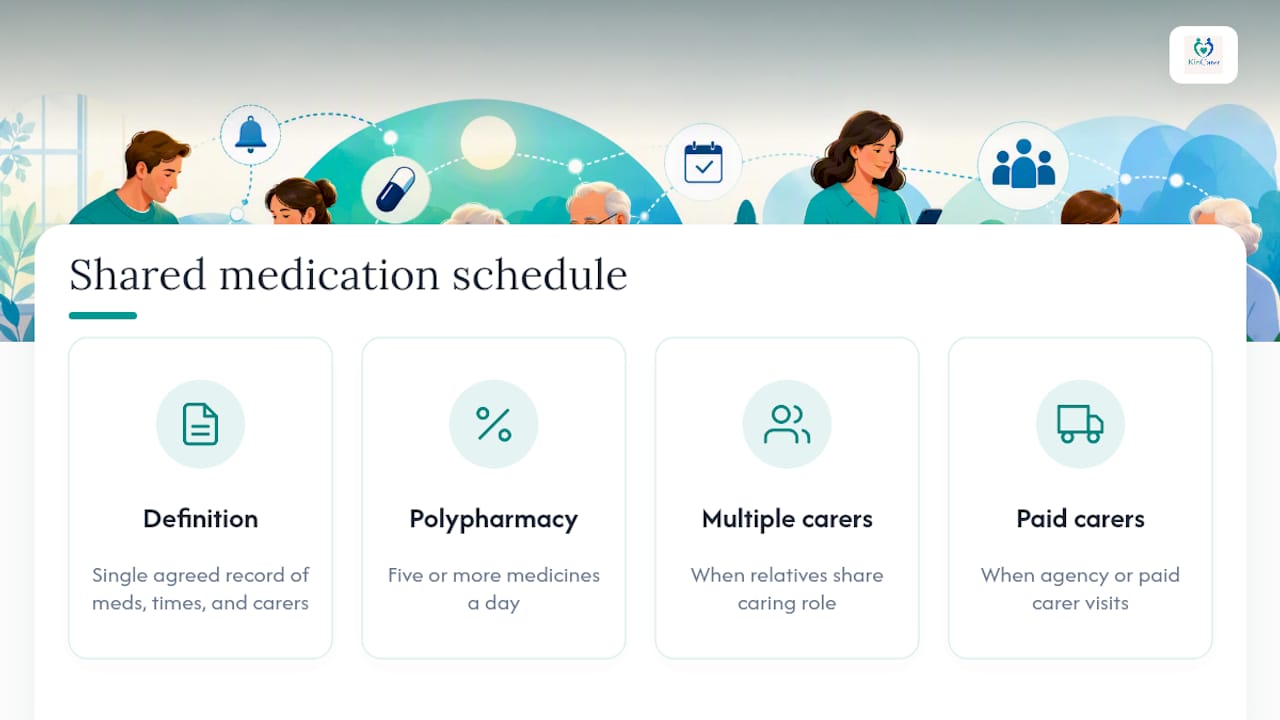
Not every family needs one straight away. But a few situations make it close to essential: when your parent takes five or more medicines a day (known clinically as polypharmacy), when more than one relative shares the caring role, or when a home care agency or paid carer visits alongside family members. Informal carers already carry out both the physical tasks, preparing and giving medicines, and the cognitive load of monitoring and reordering them, often without proper tools to do it safely. A shared schedule is the tool that closes that gap.
A copy-ready shared medication schedule template
You don’t need to design this from scratch. Build a master list with these fields, then transfer it into whichever app, spreadsheet, or printed chart your family uses:
- Medicine name (brand and generic, so nobody gets confused at the pharmacy counter)
- Indication (what it’s for, so a new carer understands the purpose, not just the pill)
- Dose and timing (exact amount and time of day)
- Formulation (tablet, liquid, patch, inhaler)
- Special instructions (with food, avoid alcohol, crush if needed)
- Prescriber name
- Dispensing pharmacy
- Date of last medicines review
Each field earns its place. The indication field stops a well-meaning relative stopping a “pointless-looking” tablet that’s actually managing blood pressure. The last review date flags when it’s time to ask the GP whether ten medicines are still all necessary. Consider a straightforward case: one blood pressure tablet each morning, logged in seconds. Then consider a more complex one: four medicines timed around meals, one PRN painkiller, and a weekly injection, where the same fields prevent the timing details getting lost between carers.
How do you set up a shared medication schedule?
Building the schedule properly the first time saves you from unpicking mistakes later. Work through it in order:
- Book a medicines review with the GP or a pharmacist first. This gives you an accurate, prescriber-approved master list rather than one pieced together from old boxes in a drawer.
- Agree roles in writing. Decide who prepares doses, who actually administers them, and who logs that it’s been done. These can be three different people, and writing it down avoids the assumption that “someone else did it.”
- Choose your tool and set permissions. Whether it’s an app, a shared document, or a printed chart on the wall, decide who can edit the master list and who only needs to view it.
- Migrate the master list in, then set daily reminders and a review cadence, ideally after any hospital stay and at least quarterly otherwise.
- Plan for PRN doses and missed doses. Write down the maximum frequency for “as needed” medicines and exactly who gets called if a dose is missed or a dose looks like it’s been given twice.
Pro Tip: Run a full medication reconciliation the moment your parent comes home from hospital, and mark that date clearly on the master list. Post-discharge is when doses get duplicated, discontinued medicines get restarted by accident, and new prescriptions go unrecorded.
NHS guidance for carers recommends pairing this process with a monitored dosage system, sometimes called a Dosette box, when a regimen is complex enough to benefit from pre-sorted trays.
Which digital features actually matter for shared schedules?
Plenty of medication management apps promise convenience. Fewer actually solve the coordination problem families face day to day. Focus on features that change behaviour, not ones that just look good on an app store listing:
- Multi-user access with role-based permissions, so a paid carer can log a dose without being able to alter the prescriber’s instructions.
- Timestamped adherence logs, not just a tick box. Knowing a dose was confirmed at 8:14am beats a vague reminder that “it’s done.”
- Exportable, printable reports you can hand to a GP or bring to a medication review without retyping anything.
- Consent-aware sharing controls, so each family member or paid carer sees only what they need to.
- Refill and appointment reminders, plus a version history showing when and why the schedule changed.
Design research on carer-facing tools backs this up directly: carers respond better to tools that give visibility, two-way confirmation, and clear privacy settings than to a basic one-way alarm. A reminder that nobody confirms is just noise. A logged, visible confirmation is what actually reduces the anxious “did Mum take her tablets?” phone calls between siblings. That anxiety is well documented: systematic evidence shows multi-user digital tools with shared visibility can meaningfully reduce carer anxiety and improve adherence, precisely because everyone stops guessing and starts checking the same record.
Roles, consent and safety: what you’re legally expected to record
NICE guidance NG67 sets out clear expectations here: accurate, accessible medicines records, defined processes for sharing information between health and social care teams and family carers, and documented responsibilities within the care plan. That’s not bureaucracy for its own sake. It’s the difference between a carer knowing what they’re accountable for and guessing.
Consent has real limits. A family member can support decisions, but only someone with Lasting Power of Attorney for health and welfare can make medical decisions once your parent lacks the mental capacity to do so themselves. Covert administration, hiding medicine in food or drink, is a regulated, last-resort step. NICE is explicit that it requires a formal capacity assessment, documentation, and legal advice before it’s ever considered, never a quiet decision made at the kitchen table. Keep a printed copy of the master list ready for every appointment and formal medicines review, regardless of which digital tool you use day to day.
Quick, evidence-based tactics to cut errors and carer burden
A few habits do most of the heavy lifting. Keep one authoritative list, visible to the whole care circle, rather than several versions floating around on different phones. Pair dosing times with existing routines, breakfast, bedtime, so doses attach to habits your parent already has, and use a monitored dosage system where a pharmacist recommends one.
Agree a missed-dose protocol before you need it: who calls the GP, who calls the pharmacy, and at what point a missed dose becomes urgent rather than routine.
Pro Tip: Photograph the label every time a prescription changes and attach the image to the medication record. It takes ten seconds and stops mix-ups between similar-looking boxes, especially when a generic brand switches packaging between refills.
Reviews of dispenser devices and digital tools show they can improve adherence and ease carer burden in many cases, though the evidence quality varies and long-term effects aren’t fully settled. Matching the tool to the person’s abilities matters more than the tool itself.
Connecting the schedule to your emergency care plan
A shared medication schedule only earns its keep in a crisis if it’s connected to the plan a paramedic, out-of-hours GP, or A&E team will actually see. Keep an up-to-date, printable version of the master list alongside your emergency contact details, allergies, and any advance care wishes, and make sure at least one family member knows exactly where to find it at 3am.
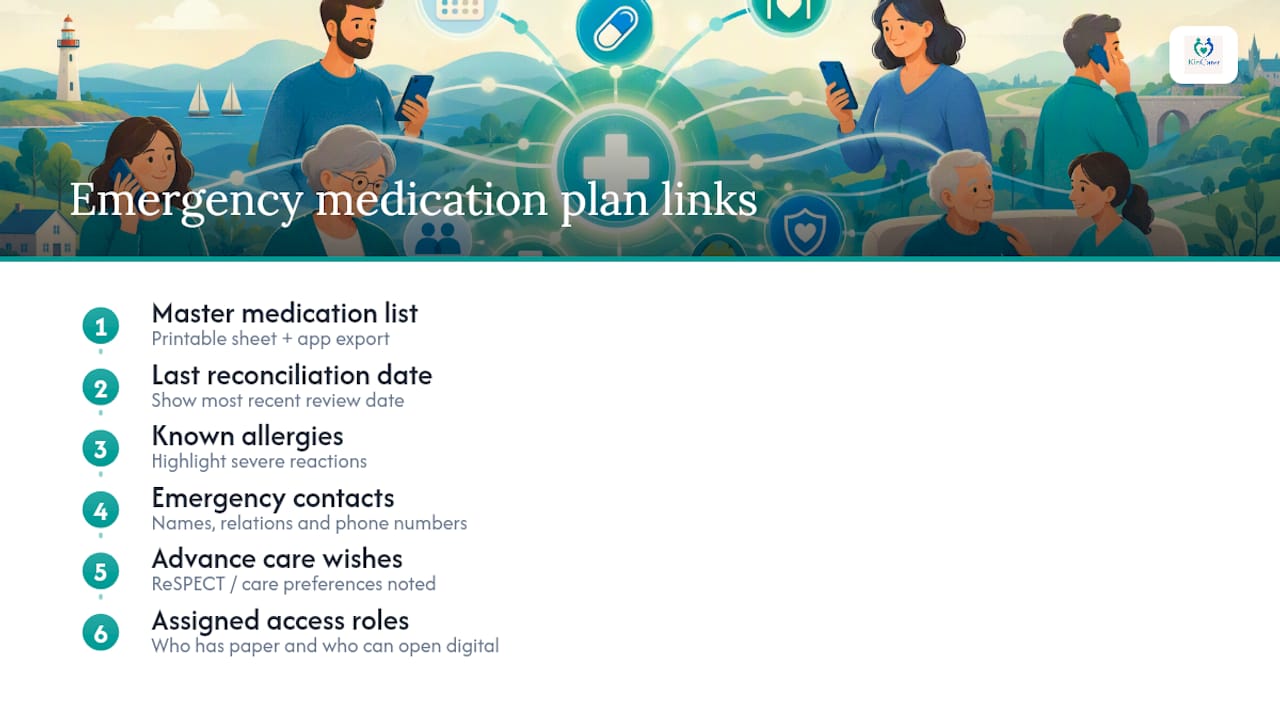
This matters more than it sounds. A paramedic treating someone mid-episode has no time to piece together medication history from memory or a drawer full of boxes. A single printed sheet, or an exportable report from a shared app, showing current doses, the last reconciliation date, and known allergies can shape treatment decisions within minutes of arrival.
Build this into your family’s plan the same way you’d store a spare key: decide who holds the paper copy, who can pull up the digital version, and check it’s actually current every time a medicine changes. If your parent has a hospital passport, care plan folder, or ReSPECT form, the medication schedule should sit alongside it, not as a separate document nobody remembers exists. Review this pairing at the same cadence as your medicines review, since a schedule that’s accurate but sitting in the wrong folder helps nobody in an emergency.
Why a shared schedule changes how families actually cope
Many families face the situation where one adult child ends up holding every detail in their head, while siblings and paid carers work from whatever fragments get passed on. Shared care circles, medication reminders, and handover notes exist to fix exactly that gap. Picture two siblings, one nearby, one three hours away, both able to see the same medication log and know a dose was given without a single phone call. That’s the coordination a shared schedule is meant to deliver, and it’s the problem worth solving properly.
— KinCarer
How KinCarer supports your family’s shared medication schedule
There are apps that provide families a shared care circle where medication reminders, handover notes, and a master medicines list live in one place, so nobody’s relying on memory or a buried text thread. Families can invite siblings, paid carers, or home care agency contacts into the same circle, each seeing what’s relevant to their role, without recreating the wheel every time something changes.
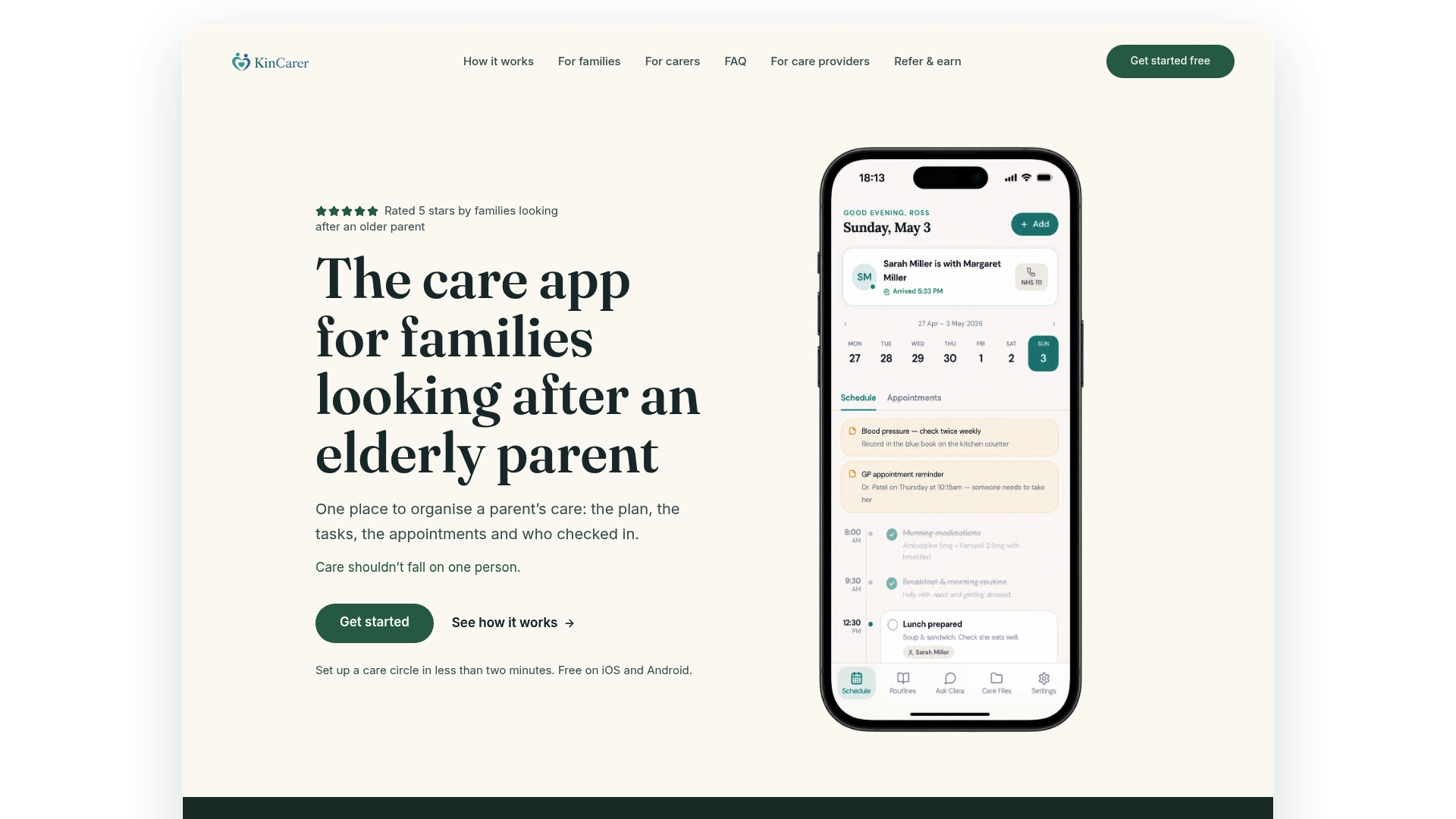
Getting started takes three steps: add your parent’s master medication list, invite the family members or carers who need visibility, and set reminders around existing routines. It won’t replace advice from a GP or pharmacist, and Clara, the built-in assistant, won’t offer medical guidance either, but it will stop the schedule living in one person’s head. Try the KinCarer app free for 14 days and see whether it fits how your family already works, or look at options for larger care circles if several carers are involved.
This article is general information, not a substitute for advice from a qualified doctor. Consult a qualified healthcare professional about your own circumstances before acting on anything here.
Sources
- Digital tools reduce caregiver anxiety and improve adherence (systematic evidence)
- Medicines: tips for carers — NHS
- Managing medicines for adults receiving social care in the community — NICE NG67
- Effects of dispenser devices and IT tools on medication adherence and caregiver burden — systematic review
FAQ
What are the NHS shared care protocols?
NHS guidance doesn’t set out a single formal “shared care protocol” for family carers, but it does recommend keeping a clear master medication list, using dosette boxes where appropriate, and requesting a pharmacy or GP medicines review for complex regimens. Formal shared care arrangements between GPs and hospital specialists are a separate clinical process, agreed directly between prescribers.
How do I create a medication schedule?
Start with a medicines review with a GP or pharmacist to get an accurate master list, then record medicine name, dose, timing, and special instructions for each item. Agree who prepares, gives, and logs each dose, and choose a tool, whether app, spreadsheet, or printed chart, that everyone in the care circle can access.
Is sharing prescription medication legal in the UK?
No. Prescription medicines are prescribed for one named person, and giving your own prescribed medicine to someone else, or vice versa, isn’t legal or safe regardless of similar symptoms. A shared medication schedule refers to sharing information about doses between carers, not sharing the medicines themselves.
Can I take five different medications at once?
Taking multiple medicines, known as polypharmacy, is common among older adults and can be managed safely, but it increases the risk of interactions and side effects. Anyone on five or more medicines should have a regular medicines review with their GP or pharmacist, and this is exactly the situation where a shared, documented schedule matters most.