
Handover Checklist for Home Care: What UK Families Should Include
A practical handover checklist for home care: what to record, how to share it between family and paid carers, and what to do when something changes.
By The KinCarer team ·
A good handover checklist for home care answers five things every time someone takes over: how your mum is right now, what has been done, what has changed, what still needs doing, and who is responsible for it. You can write it on paper, in a notebook by the front door or in a shared app. What matters is that every relative and every paid carer uses the same structure, so nothing lives only in one person’s head or buried in a WhatsApp thread.
If you are the one who always seems to hold the full picture, this guide is for you. It gives you a checklist you can copy today, explains why each line is there, and shows how to keep it going when several people share the caring.
TL;DR
- A handover should cover the person’s current state, care given, changes, medicines, safety concerns and clear next actions with a name against each.
- Keep one shared record that everyone involved can read and add to, ideally with one named person who looks after it.
- Ask your parent before sharing their information, and if they cannot decide for themselves, think about what is in their best interests.
- Urgent changes need a phone call or emergency help, not just a note.
- A short, repeatable template beats a long, perfect one that nobody finishes.
Table of Contents
- What a home care handover checklist is for
- The handover checklist: copy this
- A worked example
- Keeping the record in one place
- When the handover contains something urgent
- Privacy and consent
- Mistakes that make handovers fail
- Our perspective
- Turning the checklist into a shared routine
- Try it in one shared care circle
- FAQ
- Sources
What a home care handover checklist is for
A handover is the moment responsibility passes from one person to another. It might be a care worker finishing a morning visit, your sister taking over for the weekend, or you flying back to Manchester after a week with your dad. Staffordshire County Council’s adult social care guidance describes handovers as passing on information, responsibility and accountability, and that last word is the one families often miss. A handover is not just “here is what happened”. It is “this is now yours, and here is what you need to pick it up”.
Families tend to need one when:
- a home care agency starts visiting and relatives want to know what happened between calls
- two or more siblings share the caring and live in different places
- your parent has just come out of hospital and routines have changed
- a regular carer is away and cover arrives who does not know your mum
- you are stepping back for a few days and someone else is stepping in
NICE’s guidance on home care in England recommends a care diary: a detailed day-to-day log of the care and support provided, kept in the person’s home, with a copy offered to them. A handover checklist is the quick, structured layer that sits on top of that diary and tells the next person what matters most.
The handover checklist: copy this
This is a practical version for families. Adapt the wording to your parent, but keep the order. Putting the most important information first means a tired relative reading at 10pm still sees it.
1. The basics
- Name, date and time of the handover
- Who is handing over and who is taking over
- Where the handover is happening (in person, by phone, written note, app)
2. How they are right now
- Mood and energy: settled, tired, confused, low, anxious, cheerful
- Eating and drinking: what they had, what they refused
- Mobility: any unsteadiness, falls or near misses
- Sleep, if you know it
- Pain or discomfort they mentioned, in their own words where possible
Stick to what you saw and heard. “Said her hip was sore when getting out of the chair” is more useful than “seemed unwell”.
3. What has been done
- Personal care completed (washing, dressing, continence care)
- Meals prepared
- Medicines given or prompted, and the time
- Appointments attended or missed
- Shopping, laundry, cleaning or other practical jobs finished
4. What has changed
This is the section that earns the checklist its place. The Staffordshire guide lists the kinds of things a handover should flag: new or worsening symptoms, medication or treatment changes, updates to the care plan, changed needs or preferences, mood or behaviour changes, safeguarding concerns, equipment or home safety issues, and accidents or injuries. Turn those into prompts:
- Any new symptom, or one that seems worse?
- Any change to tablets, doses or treatment from the GP, pharmacist or hospital?
- Any change in mood, confusion or behaviour?
- Any fall, bump, burn or other accident?
- Anything about the home that is unsafe, such as a loose rug, a broken stairgate or a faulty alarm?
- Anything that worried you, even if you cannot say why?
5. Medicines
- What was due, what was taken, what was missed
- Any supplies running low
- Who orders and collects repeat prescriptions
NICE’s quick guide on medicines support says responsibilities, including who orders and collects or delivers medicines, should be recorded in the care plan. If that is not written down for your family, put it on the checklist now. For questions about doses or side effects, the person to ask is the pharmacist or GP, not the handover note.
6. Next actions
This is where most family handovers fall down. The NHS England Safe Communication guide asks for recommended actions, timeframes and who is responsible to be recorded. For each action, write three things:
- what needs doing
- by when
- who has said they will do it
“Someone needs to ring the GP” is not an action. “Priya to ring the GP surgery at 8.30am Tuesday about the sore hip” is.
7. Confirmation
The same guide says the person receiving the handover should clarify their understanding and confirm they take responsibility. In a family, that can be as simple as a thumbs-up and “Got it, I’ll do the tablets tonight”. It closes the loop and stops the quiet assumption that somebody else has it covered.
A worked example
Here is what a filled-in handover might look like between a home care agency’s evening visit and a daughter who lives nearby.
Thursday, 7.45pm. From: evening care worker To: Aisha (daughter) Right now: Mum is settled in her chair, in good spirits. Ate most of her shepherd’s pie, had two cups of tea. Done: Washed and changed for bed, evening tablets given at 7.15pm, bins out. Changed: Mentioned her left ankle is a bit swollen. Not mentioned before. No fall reported. Medicines: All given. Blister pack has four days left. Next actions: Aisha to look at the ankle on Friday morning and ring the GP if still swollen. Aisha to ask the pharmacy about the repeat prescription by Saturday. Confirmed: Aisha, by text, 8.05pm.
That took two minutes to write. It also means that if Aisha’s brother covers on Friday, he does not have to ask what happened.
You will find more examples you can copy in our guide to one page handover notes, and a longer template in our care notes template for UK family carers.

Keeping the record in one place
A checklist only works if everyone can see it. NICE’s communication resource says the care diary should be accessible to everyone involved in providing care and support, that everyone should read new entries and add information, and that a named care coordinator should have overall responsibility. Translate that for your family:
- Pick one home for the record. A folder in the hallway, a shared document, or an app. Not three of them.
- Name a coordinator. This does not have to be you. It is the person who checks the record is being filled in and chases gaps.
- Agree when handovers happen. The Safe Communication guide recommends handovers at an agreed time and place using an agreed standard process. For families that might be a ten-minute call every evening or an end-of-visit note.
- Include paid carers. If your parent has a home care agency, ask how their visit notes are recorded and whether you can read them, and agree where your own updates go.
- Keep it readable. Short lines, plain words, no private shorthand that only you understand.
NICE also notes that care diaries help people communicate effectively especially if they do not routinely speak in person. That describes most families spread across different towns. If you coordinate from a distance, a written handover is how you stay in the loop without ringing the house three times a day.
If you want a simple daily routine to sit alongside the handover, our daily carer task list and daily care log templates are designed for exactly that.
When the handover contains something urgent
A handover note is a record, not an alarm. If you notice a sudden change in your parent’s health, such as a new confusion, a fall with injury, chest pain or breathing difficulty, do not write it down and wait for the next person to read it. Call 999 in an emergency, or 111 for urgent advice, and then record what happened and what you did.
For less dramatic changes, the checklist still helps you decide who to tell and how quickly:
- Same day: a new symptom, a missed dose, a fall without injury. Phone the next person rather than relying on a message they may not see, and contact the GP or pharmacist as needed.
- Within a day or two: low mood, poorer appetite, a worry about the home. Put it in the handover and ask for it to be discussed.
- Straight to the agency or social worker: concerns about the quality of paid care, or any safeguarding worry.
Missed or late visits
If a paid care visit is late or does not happen, NICE says the change should be communicated immediately and clearly to the person and their family, with alternative arrangements set out. The guidance recognises that missed or late visits can cause real distress and loss of trust, so you are entitled to a prompt phone call, not a vague apology days later. Add a line to your checklist: “Was every planned visit completed on time? If not, what was arranged instead?”
Privacy and consent
Sharing notes among relatives raises a fair question: does your mum know who is reading about her? Official guidance on confidentiality and information sharing for direct care says to seek the person’s agreement before sharing with family members, carers or friends, and where someone lacks capacity, to judge whether sharing is in their best interests. The same guidance is clear that confidentiality should not become a barrier to safe care.
In practice:
- Talk to your parent early about who should see what, and write down what they agree.
- Share only what each person needs. A neighbour who pops in does not need the full medication list.
- Keep records somewhere secure and not on a public group chat with people outside the circle.
- Review the arrangement if your parent’s health or wishes change.
We go further into this in our guide to sharing medical information in UK care apps.
Mistakes that make handovers fail
- Writing too much. If it takes twenty minutes, it will stop happening. Aim for two to five.
- Writing opinions as facts. Record what you saw, then add what you think separately.
- Leaving actions without names. Every action needs one person.
- Using several places. Notes in a notebook, texts, a voicemail and a sticky note means someone will miss one.
- Only recording problems. Good days, favourite meals and what settled your mum when she was anxious help the next carer too.
- Forgetting the person. The Safe Communication guide asks handovers to focus on the person’s goals. If your dad wants to keep walking to the post box, that belongs on the checklist.
Our perspective
Most families we speak to do not struggle because they do not care enough. They struggle because the information is scattered. One sister has the appointment letter, a brother has the latest text from the carer, and mum’s tablets were changed in a conversation nobody wrote down.
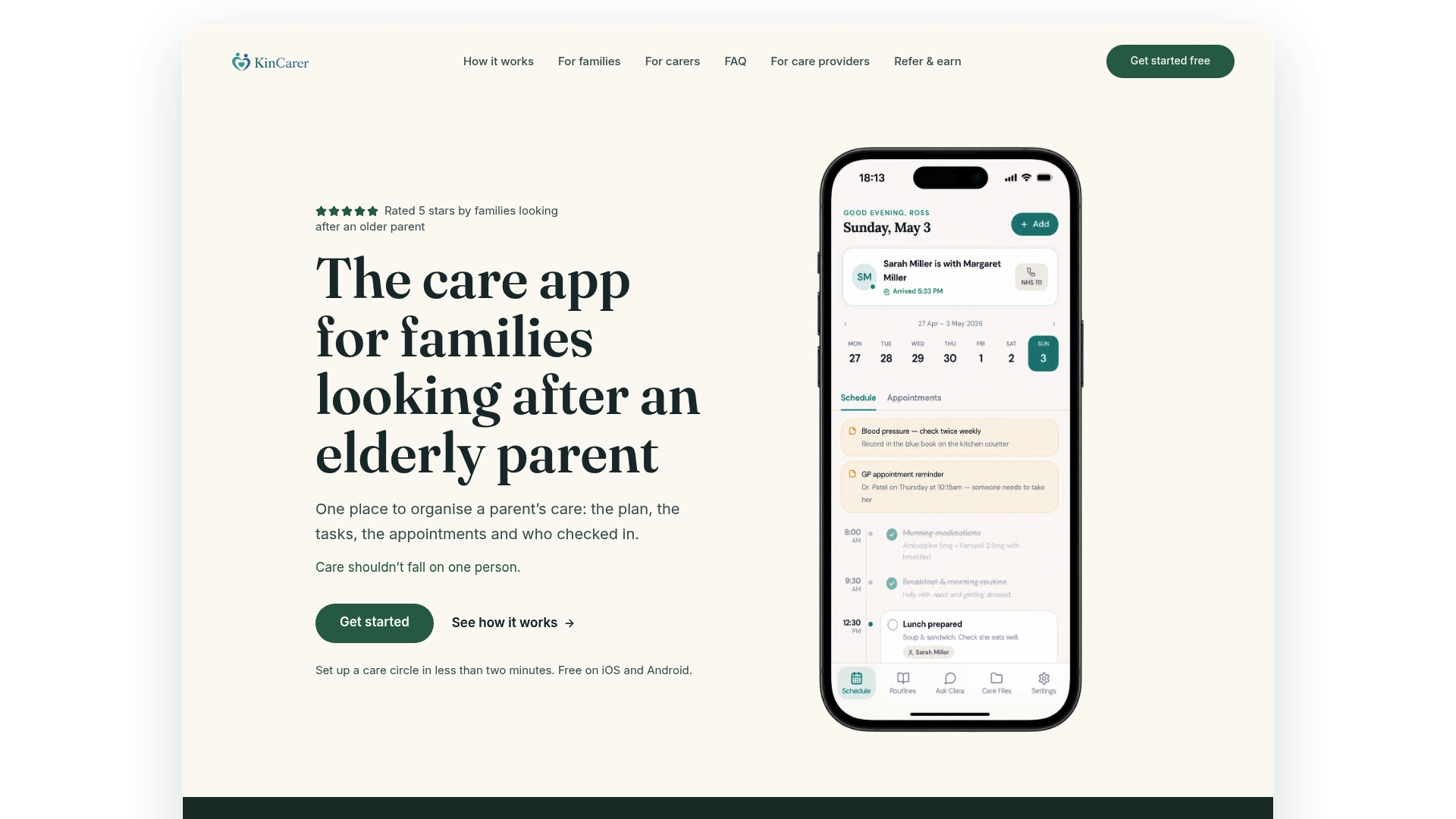
We built KinCarer around the idea that a handover should be easy enough to do when you are tired. A care circle lets relatives and paid carers see the same tasks, appointments, check-ins, medication reminders and handover updates, so the picture does not depend on one person remembering to pass it on. That also helps share the organising, which is often where carer burnout starts.
Our assistant, Clara, is optional. It can help your family search and summarise what is already in the care circle, such as what changed this week or what is still open. Clara does not give medical, legal or clinical advice. Decisions about your parent’s health stay with your parent and the professionals who look after them.
Whatever tool you choose, the checklist above is the foundation. Get the habit right first, and the tool simply makes it easier to keep.
KinCarer
Turning the checklist into a shared routine
With the structure in place, the next step is a routine your whole family can sustain. A simple way to start:
- Hold one short meeting. Agree the checklist headings, who is the coordinator and when handovers happen. Our guide to setting up a shared care plan in one meeting walks through it.
- Trial it for two weeks. Use it after every visit or every evening, then adjust the headings that nobody uses.
- Add the paperwork. Keep key documents, such as emergency contacts and consent details, in one place. Our guide to storing care documents explains what to gather.
- Plan for changes. After a hospital stay, routines and medicines often change, so revisit the checklist. Our post-discharge care plan covers what to add.
- Review the habit monthly. Ask whether anything was missed, and who found the notes most useful.
NICE adds that communication is ongoing and that a person’s preferred ways of communicating may change as their needs change. Treat your checklist as a living document, not a form you fill in once.
Remember: you do not need a perfect system. You need one that the next person can pick up in two minutes and act on.
Try it in one shared care circle
If you would rather not manage paper, spreadsheets and message threads, KinCarer lets you invite relatives and paid carers into one care circle with handover updates, tasks, appointments, check-ins and medication reminders in the same place. One subscription covers everyone you invite.
Family+ is priced at £9.99 per month per family or £69.99 per year per family. You can see the details on the Family+ page, or take a look at KinCarer to see how a care circle works. KinCarer is for families coordinating care, not for care homes, staff rotas or clinical care providers.
FAQ
What should be in care handover notes?
Include who is handing over to whom, how your parent is now, what care was given, any changes, medicines taken or missed, safety concerns and next actions with a name and timeframe. Keep it factual and short. The sections above give you a copyable structure.
How often should we do a handover?
Do one whenever responsibility passes from one person to another: at the end of a paid visit, at the end of a family member’s shift, or at the end of the day if one person coordinates. Agree a regular time so it becomes habit rather than something you remember when there is a problem.
Do I need my parent’s permission to share handover notes?
Official confidentiality guidance says to seek the person’s agreement before sharing with family, carers or friends. If they lack capacity to decide, you should consider whether sharing is in their best interests. If you are unsure, ask the GP or the care provider how they handle it.
Is a handover note enough if something urgent happens?
No. For a sudden change in health or an emergency, call 999 or 111 as appropriate and tell the right people directly. Then write the details in the handover so the next person knows what happened and what was done.
Can a home care agency and family use the same record?
Often they can, but it depends on how the agency records its visits. Ask what they write after each call, whether you can see it, and where your family’s updates should go. NICE recommends the care diary is accessible to everyone involved in care and support.
Sources
- NICE: Home care, delivering personal care and practical support to older people living in their own homes
- NICE: Communication, tools and resources for home care
- NICE: Discussing and planning medicines support quick guide
- NHS England: Safe Communication
- Staffordshire County Council: Handover Guide
- Confidentiality and Information Sharing for Direct Care
category:care-planning