6 Step Daily Caregiver Task List for UK Families to Print and Share
Printable, copy ready caregiver task lists for UK families. Includes a 6 step daily checklist plus weekly and monthly tasks.
By The KinCarer team ·
Start today with a one-page daily checklist covering personal care, medication, meals, mobility and safety checks, plus a handover line for whoever takes over next. Copy the ordered list below into a notebook, print it, or add it straight into a shared care circle. Once the daily basics are covered, book a carer’s assessment and set up a shared care plan so the load never sits on one person alone.
TL;DR:
- Accurate medication records, including drug name, dose, time, and giver, are essential to prevent confusion and ensure proper adherence.
- Weekly tasks like laundry, shopping, and medication stock checks must be shared and assigned to avoid gaps in support.
- Differentiating between ADLs and IADLs helps specify the level of support needed for personal care versus household management.
- Recording concise, factual handovers at each shift end improves continuity and reduces risks for the next caregiver.
- Using a centralized digital platform like KinCarer streamlines task sharing, appointment tracking, and handover notes for all involved carers.
Table of Contents
- Daily tasks checklist: an ordered, copy-ready list for the day
- Weekly and monthly tasks: planning chores, shopping and appointments
- Task categories explained: ADLs and IADLs and why they matter
- How to keep records and handovers: the minimum useful information
- How to share a care list with family and paid carers: paper, chat, cloud or an app
- How KinCarer supports shared tasks and handovers
- When to ask for formal help: carer’s assessment, respite care and local services
- Editorial perspective: practical priorities and protecting carer wellbeing
- Try KinCarer for shared tasks and printable checklists
- Authoritative templates and guidance
- Sources
- FAQ
Daily tasks checklist: an ordered, copy-ready list for the day
A carer task list works best when it follows the shape of an actual day rather than a random jumble of chores. Group everything by morning, midday, evening and night, so whoever is on duty, whether that’s you, a sibling, or a paid carer, knows exactly what’s expected without having to ask.
Here’s a structure you can copy directly into a notebook, a shared document, or an app:
- Morning: Help with washing, dressing, and toileting. Give breakfast and the morning medication (record name, dose, time given, and who gave it, with a tick box alongside).
- Mid-morning: Quick safety check, room temperature, trip hazards, mobility aids within reach, and a check-in call if you’re not there in person.
- Midday: Prepare or deliver lunch, prompt fluids, and administer any midday medication with the same record fields as above.
- Afternoon: Light housekeeping, a short walk or seated exercises if mobility allows, and companionship time, a chat, a puzzle, or simply sitting together.
- Evening: Dinner, evening medication, help with washing and getting ready for bed, and a final mobility and safety sweep of the home.
- Night check (if needed): A brief look-in for continence, comfort, and confirmation the home is secure.
Medication entries matter more than almost anything else on this list. Every dose needs four things recorded: the drug name, the dose, the time given, and who gave it. A missed tick box here is often how confusion starts between family members, so build it into the routine rather than treating it as an afterthought.
Safety checks don’t need to be elaborate. A glance at loose rugs, poor lighting on the stairs, or a walking frame left out of reach takes seconds but prevents falls, which remain one of the most common reasons an elderly parent ends up in hospital.
Each shift should end with one handover line, something as simple as: “Mum had lunch at 1pm, took her midday tablets, seemed a bit unsteady on the stairs, keep an eye on that.” That single sentence, written consistently, saves the next carer from having to guess.
Weekly and monthly tasks: planning chores, shopping and appointments
Daily tasks keep someone safe and comfortable. Weekly and monthly tasks keep the whole system running, and they’re the ones that get forgotten when everyone’s focused on the day-to-day.
Weekly tasks:
- Laundry and changing bedding.
- Writing and doing the shopping list, checking cupboards for gaps.
- A kitchen deep clean, wiping down surfaces, checking fridge contents for anything past its date.
- Counting medication stock so nobody runs out mid-week.
- Reviewing the coming week’s appointments, GP visits, chiropody, hairdresser, and confirming transport.
Monthly tasks:
- Reviewing medication with the GP or pharmacist if anything’s changed.
- Testing smoke alarms and carbon monoxide detectors.
- Reviewing the wider care plan, has anything got harder, easier, or changed since last month?
- Checking finances where you help manage them, bills paid, benefits claimed, nothing overdue.
Splitting these across family members and any paid carer works better with a simple shared template rather than a mental note in someone’s head. A basic table with four columns does the job:
| Date | Task | Assigned to | Done (Y/N) | Notes |
|---|---|---|---|---|
| Mon | Shopping list drafted | Sister | Y | Added incontinence pads |
| Wed | Smoke alarm test | Son | N | Battery needed |
Assign tasks based on who’s actually available that week, not who “should” do it out of habit. The sibling who lives an hour away might be better placed to handle phone calls to the GP surgery than the one doing daily visits, who’s already stretched.
Task categories explained: ADLs and IADLs and why they matter
Two terms come up constantly once you’re dealing with social workers, GPs, or care assessments: ADLs and IADLs. Knowing the difference helps you describe needs precisely instead of vaguely saying “Mum needs help with everything.”
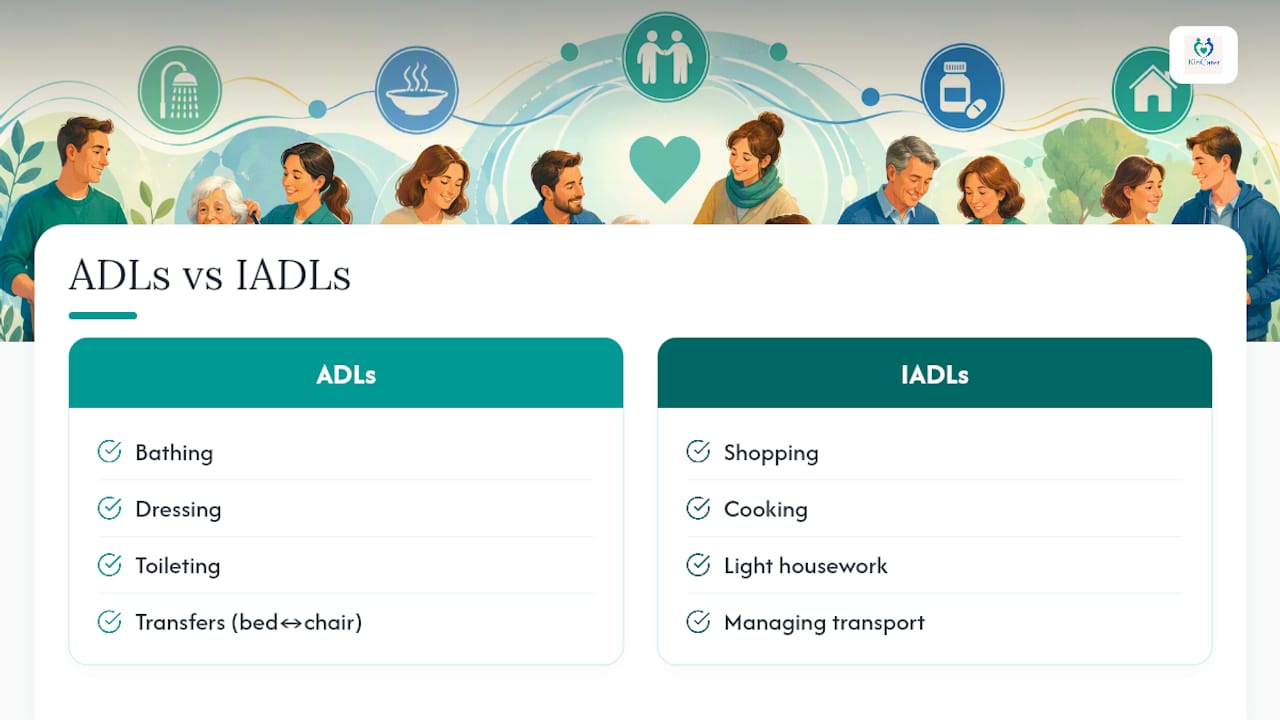
ADLs (Activities of Daily Living) are the essential personal tasks: bathing, dressing, toileting, transfers (moving from bed to chair, for instance), and feeding. These are used by clinicians and social care teams to judge how much hands-on personal support someone needs.
IADLs (Instrumental Activities of Daily Living) cover the broader tasks that keep a household running: shopping, cooking, light housework, managing transport, and handling money or bills.
Someone might be fully independent with ADLs but need heavy support with IADLs, managing perfectly well with washing and dressing but unable to manage a shopping trip or pay a bill safely. That distinction changes what kind of help gets requested. If you’re speaking to a social worker or GP about an assessment, naming specific ADLs and IADLs your parent struggles with gives them something concrete to work from, rather than a general impression of “struggling.”
A rough mapping: bathing, dressing, toileting and transfers sit under ADLs; shopping, cooking, cleaning, managing transport and finances sit under IADLs. Most carer task lists blend both without labelling them, which is fine day to day, but useful to separate when you’re asking for formal support.
How to keep records and handovers: the minimum useful information
Good records don’t need to be long. They need to be consistent, and they need to answer the same questions every time so nobody’s left guessing what happened on a shift they missed.
A useful shift log covers:
- Date and time.
- Carer’s name.
- Medication given, name, dose, and time.
- Meals eaten and fluid intake.
- Toileting and continence notes.
- Mobility, any changes, wobbles, or new aids used.
- Mood and general notes.
- Any urgent action taken or still needed.
A one-line handover example: “Tues 6pm, Dave. Evening meds given 6:05pm. Ate half her dinner. Slightly confused about the day, nothing new otherwise.” Short, factual, and specific enough that the next carer knows what to watch for.
For storage, you’ve got two realistic options: a paper folder labelled “care notes” kept somewhere obvious in the home, or a single shared digital file or app that everyone in the care circle can access. Paper works fine for one or two carers. It starts to break down once three or four people are involved and nobody’s sure which notebook has the latest entry.
Pro Tip: Keep medical and financial details in a separate, clearly labelled section from general day-to-day notes, and only share that section with people who genuinely need it. Not every relative needs to see bank details to help with a shopping run.
How to share a care list with family and paid carers: paper, chat, cloud or an app
Most families default to WhatsApp because it’s already there, but it’s rarely the best long-term home for a care list. Here’s how the four common options actually compare:
- Printed sheet: Simple, no tech needed, easy to stick on the fridge. Falls apart once more than one or two people need to update it, and there’s no backup if it’s lost.
- WhatsApp or messaging apps: Fast for quick updates, familiar to everyone. Important details get buried under unrelated messages within days, and nobody has a single current version.
- Shared cloud document: Better than paper, everyone sees the same version. Still requires manual updating and offers no reminders, task assignment, or structure.
- A dedicated family care app: Built specifically for this job, so tasks, medication records, and appointments live in one place with reminders attached.
Before sharing anything personal, run a quick privacy check: does everyone in the group actually need to see medical details, or just the task list? Shared care plans reduce missed updates between family and paid carers, but only when access is sensible, not blanket.
Inviting a paid carer into a shared record works best with limited permissions, task visibility and handover notes, yes; full financial details, generally no. Pick one primary record and one communication channel, and resist the urge to run both a WhatsApp group and a shared document at the same time. Duplication is how updates get missed.
How KinCarer supports shared tasks and handovers
KinCarer takes the structure above, shared care circles, task assignment, appointment tracking, medication reminders, handover notes and document storage, and puts it in one place instead of scattered across notebooks and message threads. Relatives and paid carers can be invited into the same circle, so a night carer’s handover note is visible to the sibling checking in the next morning without a single phone call.
Clara, KinCarer’s built-in AI assistant, helps you search and summarise what’s already logged in your care circle, useful when you need a quick answer like “when was Mum’s last GP appointment,” rather than scrolling back through weeks of notes. Clara doesn’t give medical, legal or clinical advice; it works with the information your family has already recorded.
When to ask for formal help: carer’s assessment, respite care and local services
Every unpaid carer in the UK is entitled to a carer’s assessment from their local council, regardless of how many hours you provide or your financial situation. There’s no minimum threshold to meet before you qualify.
Signs it’s time to ask:
- You’re exhausted, irritable, or dreading the next shift more often than not.
- Tasks are slipping, missed medication, skipped meals, safety checks not happening.
- You haven’t had a proper break in weeks.
Contact your GP surgery, your local council’s adult social care team, or a local carer centre to start the process. NHS guidance recommends planning respite and arranging replacement care before burnout sets in, not after.
Bring your care list to the assessment: the daily tasks, any risks you’ve noticed, and specific ADLs or IADLs your parent struggles with. Carers UK guidance also recommends registering as a carer with your GP early, it unlocks access to services and support you might not know exist.
Editorial perspective: practical priorities and protecting carer wellbeing
Sort tasks into three honest categories: non-negotiable (medication, safety), important but movable (laundry, deep cleaning), and nice if possible (a tidy garden). Protect a regular break every week, even a short one, and treat it as part of the job rather than something you earn once everything else is done.
Share the care plan properly. One person holding all the information in their head isn’t a system, it’s a single point of failure. Review it monthly, and don’t wait for a crisis to ask for help. Asking early is practical, not a failure.
— KinCarer
Try KinCarer for shared tasks and printable checklists
KinCarer exists for exactly the problem this article has walked through: one person holding every task, medication time, and appointment in their head while everyone else asks for updates separately. It centralises tasks, medication reminders, appointments and handover notes into a single care circle, so relatives and paid carers all work from the same information instead of scattered messages.
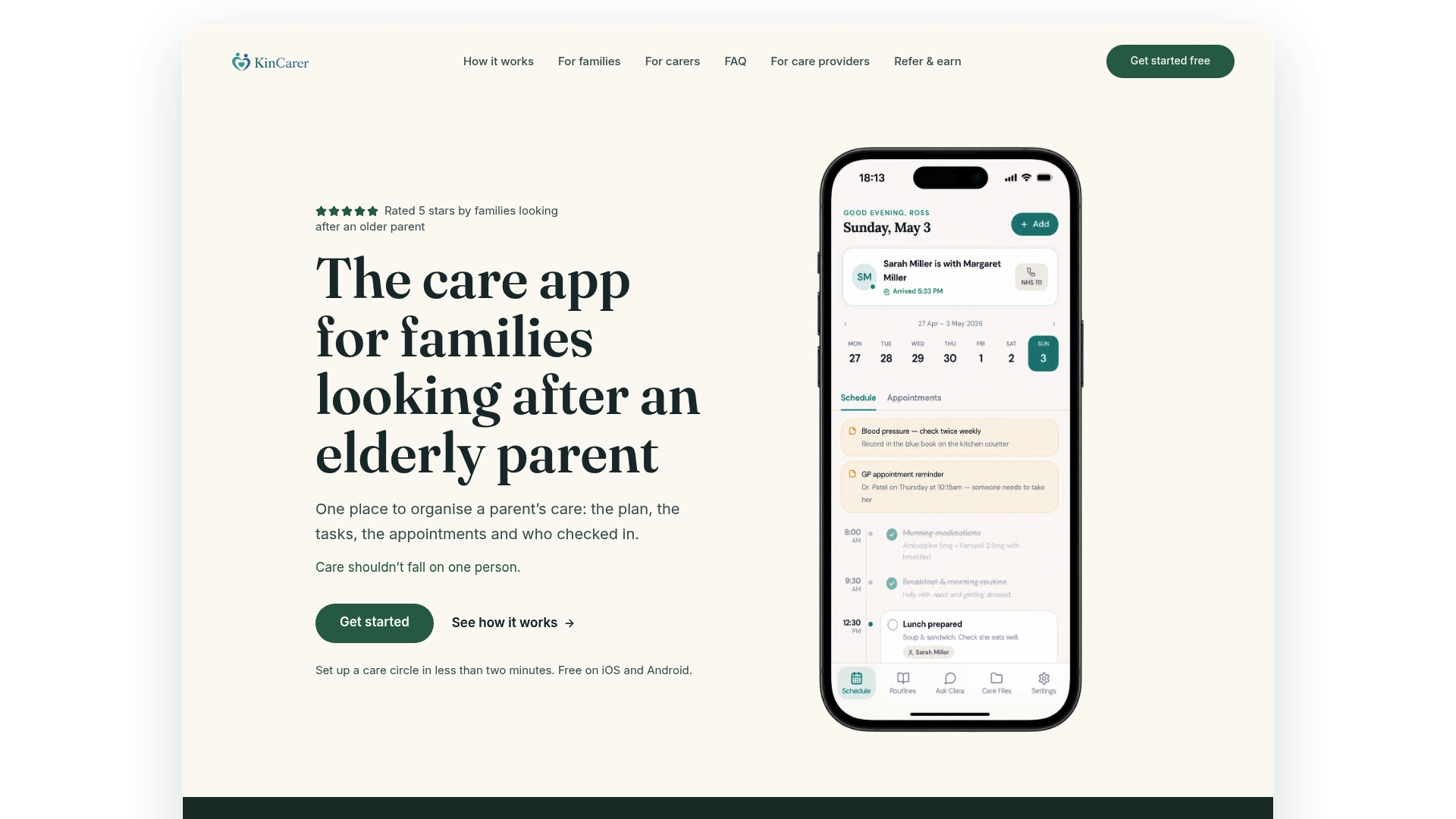
If you’d rather stop rebuilding the same list every week, visit KinCarer, start the 14-day free trial and set up a shared care circle in minutes. Families managing care with several relatives or a paid carer involved can also look at the Family+ options, which have various pricing plans depending on the arrangement. Set it up once, invite the people who need to see it, and stop carrying the whole list alone.
Authoritative templates and guidance
For further reading beyond this checklist, the NHS guide to carer breaks and respite care covers arranging replacement support. The government’s practical guide for supporting loved ones includes example templates, and Age UK’s carer’s checklist gives a concise next-steps list worth bookmarking.
Sources
- Care Act assessments 2026: UK family guide
- Carer breaks and respite care | NHS
- Supporting loved ones with health or care needs: your practical guide (prototype)
- Looking after someone 2026–27 (Carers UK)
FAQ
What are the daily tasks of a carer?
Daily tasks typically include personal care (washing, dressing, toileting), giving meals and medication at set times, helping with mobility, and running basic safety checks around the home. A short handover note at the end of each shift keeps the next carer informed.
What is an example of a carer’s task?
A single example would be giving morning medication and recording the drug name, dose, time given, and who gave it, then ticking it off a shared checklist. That one entry alone prevents a huge amount of confusion between family members.
What are the 5 main duties of a carer?
Most carer task lists centre on personal care, medication management, meal preparation, mobility support, and household or errand tasks like shopping. Companionship and emotional support run alongside all five, even though it’s less often written down.
What should be recorded in a carer’s checklist?
At minimum, record the date and time, who provided care, medication given with dose and time, meals and fluids, toileting and mobility notes, and any urgent concerns. Apps like KinCarer build these fields into shared handover notes automatically, so nothing has to be retyped each shift.