
Carer Meeting Agenda: A Family Template for Caring for Mum
A step-by-step carer meeting agenda for UK families: who to invite, what to cover, how to keep it calm, and how to follow up so tasks actually get done.
By The KinCarer team ·
A good carer meeting agenda has eight parts: what your mum or dad wants, what has changed, who does which tasks, money and paperwork, emergency cover, how updates will be shared, who writes things down, and the date of the next meeting. This page gives you that agenda in order, with timings, questions to ask and a way to follow up, so the conversation ends with decisions rather than good intentions.
If you are the one who usually organises everything, a family care conference can feel like one more job. It is also the quickest way to stop carrying the caring load alone.
TL;DR
- Keep your elderly parent’s wishes at the centre, and ask whether they would like to attend.
- Send a short agenda beforehand and ask everyone to jot down their thoughts.
- Cover needs, tasks, money and paperwork, emergency cover and how updates are shared.
- Name a note-taker, write down who does what by when, and book the next meeting before you hang up.
- Treat it as a regular check-in, not a one-off, because care needs change.
Table of Contents
- What a family care meeting is, and when to hold one
- Decide who comes
- Prepare before the meeting
- A carer meeting agenda you can use
- The agenda at a glance
- Keep the conversation calm and respectful
- Siblings and relatives who live far away
- Record decisions and follow up
- Our perspective
- When to bring in professionals
- Keep the plan alive with KinCarer
- FAQ
- Sources
What a family care meeting is, and when to hold one
A carer meeting is a planned conversation between the people around an older person, so that care is shared fairly and agreed together. It is not the same as a formal family group conference, although the ideas overlap. A family group conference is a family-led decision-making meeting, held at a time and place that suits the family, which always includes private family time to discuss options and agree a plan. For adults, Research in Practice describes a voluntary process with an independent coordinator, where the person decides who attends and the professionals step out so the family can talk freely.
Most families do not need a coordinator. They need a kitchen table, a video call and a clear list. You might hold your first meeting when:
- your mum has had a fall, a diagnosis or a hospital stay
- one sibling has quietly become the “default” carer
- paid help from a home care agency is starting, changing or stopping
- someone is struggling with work, health or their own family because of caring
- you are beginning to worry about safety at home
The earlier the better. Your Family Matters notes that family conferences work best at an early stage, when worries about safety and welfare are first raised, and that nobody can be forced to take part. The same is true at home: an invitation works better than an ultimatum.
Meetings should also repeat. The Family Caregiver Alliance says they are not a one-time event and should happen regularly, perhaps at the same time each month, or when circumstances change. If someone cannot attend, keep in touch by phone, mail or email.
Decide who comes
Invite everyone who is, or is likely to become, involved: siblings, partners who help, grandchildren, a trusted neighbour, and any paid carer if their input is useful. The Family Caregiver Alliance also suggests thinking about whether the older person should attend. Our view is that the answer is nearly always yes, unless it would genuinely distress them, because the plan is about their life.
If your parent can make their own decisions, they should have the final say on how their care is carried out. If they would find a big gathering overwhelming, try a smaller first conversation with them, then share their views with the wider group.
It can help to choose a neutral setting. A video call works well when people live far apart, and a neutral venue can take the heat out of a conversation that might otherwise happen in someone’s own living room. If old tensions between relatives make agreement impossible, the Family Caregiver Alliance suggests a neutral facilitator. That could be a trusted family friend, or a professional.

Prepare before the meeting
Preparation is what turns a tense conversation into a useful one. A few simple steps:
- Send the agenda in advance. NEMCSA recommends sharing the agenda beforehand so nobody is ambushed.
- Keep the agenda small. The Minnesota Board on Aging worksheet suggests limiting the number of topics, arranging conference-call access for those who are far away, and collecting any medical or legal information you need.
- Ask everyone to write down their thoughts. A family meeting preparation sheet from Miami University’s Scripps Gerontology Center asks each participant, including the person needing care, to consider what is needed, what is happening now, what is wanted and what is possible.
- Give notice. Age UK’s guide to thinking about end of life recommends writing notes beforehand, giving relatives advance notice and accepting that several conversations may be needed. That applies to any hard family conversation.
- Gather the basics in one place: GP details, a list of current appointments, who already helps, and any paperwork such as powers of attorney.
If you are the main carer, add your own notes. How is caring affecting your health, work, free time and relationships? Carers UK says a carer’s assessment in England can look at wellbeing, health, work, study, leisure, relationships, housing and emergency planning. Those headings make a useful prompt for what you tell your family, too.
A carer meeting agenda you can use
Plan for 60 to 90 minutes, with a short break if it runs long. The timings below are our suggestion, not a rule. Adjust them to your family.
1. Welcome and purpose (5 minutes)
Say why you are meeting and what you hope to leave with. A line such as “We want Mum to be safe and happy at home, and for nobody to be carrying this alone” sets a kind tone. Agree a time limit and ask people to listen before responding.
2. What your parent wants (10 minutes)
Start with them, not with the tasks. Ask open questions: what matters most to you day to day, what worries you, what would you like help with and what would you rather keep doing yourself? The Age UK advice on worrying about an older person recommends listening without judgement, asking open questions and avoiding a fixed solution from the outset.
3. What has changed and what is needed now (10 minutes)
Each person shares what they have noticed: mobility, memory, meals, mood, home safety, appointments. Stick to observations rather than blame. “I noticed Mum had skipped lunch three times” lands better than “You’re not looking after her properly”.
4. Who does what (20 minutes)
This is the heart of the meeting. List every recurring job: appointments and transport, medication reminders, shopping, cooking, laundry, bills, daily phone calls, visits, liaison with the GP or care provider. Then match tasks to people.
- Think about strengths and availability, not only distance. People who live closer may take on more hands-on tasks.
- People further away can often handle paperwork, online grocery orders, phone calls and bookings. A UK government prototype guide mentions online shopping and finances as tasks distance does not prevent.
- Make sure each task has one named person and one backup.
5. Money, benefits and paperwork (10 minutes)
Who pays for what, whether anyone has applied for benefits, and who holds important documents. Agree who may speak to banks, the council or the GP, and whether legal arrangements such as lasting powers of attorney are in place. If you are unsure, note it as a question to take to Age UK, Citizens Advice or a solicitor rather than guessing.
6. Emergency cover (5 to 10 minutes)
What happens if the main carer is ill or unavailable? Cambridgeshire and Peterborough NHS Foundation Trust recommends a contingency plan that names an emergency helper, the support normally provided and any access issues, and says carers can ask for one even without a carer’s assessment. Agree who holds a key, who gets the first phone call and where the key information lives.
7. How you will share updates (5 minutes)
Decide where news goes. A busy family group chat can bury an important message under photos and jokes. Agree one place for appointments, one for daily updates and one for documents, and how quickly people should respond. Shropshire Council’s guidance for long-distance carers suggests regular phone or video calls and apps such as WhatsApp or Zoom for keeping in touch.
8. Recap and next meeting (5 minutes)
Read the decisions back aloud. Confirm who will send the notes, and put the next date in everyone’s diary before you finish.
The agenda at a glance
| Item | Key question | What you leave with |
|---|---|---|
| Purpose | Why are we here? | Shared aim and time limit |
| Their wishes | What matters most to Mum? | Her priorities in her own words |
| Current needs | What has changed? | A shared picture of the situation |
| Tasks | Who does what, and who is the backup? | Named owners and deadlines |
| Money and paperwork | Who holds what, who can act? | Open questions and a responsible person |
| Emergency cover | Who steps in if plans fail? | A contingency contact list |
| Updates | Where does news go? | One agreed channel per type of update |
| Next meeting | When do we review? | A date in the diary |
Keep the conversation calm and respectful
Even close families disagree about care. A few habits help:
- Use “I” statements. NEMCSA suggests respectful listening and “I” statements, and allowing breaks if emotions rise. “I’m exhausted by the Tuesday appointments” starts a conversation. “You never help” ends one.
- Park off-topic items. Keep a visible “parking list” for old grievances and issues for another day.
- Look for common ground first. Everyone in the room wants your mum to be well looked after. Say so.
- Focus on solutions and small steps. Agree one or two changes to try for a month rather than solving everything at once.
- Expect more than one conversation. Age UK says more than one conversation may be needed on sensitive subjects.
Remember: the aim is not to win an argument. It is to make life easier for your parent and for the people who love them.
Siblings and relatives who live far away
Distance does not mean absence. If you live two hours away, or in another country, you can still take on a meaningful share.
A fair split often separates practical support from emotional support, so each sibling contributes in a way that suits them. Roles can be assigned by task, by time of day or by rota. For example, one sibling handles GP and hospital appointments, another makes the daily phone call, and a third deals with bills and online orders. Rotating the daily call is a small change that stops the nearest person becoming the only point of contact.
If you are joining remotely:
- Ask for the agenda and notes in advance.
- Take a clear, regular job rather than offering vague help.
- Know who is nearby for emergencies, such as a neighbour, as the Shropshire guidance recommends.
- Keep a monthly video call in the diary.
Our article on care circle roles explains four roles you can assign so that one person is not doing everything.
Record decisions and follow up
A meeting only helps if what was agreed survives the following week. The Minnesota Board on Aging worksheet gives a simple structure: appoint a note-taker, review the agenda, deal with priority issues first, park unrelated items, record tasks and backups, summarise decisions, nominate a spokesperson to pass them on and schedule the next meeting.
Within 24 hours, send a short summary that includes:
- decisions made
- each task, its owner, its backup and its due date
- open questions and who will find the answer
- the date and time of the next meeting
NEMCSA also suggests circulating a responsibility calendar afterwards, so everyone can see who is covering what.
At your next meeting, start with last time’s actions. Celebrate what worked, and adjust what did not. If you want a ready-made layout for handovers, our care notes template and shared care plan guide can help, and the daily task list is useful for turning decisions into routines.
Our perspective
Most of the families we hear about do not fall out over the big decisions. They struggle with the small ones: who rang the GP, who knows when the next appointment is, who has the latest on Mum’s tablets. A meeting can settle who does what, but memory fades within days, and the information lands in a dozen chat threads.
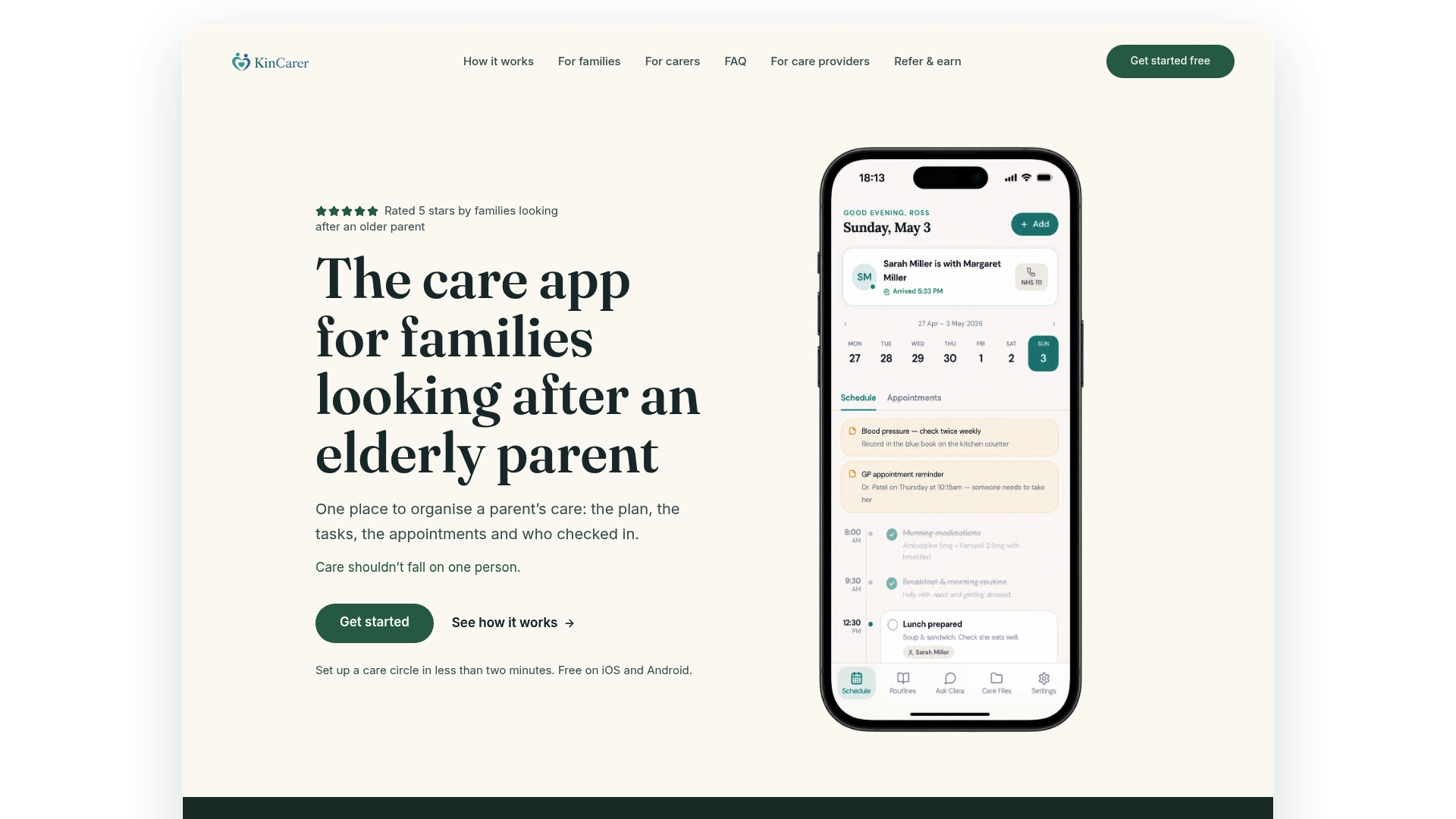
That is why we built KinCarer around the idea of a shared care circle. After the meeting, the tasks, appointments, check-ins, medication reminders, notes and handover updates live in one place that relatives and paid carers can be invited into, so everyone sees what has happened and what still needs doing. It is designed to stop the organising falling to one person.
Clara, our optional AI assistant, helps your family search, summarise and understand what is in the care circle, for example finding last week’s notes before the next meeting. Clara does not give medical, legal or clinical advice. Your meeting decides the plan, and the app helps you keep to it.
KinCarer
When to bring in professionals
A family meeting is a good start, but it does not replace formal support.
- Carer’s assessment. Anyone over 18 who cares for someone can ask adult social services at their local council for a free carer’s assessment. It is separate from the cared-for person’s needs assessment, but both can be done at the same time. The NHS suggests having your NHS number, GP details, the other person’s details and information about how caring affects your health, work, free time and relationships to hand.
- Care needs assessment. The NHS explains that a care needs assessment is required when someone wants the council to arrange or contribute towards care.
- Hospital discharge. Age UK says hospitals and foundation trusts must involve unpaid carers and family members in discharge planning as soon as feasible when ongoing care is likely to be needed. Our post discharge care plan guide helps you prepare.
- Your own wellbeing and work. If caring is affecting your health or job, read about preventing carer burnout and balancing work and caring.
If you want more signposting, see our guide to UK carer support.
Keep the plan alive with KinCarer
Once the meeting ends, the hard part begins. KinCarer gives your family a shared care circle for tasks, appointments, check-ins, medication reminders, notes and handover updates, so nothing depends on one person’s memory or a buried message thread.
Family+ costs £9.99 per month per family, or £69.99 per year per family, and one subscription covers all the invited members of your care circle. You can look at Family+ plans or see how KinCarer helps families share a parent’s care plan.
FAQ
How often should a family hold a carer meeting?
Many families meet monthly, often by video call, and again whenever something significant changes, such as a hospital stay or a new diagnosis. The Family Caregiver Alliance advises regular meetings at a consistent time. Once things settle, a shorter check-in every few weeks may be enough.
Should my mum be at the meeting?
Usually yes, if she wants to be. It is her care, and if she can make her own decisions she should be supported to choose how it is carried out. If a big group would be too much, speak to her first and share her views at the meeting.
What if my siblings will not take part?
Ask again, in writing, with a specific job and a specific date rather than a general request for help. Suggest tasks that suit their situation, such as bookings or paperwork. If conflict still blocks agreement, consider a neutral facilitator, and speak to your local council about a carer’s assessment for yourself.
Do we need a formal family group conference?
Not usually. A family group conference is voluntary and uses an independent coordinator, and may suit families facing complex situations. For most households, a well-prepared family meeting using the agenda above is a sensible first step.
Sources
- Family and Group Conferencing for Adults, Research in Practice
- Family group conferences: advice for families, Family Rights Group
- Family Group Conferences, Your Family Matters
- Holding a Family Meeting, Family Caregiver Alliance
- Holding a Family Meeting, Minnesota Board on Aging worksheet
- Family Meetings, NEMCSA
- Preparing for your family meeting, Scripps Gerontology Center
- Assessments (England), Carers UK
- Thinking about end of life, Age UK
- Worried about an elderly person, Age UK
- Guidance for long-distance carers, Shropshire Council
- Supporting loved ones with health or care needs, GOV.UK
- Getting the support you need to continue caring, CPFT NHS Foundation Trust
- Carer’s assessments, NHS
- Introduction to care and support, NHS
- Hospital discharge and recovery, Age UK