
Care Coordination Metrics: 8 Simple Checks for Families
Eight simple care coordination metrics UK families can track, plus a step-by-step family care audit to find gaps in a care plan for an elderly parent.
By The KinCarer team ·
You do not need a hospital dashboard to know whether care for your elderly parent is working. A handful of plain checks will tell you: is there a named coordinator, does everyone know their job, is the care diary being filled in, and are reviews actually happening? This guide turns the measures used by health and care services into eight checks a family can run in an evening, then shows you how to audit your care plan, spot the gaps and act on what you find.
TL;DR
- Track eight things: a named coordinator, written roles, a live care diary, shared access, medication details, appointment follow-up, review dates and how often you chase for information.
- Audit a small sample of recent entries, give every gap an owner and a date, then check later that it was fixed.
- Review the plan at least once a year, within about six weeks of a new home care plan starting, and sooner after a hospital stay, a new diagnosis or a medication change.
- These measures come from services, not families. Use them as prompts for better conversations, not as a score for how well you are coping.
Table of Contents
- What “care coordination metrics” mean for a family
- Eight checks that show whether care is organised
- How to run a family care audit
- How often to review the plan
- Finding gaps in a care plan
- After a hospital stay
- Coordinating from a distance
- What to do when the audit finds a gap
- What these measures can and cannot tell you
- Our perspective: coordination is shared, not carried
- Put your checks in one shared place
- FAQ
- Sources
What “care coordination metrics” mean for a family
In health services, care coordination metrics are the numbers used to judge whether care is joined up. The US Agency for Healthcare Research and Quality (AHRQ) groups measurable coordination activities into areas such as accountability, communication, transitions, needs and goals, proactive planning, monitoring and follow-up, and self-management. It also lists effects that matter to families: how satisfied people are with coordination, how much confusion or hassle there is (for instance how many contacts it takes to schedule care), and whether there are unnecessary tests, emergency visits or hospital stays.
Most of that was written for professionals. You are looking after your mum, not running a service. So the useful move is to borrow the questions, not the spreadsheets. Each check below is something you can answer with yes, no or a rough count, using the notes you already keep.

Remember: a metric is only useful if it leads to a conversation or an action. If a check shows a problem, that is the system telling you it needs fixing, not a verdict on you.
Eight checks that show whether care is organised
| Check | What to look at | Healthy sign |
|---|---|---|
| 1. Named coordinator | Is one person responsible for leading the planning? | Everyone can say who it is |
| 2. Written roles | Does the plan say who does what and when? | Every task has a name and a date |
| 3. Care diary | Does it record care given, incidents and changes? | Entries after every visit |
| 4. Shared access | Can everyone involved read and add to the plan and diary? | No one relies on being told verbally |
| 5. Medication information | Purpose, dose, timing and who to call with concerns | Written down in one place |
| 6. Appointments and follow-up | Is each appointment owned, and is the outcome recorded? | Nothing “someone was going to book” |
| 7. Review dates | Is the next review in the diary? | A date, and a person who will trigger it |
| 8. Chasing count | How often do you ask “did anyone…?” in a week? | Falling over time |
1. A named coordinator
NICE guidance on home care suggests identifying a named care coordinator and making sure everyone providing care can access the plan and diary. In NICE’s description, the coordinator leads the planning, makes sure everyone knows what they should provide and when, encourages regular communication and keeps the care diary fit for purpose.
For a family, the metric is simple: if you asked your brother, your sister and the care provider who coordinates, would you get the same name? If not, you have found your first gap. Coordinator does not have to mean the person doing the most. It means the person who keeps the picture complete. Our guide to assigning four roles before one carer does it all shows one way to split the load.
2. Written roles and outcomes
NICE says a home care plan should state the roles of family and carers and how outcomes will be measured. Count your tasks for the week. How many have a named person and a due date? Divide the first number by the total. Anything below “all of them” is a gap, because an unowned task tends to be the one that slips.
3. A care diary that is actually used
NICE describes a care diary that records day-to-day care, needs, preferences, experiences, incidents and changes. In its communication guidance, every practitioner should complete the diary on each visit, and everyone involved should read new entries and contribute where appropriate.
Your measure: over the last seven days, how many visits or calls have an entry? If your mum has four visits a day and the diary shows two entries, you cannot rely on it. If you want a starting format, we have three copyable daily care log templates.
4. Shared access
Check who can open the plan and diary without phoning someone. Relatives abroad, a sibling on shift work, the home care agency and you should all see the same current version. If the answer is “it is in a WhatsApp thread somewhere”, that is a metric too: the time it takes to find the last medication change. Try it. If it takes more than a minute or two, information is buried.
5. Medication information
NICE says the home care plan should include the purpose, dose and timing of medicines and whom to contact with concerns. Check each medicine against those four points. Any blank is a gap to take to the pharmacist, GP or the nurse who knows your parent’s case. Your family’s job here is to keep the record complete, not to decide what is right clinically.

6. Appointments and follow-up
For each appointment in the last month, ask three questions. Did someone attend or arrange transport? Was the outcome written down? Was any follow-up booked? Count the appointments where all three are yes. This mirrors the AHRQ idea of monitoring and follow-up, turned into a family-sized tally.
7. Review dates
A plan nobody reviews drifts out of date. The check is a calendar entry: when is the next review, and who will raise it? More on timing below.
8. Your chasing count
AHRQ lists confusion and hassle, such as the number of contacts needed to schedule care, as a trackable effect. At home, the equivalent is how many times a week you or a sibling send a message asking whether something has been done. Note it for two weeks. If it falls after you introduce shared tasks and updates, coordination is improving. If it climbs, something is not landing.
How to run a family care audit
An audit sounds formal, but it is a short, repeatable routine. Scottish good practice guidance says an audit should define what is being measured, identify actions, carry out those actions and build on previous audits, as part of continuing quality improvement. That guidance is written for services in Scotland, but the method works for any family.
- Put everything in one place. Gather the current plan or diary, medication list, appointment letters and contact numbers. NHS England’s personalised care handbook points to one current plan as the basis for support planning.
- List needs and goals. Write what your mum needs help with and what matters to her, in her words where you can.
- Give every action a name and a date. No “we should” lines.
- Sample recent entries. Pick five to ten recent diary entries or tasks. Check them against: access, clarity, responsibilities, incidents, medication, appointments, risks and follow-up.
- Record the gaps. Be specific: “No one booked the follow-up after the 12th” is better than “appointments are messy”.
- Assign corrective actions. One person, one date each.
- Check back. Put a date in the diary to confirm each fix was done. This last step is the one most families skip, and it is what turns a list into improvement.
Keep the audit short. Thirty to forty-five minutes with your siblings, once the first time, is plenty. After that, a ten-minute check at each review is enough.
How often to review the plan
NICE recommends an initial review of a home care plan within six weeks, then regular reviews, at least annually. NHS England’s handbook agrees on at least annual reviews, with more frequent ones when needs or risks warrant it. It names hospital discharge, a new diagnosis, social changes, bereavement and changes in social care support as review triggers, and says carers can trigger a review.
In practice, review sooner if:
- your parent has come home from hospital
- a medicine is started, stopped or changed
- there has been a fall, a near miss or another incident
- a family member or paid carer changes
- you notice a new risk, such as missed meals or confusion about the day
Finding gaps in a care plan
The Scottish good practice guide gives a useful list of questions. Does the person know about the plan, and did they help prepare it? If a carer was involved, was that agreed? Does the plan cover responsibilities, support needs, goals, risks, medication information, reviews and accessibility?
NICE adds that a home care plan should be copied to the person and their carer, with permission, in an accessible format. If your mum has never seen her own plan, that is a gap worth closing first.
The most common gaps families find are:
- Unclear responsibility. Two people assume the other booked it, or nobody did.
- Information held by one person. Only one sibling knows the GP’s name or the key safe code.
- Missing follow-up. The appointment happened, but nobody wrote down what was said.
- Out-of-date medication details. A change was made in a ward or surgery and never reached the shared record.
- No review date. The plan was written once and not looked at again.
If you are setting up from scratch, a shared care plan can be set up in one meeting. For the paperwork itself, see what documentation to keep and how and how to build one emergency folder.
After a hospital stay
Discharge is where coordination most often wobbles, so it deserves its own checks. NHS England South East’s 2024 discharge toolkit says families should check that the carer is identified, willing and able, included in discharge planning, informed about changed needs, medication and equipment, trained where necessary and given the discharge plan. You should also have a named contact, including out-of-hours arrangements.
The same toolkit says follow-up should be arranged across health and care services as soon as discharge is planned, with community and carer support in place before your relative leaves. For complex cases, there should be clear contacts for medicine and equipment problems in the first 24 hours.
A simple discharge scorecard:
- Do we have the discharge plan in writing?
- Is there a named contact and an out-of-hours number?
- Are medicines and equipment explained and in the house?
- Is community support booked, with a start date?
- Is the follow-up appointment booked, and who is taking your parent?
Our post-discharge care plan guide walks through the first days in more detail. If your parent has Parkinson’s, the guide to securing a named PDNS covers who to ask for.
Coordinating from a distance
If you live far away, your metrics matter even more because you cannot see what is happening. Focus on three: can you read the diary today, do you know who is coordinating locally, and do you have a task of your own with a date on it? Phone calls with the care provider, booking appointments, handling paperwork and reviewing the plan are all jobs you can own remotely. Our guide to coordinating care remotely in 24 to 72 hours sets out how to name those roles quickly.
What to do when the audit finds a gap
Do not sit on it. Depending on the gap:
- After discharge: use the named contact and out-of-hours number you were given, and follow up outstanding actions with the relevant care team.
- If needs have changed: carers should contact the care manager to request a review if their needs or the cared-for person’s needs have changed. This example comes from Northumberland County Council, so check your own council’s adult social care page.
- If there is no support in place: Age UK explains that a local authority needs assessment can be requested by the person, a family member or a professional with permission. Carers have a right to their own carer’s assessment, and an eligible care and support plan must state the needs being met, how they will be met and the costs or personal budget.
- For medicines or clinical worries: speak to the GP, pharmacist or the nurse involved. Your audit finds the gap; a professional decides the clinical answer.
What these measures can and cannot tell you
Most of the guidance above was written for services. NICE’s recommendations on named coordination, care diaries and reviews address home care services and practitioners, and AHRQ’s framework is for health systems in the United States. Adapting them for a family is sensible, but it is an adaptation.
It also helps to keep numbers in proportion. The Policy Innovation Research Unit says indicators are not definitive judgments on performance or quality and should be read alongside other local information. The same goes for your tally. A bad week after a hospital stay is not a failure. The question is whether next week is clearer than this one.
Our perspective: coordination is shared, not carried
We built KinCarer because we kept seeing the same pattern. One person ends up as the family’s memory, chasing updates through buried messages and carrying the emotional weight of keeping everything straight. Care itself may be going fine, yet the organising wears that person down.
That is why we think the best coordination metric is also the simplest: could someone else step in tomorrow and know what has happened and what is due? If the answer is yes, the load is shared. If it is no, the fix is usually not more effort from the same person, but one place where tasks, appointments, check-ins, medication reminders and handover notes live, with relatives and paid carers invited in and permissions controlled.
We also think technology should know its limits. Clara, our optional AI assistant, helps families search and summarise what is in their care circle, and can help you spot actions that look missing. Clara does not give medical, legal or clinical advice, and it should not. Those decisions belong with professionals who know your parent.
— KinCarer
Put your checks in one shared place
A tally on paper works for a fortnight. After that, it helps to have the checks built into how you share care. In KinCarer you can create a care circle, assign tasks with owners, log appointments and handover updates, set medication reminders and invite siblings or a home care agency, so everyone sees the same information. One subscription covers all invited members.
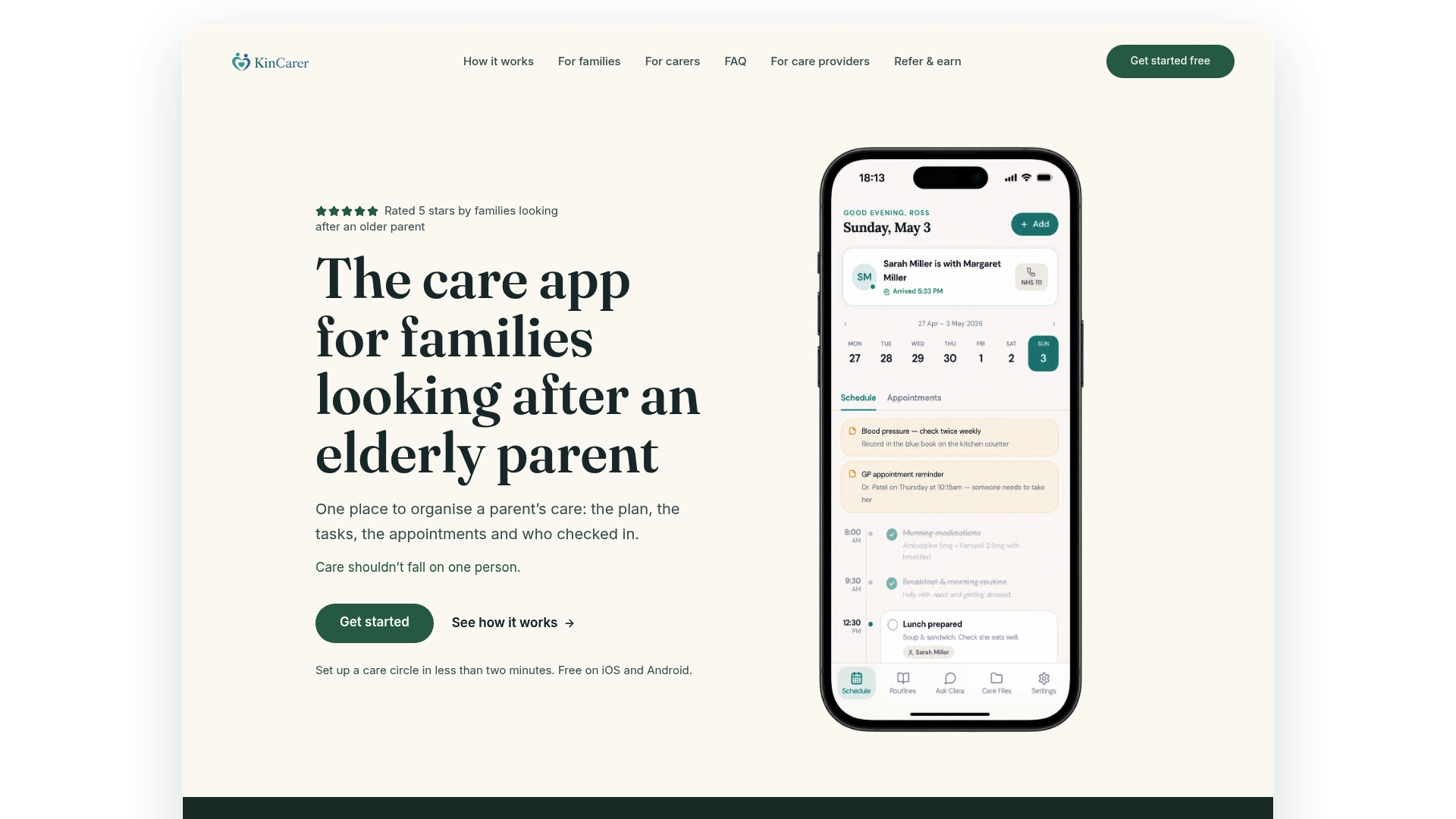
KinCarer is available through the App Store and Google Play, with a free trial before you pay. Family+ costs £9.99 per month per family or £69.99 per year per family. You can see the details on the Family+ page, or start from the KinCarer home page to see how a shared care plan works.
FAQ
What is the simplest way to tell if care is well coordinated?
Ask whether there is a named coordinator, whether every task has an owner and a date, and whether the care diary is filled in after each visit. If all three are yes, the basics are in place. Then watch how often family members need to chase each other for updates.
How often should we review a care plan for an elderly parent?
NICE recommends an initial review of a home care plan within six weeks and regular reviews after that, at least annually. Review sooner after a hospital stay, a new diagnosis, a medication change, an incident or a change in support. Carers can ask for a review too.
Who should I contact if I find a gap in the care plan?
Start with whoever owns that part of care: the named contact after discharge, the home care agency or your parent’s care manager. If the support is missing altogether, you can ask your local council’s adult social care team for a needs assessment, and a carer’s assessment for yourself. For medicine questions, speak to a GP or pharmacist.
Can a family audit replace professional assessment?
No. A family audit checks that information, roles and follow-up are organised. It does not judge whether care is clinically right. Use it to prepare for conversations with GPs, nurses and social workers, and to make sure their recommendations are carried out.
Sources
- NICE NG21: Home care, delivering personal care and practical support to older people
- NICE: Roles, responsibilities and multidisciplinary working
- NICE: Communication, tools and resources for home care
- AHRQ: Care Coordination Measurement Framework
- NHS England: Personalised care and support planning handbook
- Mental Welfare Commission for Scotland: Person-centred care plans good practice guide
- NHS England South East: Carers and Hospital Discharge toolkit
- Northumberland County Council: Support for carers of adults
- Age UK: How to get care and support
- PIRU: Integrated care and support Pioneers indicators