
UK Care Circles: Assign Four Roles Before One Carer Does It All
Learn what a care circle means for UK families, how the Care Act shapes assessments, and how to assign roles, share records and protect the primary carer.
By The KinCarer team ·
A care circle is a coordinated network of family, friends and professionals who share responsibility for an elderly parent’s day-to-day wellbeing. Under the Care Act 2014, councils must involve the adult, their carers and anyone they ask for in a needs assessment. A circle is about coordination and record-keeping. It never replaces clinical advice.
TL;DR:
- Councils must involve the adult, their carers, and anyone the adult requests in a needs assessment; records of a typical week can inform planning.
- Savings above £23,250 exceed the upper capital limit, while a council financial assessment determines whether it contributes and how much.
- Assign each task to a named person, choose one keeper for the shared record, and restrict access to sensitive details such as bank information.
- Keep medication details, emergency contacts, and care preferences immediately accessible, then review the plan after hospital discharge or any health change.
- Invite paid carers into shared updates when family tasks outgrow available time; digital tools can coordinate care but cannot replace clinical advice.
Table of Contents
- What does a care circle include?
- Who does what inside the circle?
- How does a care circle fit with UK assessments, plans and funding?
- How do you set up, run and review a care circle?
- Why do families use digital tools for a care circle?
- What are the benefits, and how do you protect the primary carer?
- A note from us on coordinating care as a family
- Can a family care app help you put this into practice?
- FAQ
- Sources
What does a care circle include?
Think of a care circle as two things: the people, and the information those people need. A circle that has one without the other tends to fall back on a single exhausted organiser.
Typical members are:
- Close and extended family, including siblings who live far away
- Friends and neighbours who help with visits, lifts or shopping
- Unpaid carers, often an adult child or partner
- Paid carers from a home care agency
- GP practice staff and, where involved, a social worker
Carers UK guidance says a well-functioning circle should include professionals alongside family, especially during transitions such as hospital discharge, as its briefing on integrated working explains.
The shared information usually covers:
- A current medication list and how it is taken
- Upcoming appointments and who is attending
- Care preferences, such as routines, food and what matters to your mum
- Emergency contacts, including the GP and out-of-hours numbers
- Where legal documents are kept
- Handover notes from each visit or shift
An informal circle can later be written into a care and support plan, which records the support needed, personal preferences and what family and friends can provide.
Who does what inside the circle?
A circle works when everyone knows which jobs are theirs. Vague goodwill (“let me know if you need anything”) is how one person ends up doing everything. Here are some roles families may find useful:
- Primary organiser: keeps the overall picture, chairs check-ins and is the first point of contact for professionals.
- Medication lead: checks the medication list stays current, handles repeat prescriptions and watches for missed doses.
- Appointments coordinator: books, confirms and arranges transport, and makes sure someone attends and reports back.
- Finance and contact lead: handles bills, paperwork and who gets told what.
One person can hold two roles, and roles can rotate. What matters is that each task has a name against it.
Agree early who can see and edit what. Everyone may need to read the medication list, but fewer people need access to bank details. Decide who keeps the master record, so it is not scattered across different phones.
Bring in paid professionals when tasks outgrow family time, such as daily personal care or regular cover while you work. Invite them into the circle’s information flow, rather than leaving them outside it.
Pro Tip: Write each role down in a single shared note, with a name and a back-up person beside it, so a missed week never means a missed task.

How does a care circle fit with UK assessments, plans and funding?
Your circle’s knowledge is useful evidence. When a council assesses an elderly parent, the Care Act 2014 requires it to involve the adult, their carers and anyone else they ask for. The Care Act 2014 needs assessment provision also sets out what an assessment should consider. A circle that keeps good records can describe what a typical week really looks like.
Three official routes are worth knowing:
- Care and support plan: written after assessment, covering needs, preferences and any personal budget.
- Carer’s assessment: open to people who regularly look after someone who is ill, older or disabled, and it can identify what might make your life easier.
- Financial assessment: a means test used to decide whether the council contributes.
Funding is where families most often need signposting. The NHS explains that self-funding rules apply above an upper capital limit, and its page on when the council might pay explains how the financial assessment works.
The upper capital limit is £23,250 in savings, and a means test decides what the council contributes.
Professionals are also expected to bring unpaid carers into planning, as Carers UK’s guidance on integrated system working makes clear.
How do you set up, run and review a care circle?
You can do this in one sitting. Work through these steps in order:
- Gather the essentials. Collect the medication list, key contacts and your parent’s preferences, and store them in one central place.
- Choose and invite members. Ask family, friends and any paid carers. Be specific about why you are asking each of them.
- Agree roles and how you will talk. Pick one communication method, so updates do not scatter across threads.
- Hold a first planning meeting. A call can help you name roles and set expectations.
- Build a contingency plan. Practitioners recommend this as a core component: medication lists, emergency contacts and care preferences should be instantly accessible if the primary carer is unavailable.
- Set review triggers. Review after a hospital discharge or any change in health, and add a simple regular check-in beyond that.
If you want a step-by-step walkthrough, our guide to setting up a shared care plan in one meeting covers it, and our post on naming roles when you coordinate remotely helps if family live far apart.
Pro Tip: Test your contingency plan once: ask someone who is not the primary carer to find the medication list and the GP number without help.
Why do families use digital tools for a care circle?
Most circles begin in a group chat. It works for a few weeks, then important updates get buried under photos and replies. Digital coordination tools put tasks, medication reminders and handover notes where everyone can see them. West Berkshire Council’s page on Carers UK digital resources notes that shared access to task management, medication managers and contingency planning documents helps prevent carer burnout.
Features worth looking for:
- Shared tasks that can be assigned and ticked off
- Medication reminders that more than one person can see
- Appointment tracking with notes afterwards
- Handover notes for each visit or shift
- Document storage for contingency plans
- Permission controls, so people see only what they need
Think about privacy before you invite anyone. Decide who sees medical details, and invite paid carers or professionals only when the circle’s routines are settled. If medication reminders matter most to you, our comparison of medication reminder apps for UK families is a good starting point. Remember that a tool aids coordination. It does not replace advice from a GP, pharmacist or nurse.
What are the benefits, and how do you protect the primary carer?
A working circle gives you shared responsibility, clearer handovers and better information for professionals. It also spreads the emotional weight that so often sits on one person.
Protecting the primary carer takes deliberate steps:
- Keep a carer’s diary of time and tasks, which supports a carer’s assessment (see Carers UK’s toolkit for support)
- Split roles realistically, based on who has time, not who feels most guilty
- Agree review points, particularly after a major change in health
Carers UK guidance, as discussed in a Carers Partnership webinar, highlights that primary carers often carry an invisible organising burden. Talk early about expectations and realistic time commitments, so no one is quietly isolated.
Pro Tip: Ask each member to name one thing they can do every week, however small, and put it in the shared plan.
A note from us on coordinating care as a family
We talk to families whose biggest struggle is not the care itself but the organising around it: who knows what, and who was meant to call the GP. Simple, shared routines usually help more than ambitious plans. If this explainer has been useful, our caregiving guides go deeper on the everyday detail.
— KinCarer
Can a family care app help you put this into practice?
If you would rather not build a care circle from scratch, our app is one practical way to do it. KinCarer lets you create a shared care circle where relatives and paid carers can see tasks, appointments, check-ins, medication reminders, notes and handover updates in one place. It maps neatly to the steps above: a central store, controlled permissions and room for your contingency plan. Clara, our optional AI assistant, helps you search and summarise your circle’s information, and does not give medical, legal or clinical advice.
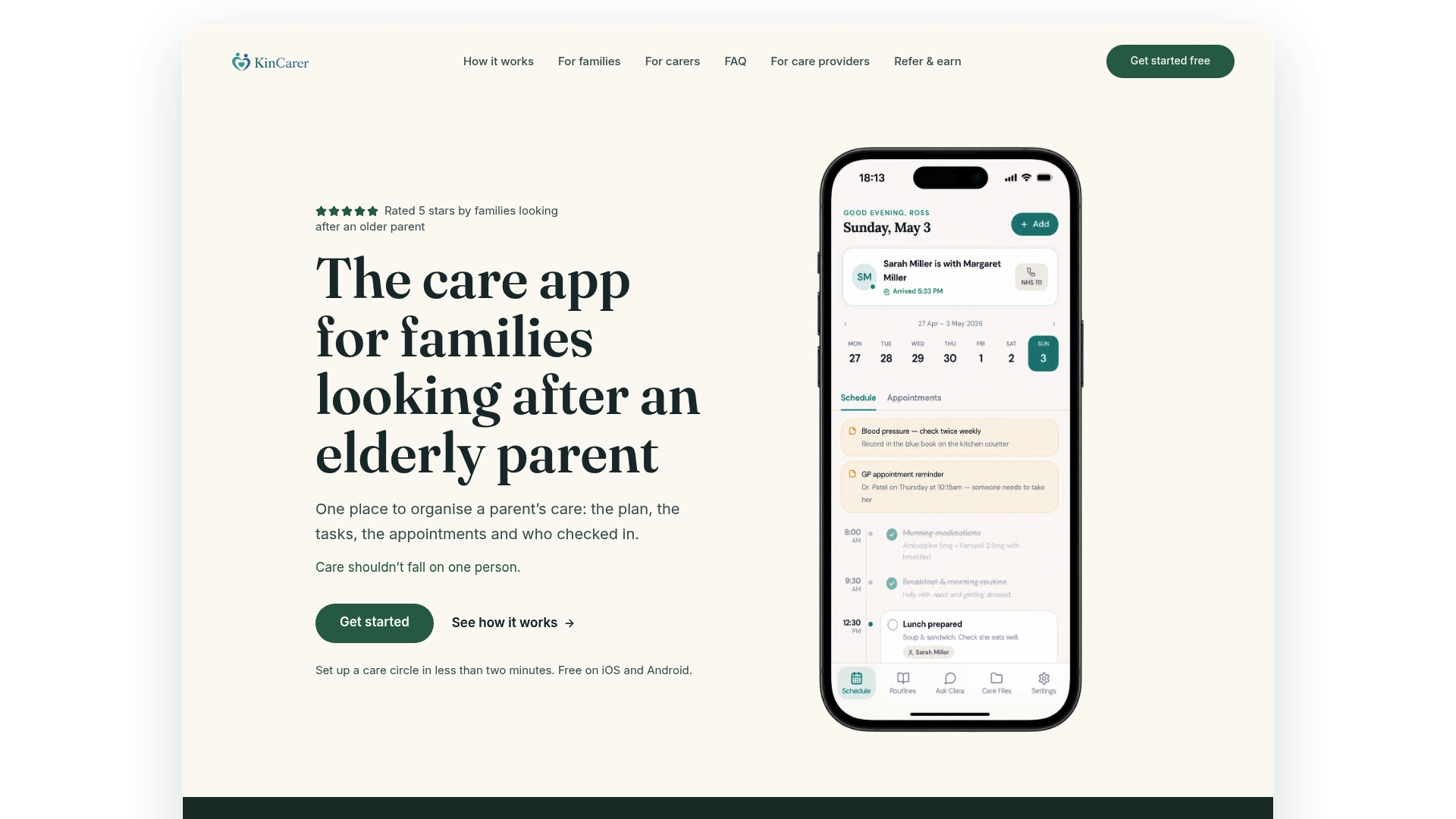
You can explore the KinCarer family care app and see whether it suits your family.
FAQ
What is a care circle in simple terms?
A care circle is the group of family, friends and professionals who share the work of supporting someone who needs care. It focuses on coordination: who does what, and who knows what. It sits alongside, not in place of, formal assessments and clinical care.
Who is usually in a care circle?
Most circles include family, friends, unpaid carers and paid carers from a home care agency. Many also involve GP practice staff or a social worker. Carers UK guidance says a well-functioning circle includes professionals alongside family.
Do you have to pay for community care?
It depends on a means test run by your local authority. The NHS explains that you may be eligible for council help if you have less than £23,250 in savings, and a financial assessment decides how much the council pays.
Does a care circle replace a care and support plan?
No. A circle is how your family organises everyday support, while a care and support plan is the council’s written record after an assessment. The circle’s notes can feed into that plan.
Sources
- Legislation
- Westberks
- Identifying and supporting unpaid carers in England to improve integrated system working | Carers UK