
4 September 2026
Most U.S. Adults Need Both: Healthcare Proxy or Power of Attorney
U.S. comparison of healthcare proxies and powers of attorney. Learn when to use each, state by state setup steps, and how to make signed documents...
A health care proxy (also called a medical power of attorney) lets someone make medical decisions for you when you can’t. A power of attorney, especially a durable one, lets someone handle your finances and legal affairs. Most adults need both. Start by getting your state’s official forms and choosing one trusted agent, or two if you’d rather split the duties.
TL;DR:
- A health care proxy activates only after a doctor confirms you lack decision-making capacity, requiring official medical assessments in most states.
- A durable financial power of attorney remains effective through incapacity if explicitly drafted, while a general POA typically ends when you become incapacitated.
- State-specific forms, witness or notarization requirements, and proper storage are critical to ensure your documents are valid when needed.
- Choosing an agent with reliability and understanding your values is more important than medical expertise, and ongoing conversations improve decision-making quality.
- Without these documents, families face lengthy court procedures and potential court-appointed strangers handling finances and medical decisions during emergencies.
Table of Contents
- Healthcare Proxy Explained: Key Terms You’ll See on State Forms
- How a Healthcare Proxy and Power of Attorney Actually Differ Day to Day
- Setting Up Both Documents: A State-by-State Action Plan
- What Makes Someone the Right Agent for the Job
- Skip These Documents, and a Court Decides Instead
- Where State Rules Diverge, and a Final Execution Checklist
- Keeping These Documents Usable When It Actually Matters
- What People Get Wrong About Putting This Off
- Store Your Signed Documents Where Your Family Can Actually Find Them
- Sources
Healthcare Proxy Explained: Key Terms You’ll See on State Forms
A health care proxy is a legal document that names someone, often called your health care agent or health care surrogate, to make medical decisions if a doctor determines you can’t make them yourself. This is the standard industry term for what most people mean when they say “medical power of attorney.” The agent can consent to or refuse treatment, talk with your doctors, and access your medical records under HIPAA. A medical power of attorney commonly works alongside a living will, which spells out your specific wishes on things like resuscitation and artificial nutrition.
A financial power of attorney is a separate document covering money and legal matters, not medical care. It comes in a few forms:
- General power of attorney: broad authority over finances, but it typically ends the moment you’re incapacitated, the exact situation when you need it most.
- Durable power of attorney: the same broad authority, but it survives your incapacity if the document says so explicitly.
- Springing power of attorney: stays dormant until a specific triggering event, usually a doctor’s written determination of incapacity.
States use different labels for the same roles. New York calls the medical document a “health care proxy.” California and several other states use “advance health care directive” to bundle the proxy and a living will together. Don’t assume your neighbor’s form works in your state.
How a Healthcare Proxy and Power of Attorney Actually Differ Day to Day
The scope split is simple on paper: a health care proxy covers medical treatment decisions, a power of attorney covers money, contracts, and property. In practice, the differences show up in how and when each one kicks in.
A health care proxy activates only after a clinician formally determines you lack capacity to decide for yourself. That’s not a formality your family gets to decide alone. It usually takes a documented physician assessment, sometimes two, depending on the state. A financial power of attorney works differently depending on how it’s drafted:
- A general POA is active the moment you sign it and stays active only while you’re competent. It’s often used for a specific errand, like signing paperwork while you’re traveling.
- A durable POA is also active immediately, or on a trigger you choose, but keeps working straight through incapacity. A durable power of attorney remains effective through incapacity specifically because it’s drafted to say so; without that language, authority lapses exactly when your family needs it.
- A springing POA waits for a defined trigger, often the same incapacity determination used for the health care proxy.
Where families get confused: naming someone as your financial agent does not hand them personal liability for your bills. The agent uses your funds, not their own, to pay what needs paying.
Duration also differs. A health care proxy generally lasts until you revoke it, name a new agent, or die. A financial POA ends at your death, at revocation, or, for a non-durable version, the moment you’re incapacitated. Some families split roles between two people so no single person carries both medical and financial pressure. Others name one person for both, betting on simplicity over shared load.
Setting Up Both Documents: A State-by-State Action Plan
1. Get your state’s official health care proxy or medical POA form. Most states publish these free through the attorney general’s office or the state bar association. Confirm your state’s witness requirements. Some require two adult witnesses; others accept a notary in place of witnesses.
2. Tell your doctor’s office once it’s signed. A signed form sitting in a drawer helps no one. Hospitals typically want a copy on file before you’re admitted for anything serious.
3. Complete your financial POA and decide durable versus limited. If you want the document to survive incapacity, the durable language has to be explicit. Banks and title companies almost always require notarization before they’ll honor it, even in states where notarization isn’t legally mandatory for validity.
4. Assemble supporting documents for your agent. Include your living will, a list of accounts and providers, and any passwords or access instructions they’ll need under pressure.
5. Store originals somewhere retrievable, and give copies to your agent and your primary doctor. A fireproof box that nobody else knows about defeats the purpose.
Pro Tip: Keep a digital folder with scanned copies of every signed document, plus a one-page list of account numbers and emergency contacts. During an actual hospital admission, nobody has time to search a filing cabinet.

What Makes Someone the Right Agent for the Job
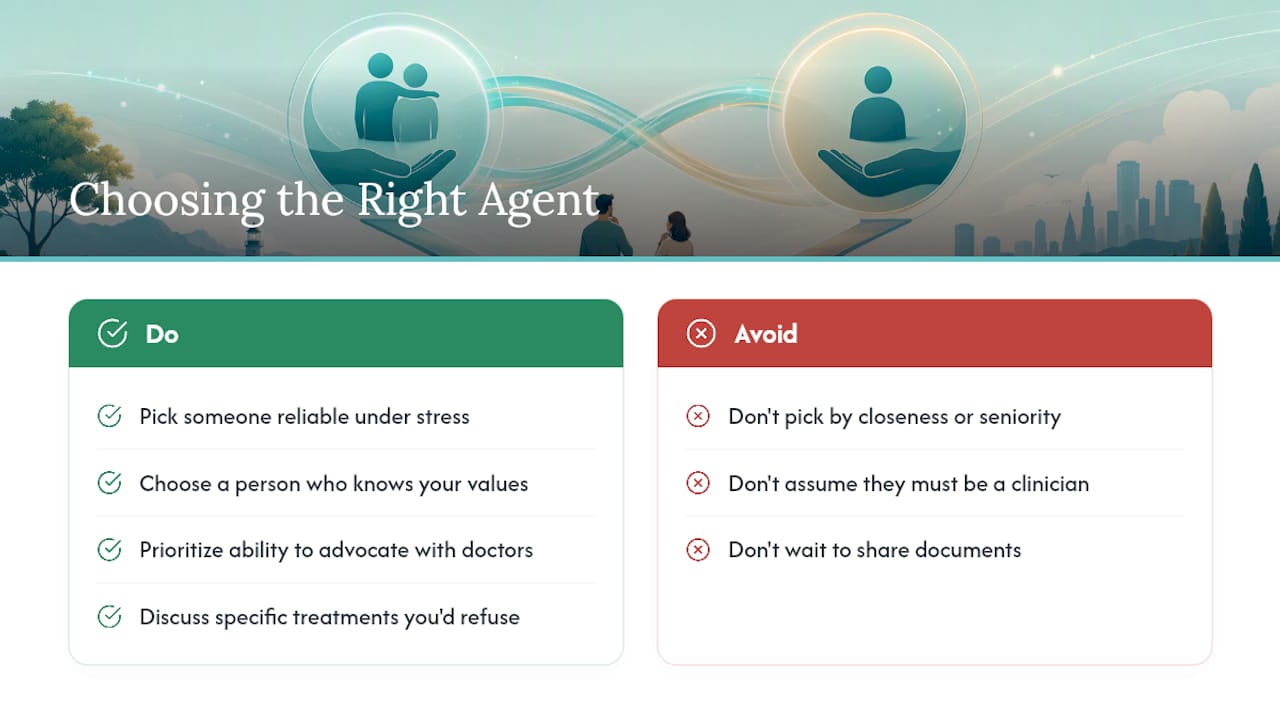
Pick an agent based on reliability under stress, not just closeness or seniority in the family. Someone who understands your values and can hold their ground with doctors during a hard conversation matters more than medical training. Your agent doesn’t need to be a clinician, but they do need to be willing to advocate for what you actually want, even when it’s uncomfortable.
Before a crisis, talk through specifics: which treatments you’d refuse, what quality of life would be unacceptable to you, and who should get the first call in an emergency. Choosing your proxy is an ongoing conversation, not a one-time signature. Name a backup agent in case your first choice is unavailable.
Pro Tip: Give your named agent a physical or digital copy now, not “when it matters.” Waiting means they’re improvising during the worst week of your life.
Skip These Documents, and a Court Decides Instead
Without a health care proxy, many states default to a hierarchy: spouse, then adult children, then parents, as the legal decision maker. That sounds fine until family members disagree, and then a hospital may ask a court to step in.
Without a financial power of attorney, there’s no automatic stand-in for your finances. Family members typically have to petition for guardianship or conservatorship, a court process that:
- Takes weeks to months to resolve, not days
- Involves attorney and court filing fees
- May result in a court-appointed stranger managing the money, not the family member you’d have chosen
Where State Rules Diverge, and a Final Execution Checklist
Every state writes its own execution rules, and skipping them is a common reason hospitals or banks reject the document exactly when someone needs it. Some states want two witnesses for a health care proxy; others accept notarization instead. Most agents must be at least the age required by state law, which is typically adulthood, with some states requiring the agent to be older.
Before you consider yourself covered, work through this:
- Download your state’s specific proxy and POA forms, not a generic template found online
- Confirm whether your state requires witnesses, notarization, or both
- Sign exactly as instructed, in front of the required parties
- Deliver copies to your agent, backup agent, and primary physician
- Store originals somewhere retrievable, and note their location with your agent
Talk to an estate attorney if you own property in more than one state, run a business, or want to grant unusual powers, like gifting authority. The American Bar Association’s advance planning toolkit is a solid starting reference for exactly these edge cases.
Keeping These Documents Usable When It Actually Matters
Signing the forms is half the job. The other half is making sure your agent can find them at 2 a.m. from a hospital waiting room. A shared care coordination app lets you store signed copies where your whole care circle can reach them, assign reminders for renewal dates, and log who’s already been notified so nobody duplicates the same phone call during a crisis. That kind of coordination doesn’t replace the legal document. It just makes sure the document does its job when it’s needed.
What People Get Wrong About Putting This Off
The most common mistake isn’t skipping the paperwork. It’s assuming a verbal conversation with your family counts as a plan. It doesn’t hold up in a hospital or a bank. Pick one day this week, sign your state’s form, and upload it somewhere your agent can actually reach.
— Rex
Store Your Signed Documents Where Your Family Can Actually Find Them
Signing a health care proxy or power of attorney is only useful if the right person can find it fast. The app is not a law firm and doesn’t draft or notarize these documents. It aims to give your care circle one shared place to store signed copies, assign check ins, and track who’s been told about a diagnosis or a hospital admission, so a proxy or POA doesn’t sit forgotten in a drawer while a family scrambles.

Once your attorney or your state’s official form gives you a signed document, upload it to your family care plan and share access with your named agent and backup agent. If you’re coordinating care across siblings or a broader family, the organizational plan extends the same shared visibility to larger care teams. For the legal drafting itself, always consult a licensed attorney in your state. Start by creating your family’s shared care circle and adding the documents you already have signed.
This article is general information, not a substitute for advice from a qualified lawyer. Consult a qualified legal professional about your own circumstances before acting on anything here.