
6 September 2026
Doctor Visit Summary That Respects NHS Consent, One Page for UK Carers
A one page doctor visit summary UK carers can write and share. Includes NHS consent steps, a template and practical handover actions to assign.
Doctor Visit Summary That Respects NHS Consent, One Page for UK Carers
A doctor visit summary is a short, factual note that records what happened at your mum’s GP or hospital appointment, written by family carers for family carers, not a clinical document. The best format follows three headings, before, during and after and should take under a minute to read. Only note what your parent has agreed to share, plus anything essential for their safety.
TL;DR:
- Visit summaries should focus on the three key sections: before, during, and after the appointment, with each part clearly documented and ownership assigned.
- Owners must record explicit consent from the patient or authorized representative before sharing clinical details, especially in family access arrangements.
- Updating medication lists and booking follow-up actions immediately after the appointment reduces risks of errors or missed care steps.
- Family members should use shared care apps or designated places with version control to store, track, and update visit notes securely and consistently.
- Summaries need to include appointment details, key findings, medication changes, referrals, warning signs, and next review dates to support effective care coordination.
Table of Contents
- What is a doctor visit summary and why does it matter?
- A copyable template you can use today
- What facts should a visit summary actually capture?
- Do you need consent to share doctor visit notes?
- How should a family share and store visit notes?
- What should you do in the 24 to 48 hours after the appointment?
- Why a shared note habit changes how families cope
- Keep every visit summary in one place with KinCarer
- Where to go for further guidance
- Sources
- FAQ
What is a doctor visit summary and why does it matter?
A doctor visit summary is not a medical record. It is a handover note, written by whoever attended the appointment, so that everyone else in the family knows what happened without ringing round or scrolling through old messages. Think of it as the caring equivalent of a shift handover: quick, factual, and built to be read in under a minute by someone who was not in the room.
The purpose is coordination, not documentation. Your sister does not need every word the consultant said. She needs the three things that changed, the one thing to watch for, and who is doing what next. That distinction, between a clinical record and a family coordination note, shapes everything else in this guide.
A copyable template you can use today
Structure each summary around three simple headings: before, during and after. Before covers what you went in hoping to ask. During covers what actually happened. After covers what needs doing next.
Here is a working template:
- Appointment: who, where, when (e.g. “Dr Iqbal, Elmfield Surgery, 14 January, 10.20am”)
- Before: top concerns you or your parent wanted addressed
- During, completed: what was checked, discussed or examined
- During, noticed: anything the clinician flagged, in their words where possible
- Question: anything left unclear, marked as a question rather than a fact
- Promised next step: the action, who owns it, and by when
- Next check-in: when the next review or call happens
A filled example might read: “Dr Iqbal reviewed mum’s blood pressure and swollen ankles. Completed: blood pressure check, 148/92. Noticed: mild ankle swelling, likely fluid retention. Question: whether this links to the new tablets. Promised next step: bloods booked for 22 January, owner Sarah. Next check-in: phone review 29 January.”
That five-part shape, completed, noticed, question, promised next step, next check-in, comes from practical carer handover guides for a reason: repetition speeds up scanning and forces clear ownership onto every action.
A few editing habits make these notes far more useful. Attribute anything uncertain, “the nurse mentioned” rather than presenting it as fact. Avoid diagnosing anything yourself; if the clinician did not say “kidney function,” do not write it either. Always use names and dates for actions, never “someone will sort it.”
Pro Tip: Write your summary within the hour, while the appointment is still fresh. Details fade fast, and a note written the next day is often half-guesswork.
What facts should a visit summary actually capture?
Vague notes cause more problems than missing ones. “Doctor happy with progress” tells the next carer nothing useful. Aim to capture these specifics:
- Appointment details – date, clinic or surgery, and the clinician’s name and role.
- Key findings – what was checked and what the result was, in plain terms.
- Medication changes – exact name, dose, and whether it starts or stops, and from when.
- Tests or referrals – what was ordered, where, and roughly when results are expected.
- Watch-for signs – anything the clinician said should prompt an earlier call, stated plainly.
- Next review – date, and who is responsible for booking or attending it.
Phrasing matters as much as content. Write what you personally saw or heard, not your interpretation of it. Quote the clinician directly where you can (“said to reduce the dose to 5mg from Monday”). If something is unclear, phrase it as a question in the note rather than guessing an answer. Leave out editorial comment entirely, “seemed a bit dismissive” belongs in a private conversation, not the family note.
Medication changes deserve particular care. The moment a dose changes or a drug stops, update your home medicines list the same day, not after the next pharmacy run. Remove discontinued medicines from that list immediately rather than leaving them “just in case,” since a stale list is often more dangerous than no list at all.
Do you need consent to share doctor visit notes?
Sharing a visit summary within the family is different, legally, from sharing full clinical information, and the rules are worth understanding before you circulate anything.
Healthcare professionals need explicit consent before sharing clinical information with relatives. Where a patient lacks the capacity to give that consent, professionals can share information in the patient’s best interests, and a health and welfare Lasting Power of Attorney (LPA) gives a named representative specific authority to act and receive information.
The practical steps for families are straightforward:
- Ask your parent directly what they’re happy for others in the family to see, and note that agreement in the summary itself.
- Check whether the GP surgery supports family and carer (proxy) access, which typically covers booking appointments, ordering repeat prescriptions and viewing some test results.
- Record consent decisions in the note itself, so nobody has to ask twice.
- Log any LPA arrangement where it applies, and who holds it.
Government guidance on NHS continuing healthcare consent makes clear that consent should be informed and recorded, not assumed. Where capacity is genuinely in question or the situation is complex, involve the GP surgery or a solicitor rather than making the call yourselves within the family.
How should a family share and store visit notes?
Most families default to whatever’s easiest, a WhatsApp group, a shared Google Doc, a notebook by the phone, and each has real weaknesses when it comes to caring for someone long-term.
- Group messages are quick but notes get buried within hours, and there’s no single up-to-date version.
- Paper notebooks work for one household but can’t be shared, copied, or backed up.
- Shared documents solve visibility but rarely track who changed what, or when.
- Shared care apps built for this purpose tend to combine version history, permissions and appointment tracking in one place, which paper and group chats can’t offer.
Whichever method you choose, name one person as owner of the master note, and add an “updated on” timestamp every time it changes. Name who owns each follow-up action explicitly, “Sarah, bloods, 22 January,” not “someone will book it.”
Keep clinical questions out of the family note entirely. If a genuinely new or urgent concern comes up, route it straight to the surgery rather than debating it in the group chat.
Pro Tip: If more than two people are editing the same note, agree in advance who has final say on wording. Small disagreements about phrasing waste more energy than the actual caring does.
What should you do in the 24 to 48 hours after the appointment?
The summary only earns its keep if it turns into action within a day or two.
- Fill in the master note the same day, while memory is fresh.
- Update the home medicines list with any new doses, start dates or stopped drugs.
- Arrange or collect any new prescriptions promptly.
- Book any tests or follow-up appointments mentioned during the visit.
- Notify named carers or relatives who weren’t present, using the summary itself.
- Set reminders for the next review date and confirm transport if your parent will need it.
- If any instruction is unclear or feels urgent, ring the surgery that day rather than waiting for the next scheduled call.
None of this needs to be elaborate. It just needs to happen consistently, appointment after appointment, so nothing quietly slips through the gaps between family members.
Why a shared note habit changes how families cope
Most caring breakdowns aren’t caused by bad intentions. They’re caused by information sitting in one person’s head, or one phone, while everyone else guesses. A single-page note, kept in one place with one clear owner, removes most of that friction almost immediately.
The governance matters more than people expect. Agree early who owns the master note, how wording disputes get settled, and crucially, keep your parent included in what gets written about them. A note built without their input, even a kind one, can quietly erode trust.
Tools like shared care apps exist precisely for this habit: a shared care circle where the note, the medicines list and the next appointment all live in one governed place, rather than scattered across multiple memories.
— KinCarer
Keep every visit summary in one place with KinCarer
Some care coordination apps provide a single master note as this guide has been describing, helping to reduce fragmented group chats and missing updates. Inside a shared care circle, families can log appointment notes, track medication changes, assign follow-up actions to a named person, and set reminders for the next review, all visible to everyone invited in.
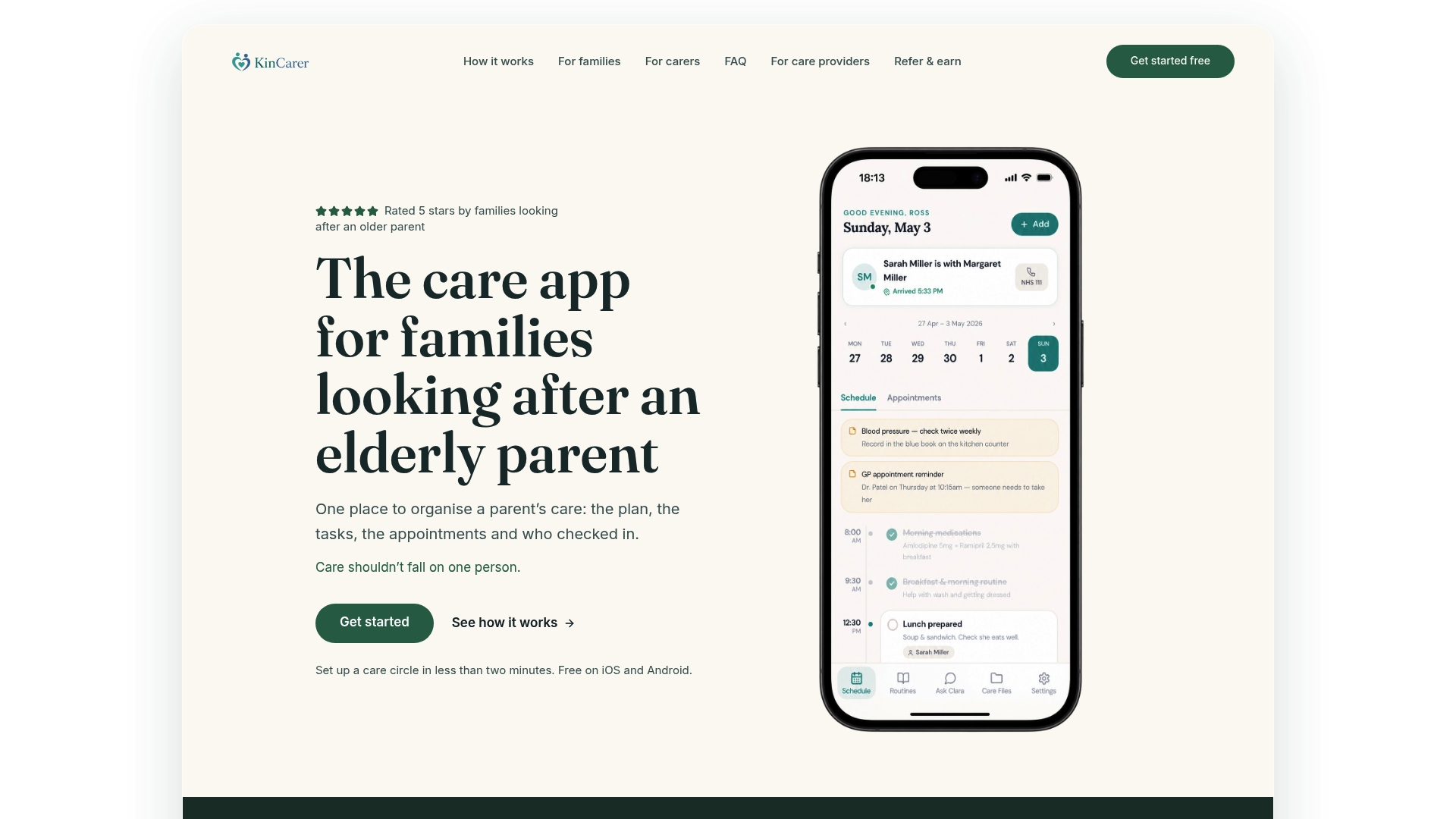
Picture a typical circle: your mum, you, your sibling, and perhaps a home care agency’s care coordinator, all seeing the same visit summary the moment it’s written, complete with who owns the next step and by when. KinCarer’s optional AI assistant, Clara, can help you search past notes or pull together a quick summary of recent appointments, though it doesn’t offer medical, legal or clinical advice. If a paid care provider joins your circle, the organisation-focused features support that wider collaboration too.
Visit the KinCarer app to try the free plan and get started with a template built for exactly this kind of family handover.
Where to go for further guidance
- NHS guidance on unpaid carer access explains consent rules and best-interests sharing when capacity is limited.
- NHS proxy access setup walks through how to request family and carer access through a GP surgery.
- Gov sets out how consent should be recorded and withdrawn for continuing healthcare cases.
- The MND Association’s appointment template offers a printable one-page format you can adapt directly.
- If a care transition is on the horizon, this pre-tour checklist for care homes helps families ask the right questions early.
Sources
- Sharing information with unpaid carers - NHS England Digital
- How to give someone you trust access to your online health services - NHS
- Gov
FAQ
What should a doctor visit summary include?
Appointment details, key findings, medication changes with exact doses, any tests or referrals, warning signs to watch for, and the next review date with a named owner.
Do I need my parent’s permission to share visit notes?
Yes. Clinicians require explicit consent to share clinical information, and families should also ask their parent directly what they’re comfortable having shared, recording that agreement in the note itself.
What if my parent can’t give consent themselves?
Information can be shared in their best interests, and a health and welfare LPA gives a named representative specific authority to receive and act on it; complex cases should go to the GP surgery or a solicitor.
How is a doctor visit summary different from the NHS App?
The NHS App surfaces official appointment notes, test results and medicines to authorised users, while a family visit summary is a shorter, carer-written note focused purely on coordination.
Where should our family keep the master visit summary?
Pick one owner and one place, ideally somewhere with version history and permissions, such as a shared care app like KinCarer, rather than splitting the note across messages and paper.
Keywords: doctor visit summary, medical appointment overview, healthcare visit recap, patient consultation summary, prepare for doctor appointment, category:care-planning